
When the Text Becomes the Interface: Turning a Classical Chinese Story into a Social Media Game
By Ching-Yu (Momo) Hu, Hsin Ke Junior High School, Taiwan

DOI: https://www.doi.org/10.69732/JAEW8386
I have been teaching Chinese in Taiwanese junior high schools for fifteen years. One pattern keeps returning. Students may be able to explain an old story clearly once they have heard it or read the text, yet still feel that the problem that the story depicts belongs to someone else.
One text that stayed with me was “Zou Ji Admonishes the King of Qi” (鄒忌諷齊王納諫). Zou Ji asks his wife, his concubine, and a guest whether he or the famously handsome Lord Xu Gong is more attractive. All three praise him. After seeing Lord Xu himself, Zou Ji realizes that each answer has been shaped by a different relationship: his wife favors him, his concubine fears him, and the guest wants something from him. He carries that realization to the king, who orders that people who point out his faults will be rewarded. I wanted to know whether students would recognize the same motives once the setting no longer looked ancient.
The project began with a podcast episode I made about the story. The podcast, which I developed through conversations with ChatGPT, connected the story with ideas such as the spiral of silence, which is when people hide their personal views when they believe they are in the minority (Noelle-Neumann, 1974) and echo chambers (when beliefs are repeatedly amplified and opposing beliefs are ignored). In November 2025, I gave the script to Gemini and asked it to design a game. The result was not what I wanted, so I brought the problem back to ChatGPT. The three-voice system at the center of my game, called Three Hearts Beneath the Mirror (《鏡下三心》), emerged during those exchanges.
The finished game is free, opens in a browser, and requires no account. My classroom trials so far have all used the Traditional Chinese interface. The English version is available for teachers and learners outside Taiwan, but I have not yet tested it with students learning Chinese. I organize the design here around three ideas—context, agency, and immediate feedback—before describing three classroom uses, how I built the game with AI, and what another teacher might borrow from the experience.
Students open the game from a web link in any browser; there is nothing to install. In guest mode, gameplay data stays on the player’s device and is not sent to the teacher dashboard. When I want to see class results, I share a class link instead; students choose classroom mode and enter their class, seat number, and name. Only then does the game send their values to my teacher dashboard. My club students played on desktop computers; in regular classes, students used school tablets. In June, I posted the link in Google Classroom.
Context
I did not look for modern versions of a wife, a concubine, and a guest. Instead, I translated the reason that each of them could not speak freely.
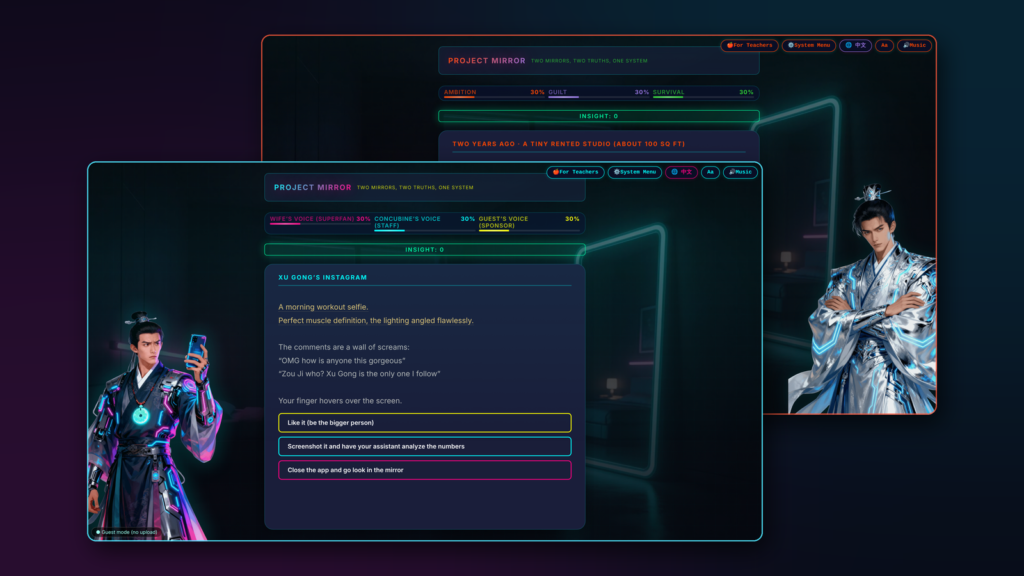
Affection (wife) became a superfan who defends the creator almost unconditionally. Fear (concubine) became a staff member whose job depends on that creator. Self-interest (guest) became a sponsor who needs the creator to remain marketable. On screen, these appear as three voices. A fourth value, Insight, reflects whether the player checks information, uses hints, and looks beyond the most comfortable explanation.
The two chapters place players in different positions inside the same social media system. In Chapter One, the player occupies Zou Ji’s position, surrounded by the Superfan, Staff, and Sponsor. In Chapter Two, the player occupies Lord Xu Gong’s position, and the same part of the interface shifts to Ambition, Guilt, and Survival.
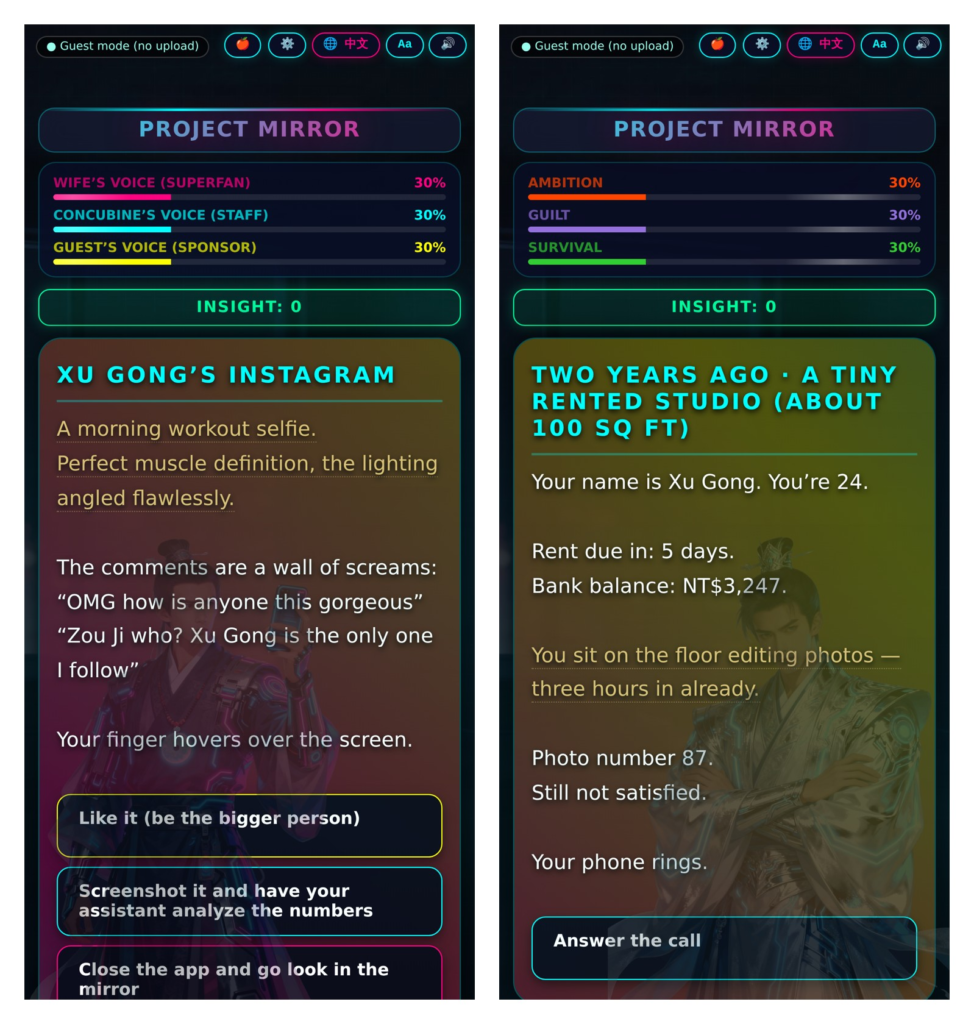
The social media setting gave students relationships they could recognize without knowing the ancient text first. Followers, sponsorship, criticism, visibility, and fear of losing attention all change what people are willing to say, but the older problem is still there. How do you judge praise when the people around you have reasons not to speak freely?
Agency
In Chapter One, the player becomes Zou Ji as a successful online creator with followers, staff, sponsors, and a reputation to protect. Lord Xu appears as a rising creator whose popularity threatens that position. In Chapter Two, the player becomes Xu Gong, now on the less powerful side of the same environment, with less visibility and more pressure to keep performing the version of himself that gets attention.
During an online attack, the player can restrict a post so that only followers may comment. The noise stops, supportive comments surge, and the screen feels safer. But Insight falls and the Superfan value rises. Ten minutes later in the game world, people outside the closed space begin circulating screenshots and accusing the creator of shutting out criticism. The game does not tell the player that restricting comments was wrong. The relief is real, and so is what follows.
In Chapter Two, one student later identified the choice between resting and continuing to push for visibility as the hardest decision in the game. The game allows Xu Gong to stop everything and rest, even when stepping back may mean giving up attention.
Immediate Feedback
The game responds visibly to choices. In Chapter One, the red echo-chamber effect appears when the Superfan value reaches 70. In Chapter Two, it appears when Ambition reaches 70. A pulsing red glow closes in from the four edges of the screen, accompanied by thin red scan lines.
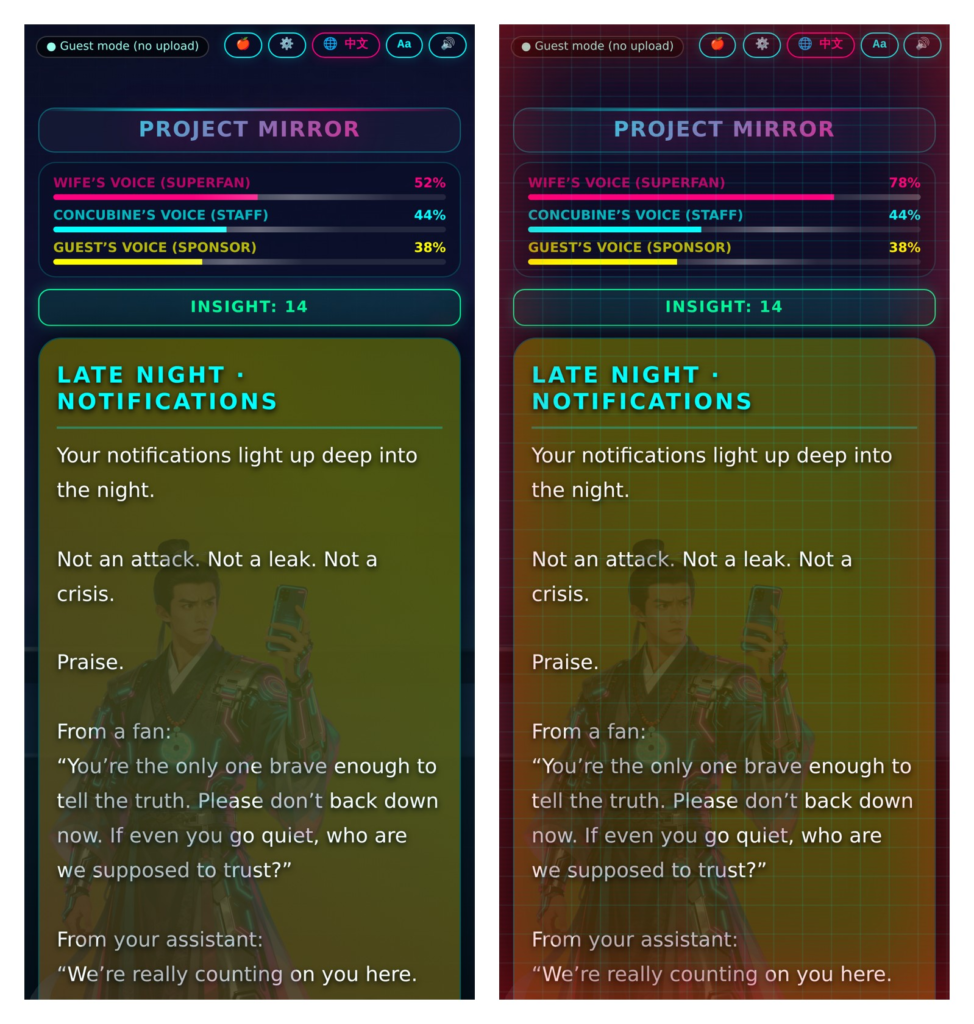
Insight works differently. Checking information or using a hint can raise it. Retreating into the echo chamber can lower it. Insight does not unlock or block any ending.
After play, the game generates a short profile. Each profile includes both a strength and a blind spot, and the profiles are not ranked. The game also contains a hidden “true ending,” so I do not claim that every part of its structure is hierarchy-free. Once the player reaches that final scene, however, two roads sit side by side. Zou Ji remains inside the existing platform and tries to repair it. Xu Gong leaves to build a smaller place whose future is uncertain. Neither road guarantees success.
None of this is graded. In the school environment I know, Chinese language learning is often measured through test scores and knowledge of the forms, sounds, and meanings of characters. I wondered whether students could see something beyond that—something a paper test might not fully capture. In my first club playtest, students kept playing for more than twenty minutes because they wanted to reach the hidden ending.
Three Classroom Uses
The first playtest took place on March 5, 2026, with my AI and media-literacy club. Thirteen students completed the feedback form. None had studied this text, and each used a desktop computer.
Before they played, I asked why the people around Zou Ji answered him as they did. Since they had not read the original text, I quickly explained the three reasons in the story and then asked whether not being Zou Ji really meant that we never encounter anything similar in our own lives.
When asked afterward which kind of person they saw most often on the social platforms they used, eight selected the “wife” position, one selected the “concubine,” and four selected the “guest.” I treat these numbers as descriptions of that small group, not findings about adolescents. The club session was a playtest from the start. I asked students to approach the game as players, look for bugs, and tell me what should be fixed before I brought it to other classes. One student found a save-state bug that could erase Chapter Two progress. Two others wanted more ways for a creator to defend themself during online attacks. The bug was fixed, and later versions added more defensive and supportive options.
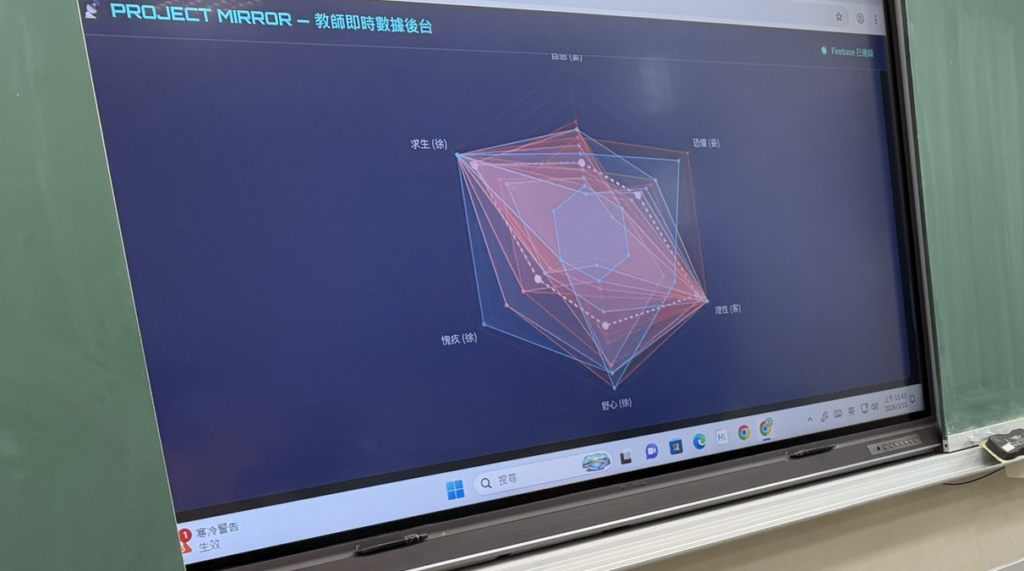
On March 10, I used the game while substituting for a ninth-grade class. Eighteen students completed the form. Only one had heard the Zou Ji story before. I spent roughly three to five minutes on the same opening idea without distributing the original text or teaching it in detail. During the final five to ten minutes, I opened the teacher dashboard on the classroom touchscreen. The teacher dashboard plots the six values from both chapters on a 0–100 radar chart: Superfan, Staff, and Sponsor from Chapter One, and Ambition, Guilt, and Survival from Chapter Two. Each student appears as one numbered outline, and a dashed line shows the class average. The chart contains no names and nothing students wrote or chose in the story, so I could project it. I used its overall shape as a starting point for discussion: whether the outlines bunched together or spread apart, and which axis stood out. It is not a measure of whether a class has become an echo chamber.
Before the bell, we looked at the chart together. Reading which way the values leaned, the students decided that it described them well. They saw themselves as careful around their homeroom teacher and good at survival. They laughed. I agreed with them.
I also asked whether they had seen the red screen. After playing, students completed the feedback form.
On the same social media question, nine selected the concubine position, six the wife, and three the guest. Thirteen of the eighteen said playing Zou Ji felt more stressful, often because they feared being replaced or losing attention. Most said they had never triggered the red effect. Among those who noticed it, some said it did not affect their decisions. One treated it as an ordinary visual effect; another felt that the visual pressure mattered.
I had thought of the red screen as a clever touch. That class made me confront a simpler problem—many students had never seen it. The red screen still appears at 70, but what changed was how I asked about it. An in-game reflection prompt used to ask whether the player had triggered the echo-chamber filter. Because “no” so often ended the conversation, that prompt was later removed. Instead I can discuss whether or not the effect appeared in class.
My third example is different because I was not in the room. Beginning June 4, while I was away for the IASE competition, I posted three games in Google Classroom and let students in my own eighth-grade class choose which ones to play. Four students chose Three Hearts Beneath the Mirror. They had played two of my other games before, but not this one, and they had not studied the Zou Ji text.
The four students completed an after-class form that included consent for anonymized use in future writing or presentations. The form asked whether the player had reached the hidden true ending. One student wrote that the hardest decision was whether Xu Gong should rest or continue struggling for attention because Xu Gong was already exhausted but still wanted to be noticed.
The student wrote, “I didn’t reach the hidden true ending, but it felt accurate. In real life, when I’m exhausted, I really do choose to go it alone.” What interested me was the connection between a choice in the game and a pattern in the student’s own life. I cannot turn one reflection into evidence that the game worked, but it is the kind of connection I had hoped the old story might make possible.
How I Built it with AI
I am a Chinese language teacher, not a software engineer. I describe to the chatbot in natural language what I want the game to do, and AI writes much of the code. At first, I downloaded the HTML file a chatbot produced and tested it in a browser. Now AI works directly in the project’s code, and I play each new version in the browser and describe what does not match what I intended. When students find bugs, I now ask the AI for a test that would catch the same kind of failure.
The literary side is collaborative too. AI has proposed, drafted, revised, translated, coded, and tested substantial parts of the project. I decide whether the result still serves the literary question, the values I am willing to put in front of students, and the kind of judgment I want the game to leave open. Sometimes I can no longer remember which collaborator (myself or AI) first proposed a particular mechanism.
What Another Teacher can Borrow
A teacher does not need to build a branching game to use the same design questions.
What tension is already inside the text? In this case, it was distorted feedback shaped by affection, fear, self-interest, and power.
What could students be asked to do before everything is explained? A decision can make an abstract idea harder to keep at a distance. What should the environment show back to them, and how will I know if it fails? If students never see an effect, misunderstand it, or treat it as decoration, that is information about the design too.
The goal is not to replace reading. Students still need the original text to understand the literary work itself. The game asks what may happen after explanation, when they must make a judgment while praise, fear, self-interest, visibility, or scarcity are already shaping the situation.
A text more than two thousand years old did not predict social media. It described a human problem that social media gives new forms. Sometimes educational technology does not need to explain a text from outside. It can create a temporary place in which a student has to make a decision from inside the tension.
Resources
Three Hearts Beneath the Mirror: https://threeheartsmirror.netlify.app/
Bilingual teacher’s guide: https://threeheartsmirror.netlify.app/teacher_guide.html
MomoLab: https://momolab.netlify.app/
References
Noelle-Neumann, E. (1974). The spiral of silence: A theory of public opinion. Journal of Communication, 24(2), 43–51. https://doi.org/10.1111/j.1460-2466.1974.tb00367.x
AI disclosure
Generative AI was used substantially in both the development of the game and the preparation of this article. ChatGPT helped draft and restructure this revision from my classroom records, game-design notes, project documentation, and reviewer feedback. Claude Code separately checked factual statements against available source files, code, and repository history. Earlier English materials also received assistance from Claude, Gemini, and NotebookLM. Dreamina and ChatGPT were used to generate artwork for the game.
I supplied the classroom records, the student quotation used here, my reading of the primary text, and the pedagogical and editorial decisions reflected in the article. I reviewed the revision and take responsibility for what I choose to publish. I do not claim to have independently verified every English-language, technical, or implementation detail; those parts of the work rely heavily on AI assistance and cross-model checking.