
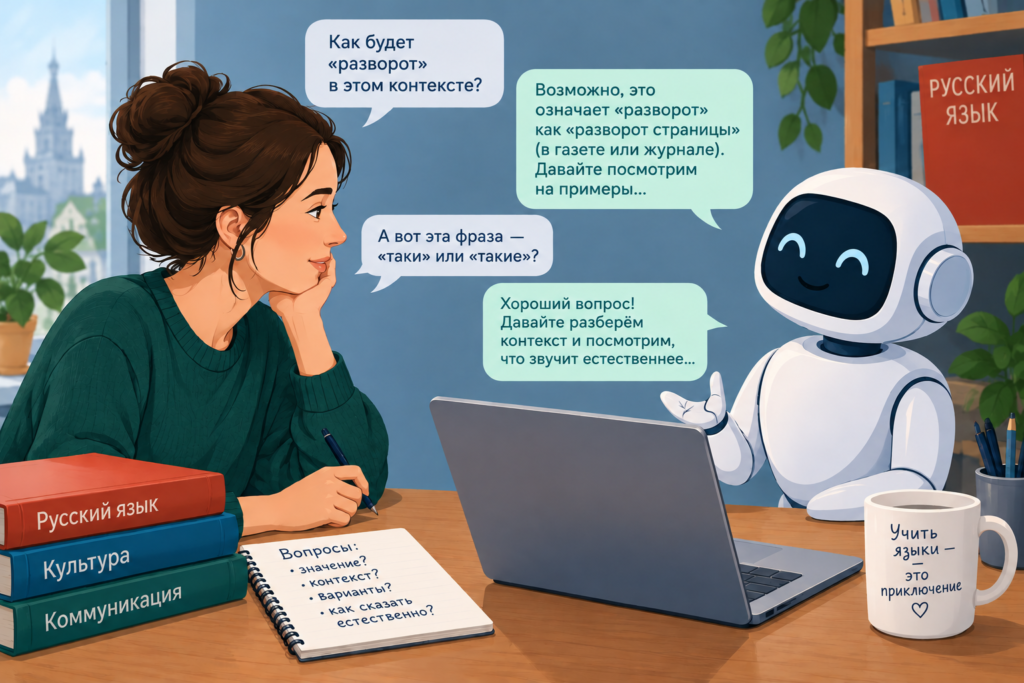
Ask, Push Back, Reconsider: AI as a Native-Speaker Informant
By Shannon Donnally Quinn, Michigan State University

DOI: https://www.doi.org/10.69732/MDPP1855
I keep saying that I am somewhat of an AI skeptic, and I still have many reservations about AI use, including concerns about its environmental impact and the ways in which it may inhibit our students’ learning. At the same time, I keep finding new ways in which AI is useful to me in my work as a language teacher. Earlier, I wrote about the power of AI for Language for Specific Purposes and about using AI as a way to extend the authentic text. In this piece, I want to write about another role AI has come to play for me: native-speaker informant.
I teach Russian, but I am not a native speaker of Russian. Despite having studied Russian for more than 30 years, there are still things I miss or don’t understand when I interact with authentic texts. This doesn’t bother me any more. In fact, I think it is important for learners to have non-native-speaking teachers so that they can see that success in language learning does not mean achieving perfection.
In the past, when I encountered something I couldn’t interpret, it would either remain a mystery or, if it seemed important enough, I would eventually ask one of my native-speaker friends from graduate school or people I knew through teaching at the Middlebury School of Russian. Recently, AI has begun to play a role similar to that of these native-speaker informants. There is one important difference, though: I can ask AI all the little questions that I would never want to bother a friend with. While I am certainly aware that AI is not infallible in this role, I have found its assistance to be surprisingly accurate overall. In this piece, I will outline some of the ways I have begun using AI as a native-speaker informant.
Using AI to Figure Out What I Heard
This summer, I have been working on a set of curricular materials for an Open Educational Resource (OER) based on an authentic Russian sitcom. Both for my own use and for accessibility purposes, I have needed to create transcripts of the episodes. The AI tool Turboscribe has been particularly valuable for creating these transcripts, but there are still moments that, for whatever reason, do not come out correctly or are simply not comprehensible to me. Sometimes the problem is colloquial speech or language specific to a particular context; other times, there is background noise, music, or overlapping speech. Native-speaker ears are often better at filling in these gaps.
As I worked on the course materials, I created a pinned project within ChatGPT and uploaded all of the transcripts so that ChatGPT would have access to the specifics of the show’s plot and characters when I asked it questions. Having this context has sometimes been essential to getting a useful answer.
One example came when I was trying to puzzle through a conversation between two characters. One of them said:
“Интервью. Ты вчера по пьяной лавочке обещал ему… С разворотом.” (“Interview. Yesterday while drunk you promised him… With a U-turn.”)
I couldn’t understand what a U-turn had to do with the situation. When I looked up the word разворот, I wasn’t finding anything that made more sense. Google Image Search, which is a strategy I sometimes use when trying to figure out an unfamiliar word, was filled with pictures of U-turns.
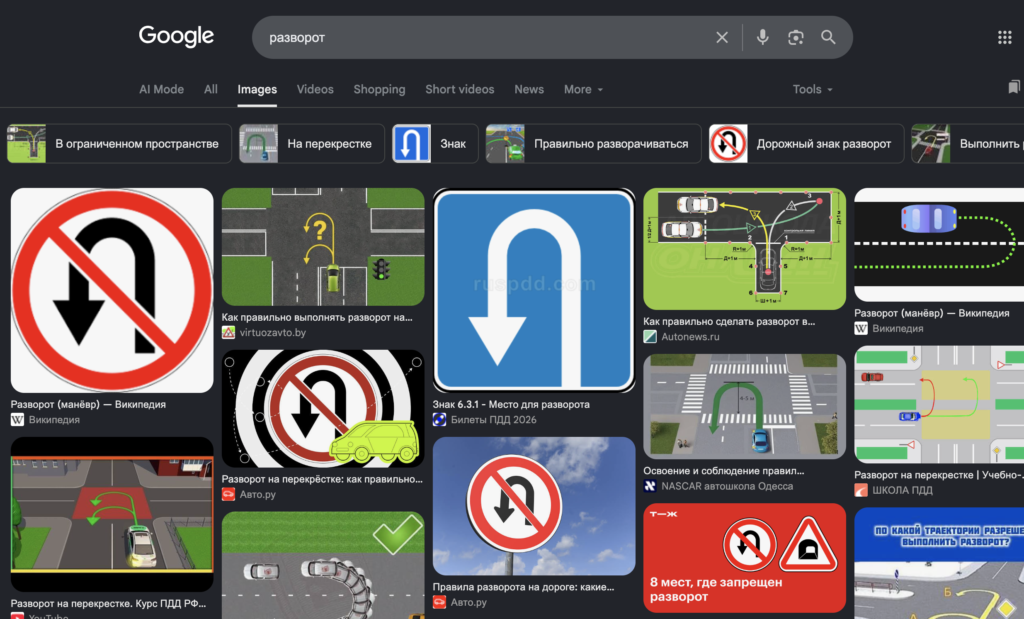
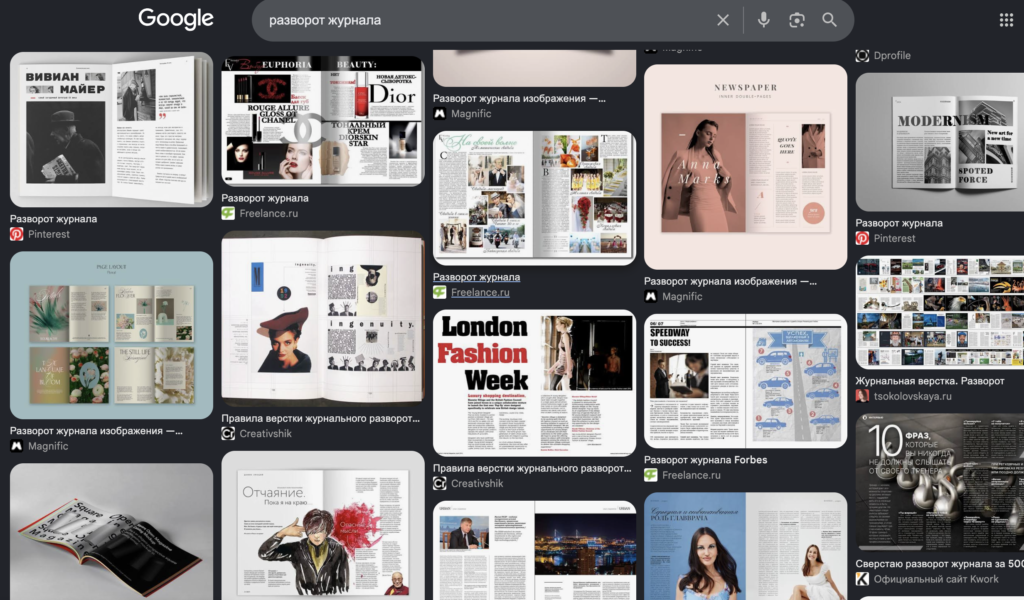
However, when I gave ChatGPT the quote and confirmed that it knew the context of the conversation, it was able to identify a meaning that made much more sense. Since the characters work for a newspaper, it suggested that разворот probably meant a “spread”, a two-page feature in a newspaper or magazine, often including photographs. I didn’t simply take ChatGPT’s word for it, of course. I added some context to my search query and was able to find examples of this usage, as well as a definition in a more specialized dictionary.
Another example came when ChatGPT helped me correct an inaccuracy in the show transcript. Two characters were talking over each other, making it difficult to hear one of them. The AI transcription gave the phrase as “сутопитное слово,” which didn’t make sense to me, and I couldn’t find the first word in a dictionary. When I gave ChatGPT the surrounding context and the erroneous transcription, it suggested “вступительное слово” – “opening remarks” or “introductory speech” – which made sense in the context of the scene.
When I ask these kinds of questions, ChatGPT explains its reasoning and often gives me several possible options. This is extremely helpful because it allows me to weigh those possibilities against what I hear and what I see happening in the video. At times, ChatGPT has even talked itself out of its first instinct, but with enough explanation that I had a basis for making my own judgment.
One example occurred when I suspected that the transcript was inaccurate:
| Me: Should таки here be такие maybe? “Вот, принцесса, ты знаешь, я бы вот себе таки никогда не купил. По-моему, это понты.”
ChatGPT: No — таки is correct here, and такие would not work. |
ChatGPT went on to explain to me why таки should be correct, but eventually its logic came back to the fact that I might be right.
| ChatGPT: Given the transcript and the fact that Roma is pointing at the expensive item, такие would actually make very natural sense semantically: “I would never buy something like this for myself.” If you’re working from subtitles/transcription, I’d want to hear the audio before deciding whether the actor says таки or такие, because in rapid speech таки and такие can be easy to confuse.
If you have the audio/video, I’d lean toward такие as the more ordinary construction unless you specifically hear the final -и. |
I did have the video, and I eventually decided that I was probably right.
Interestingly, ChatGPT can sometimes take the sound itself into consideration indirectly, even though it does not seem to be able to listen to an audio file and verify what was actually said. Once, I asked about a strange phrase that didn’t make sense to me (рвёт имя). I explained what was happening in the scene (someone was angry) and ChatGPT came up with what I believe was the correct answer:
| ChatGPT:
рвёт и мечет ⭐⭐⭐⭐⭐ (still my top choice) This is a Russian idiom meaning:
It fits the situation perfectly: the presentation is about to begin, two key people are missing, and the boss is angry. Phonetically, it’s also not impossible. If said quickly: рвётимечет an automatic transcriber could easily hear something like: рвёт имя because the и gets swallowed and мечет is reduced. |
Once ChatGPT suggested this possibility, I listened to the scene again and could hear that it was indeed the phrase.
After seeing how useful ChatGPT could be for identifying transcription errors, I asked it to go through each transcript and identify places where it thought something might be wrong. It still missed several errors that I identified later, and sometimes misidentified things that were transcribed correctly, but it provided a useful first pass for finding potential problems.
Another AI tool that has helped with these situations is ElevenLabs, which has a Voice Isolator tool that can remove background noise or music and potentially make a speaker easier to hear. This has helped me figure out what people are saying when I otherwise cannot understand them, and I have also used it to create audio files for my students. I ask students to listen first without the background noise or music, understand the speech, and then listen again with the original noise and music added back in.
Using AI to Figure Out Subtleties of Meaning and Cultural References
AI has been helpful for me in more than just figuring out transcription errors. Sometimes I am fairly sure that I understand something, but asking ChatGPT gives me confirmation or offers a slightly different way of thinking about the question.
For example, I was asking ChatGPT about the difference between two prepositions that can both mean “about,” and its answer confirmed my thinking while also helping me connect the distinction to the scene from the show.
| ChatGPT:
Here’s how I might explain it to students: Both о and про can mean “about,” but о generally sounds more neutral or formal, while про is more conversational. Speakers often choose between them based on the situation and the relationship between the people involved. Then you can connect it to the scene: In this conversation, Roma is trying to make a good impression on Anatoly. His speech is generally more careful and respectful, so he tends to use о. Anatoly, on the other hand, is older, has more authority in the conversation, and isn’t trying to impress Roma. His use of про fits his more relaxed, colloquial style. |
Another interesting instance occurred when I was working on how to explain the particle же to learners. It is often explained as emphasizing the word that comes immediately before it. When ChatGPT initially explained it this way, however, I pushed back, citing examples that did not seem to follow that rule. The resulting discussion was helpful, and I eventually felt that I had arrived at a better way of explaining же in my materials—and, to be honest, in my own mind as well.
ChatGPT has also helped me with questions of culture. At one point, a character in the TV show said: “Русская женщина, она и коня на скаку остановит.” (“A Russian woman, she can stop a galloping horse.”). I didn’t understand what the character meant by this, and AI helped me recognize that the character was quoting poetry. This poem was on my preliminary-exam reading list more than 25 years ago, but I had forgotten that particular line. Please don’t tell my professors!
From Asking to Negotiating
Theoretically, I am missing out on interactions with friends and native speakers when I ask AI these questions. In reality, however, I probably would not have asked the majority of these questions to anyone. I would not want to disturb a friend, or I might simply forget about the question after the moment had passed. Furthermore, when I did ask these kinds of questions in the past, I generally wanted the person to be able to solve the problem quickly. I was trying to be respectful of their time and didn’t want to subject them to a long back-and-forth about one of my linguistic puzzles.
ChatGPT, however, has become an interesting partner in figuring these things out. It can’t reliably hear the audio for me, so when it proposes possible interpretations, I have to continue the investigation and make the final determination myself. Sometimes its initial suggestion is wrong or incomplete, and I have to push back, ask follow-up questions, and work through the problem with it before reaching a conclusion. In other words, we are negotiating meaning. And I am a language learner!
Consequently, this experience has made me think about how this kind of interaction could serve as a model for student use of AI. Rather than asking students to use AI simply to provide answers, what kinds of assignments could prompt them to engage in the same kind of back-and-forth that I have found useful in my own language learning? Here are a few possibilities, and I would love to hear your ideas in follow-up articles.
- Co-created Transcription
We could have students transcribe a short audio clip, identify places where they are uncertain, and then use AI as an informant to help them fill in the blanks. Students could compare their own hypotheses with AI’s suggestions and then make the final determination themselves.
- Reading Assistance
Students could read an authentic text, identify difficult or ambiguous passages, and use AI as an informant to help them work through those passages. Rather than simply asking for a translation, students could explain their own interpretation first and then ask AI to confirm, challenge, or refine it.
- Idiomatic Expressions
We could supply students with a list of idiomatic expressions and ask them to first try to determine their meanings themselves. They could then use AI as an informant to investigate when and how the expressions are normally used, including questions of register, context, and frequency.
- Probing Questions
We could challenge students to come up with probing questions about language use in an authentic text. It would not be enough simply to understand what an expression means; students could ask AI to help them investigate questions about register, frequency, collocations, connotations, or other aspects of usage.
- Challenge the AI
Students could be given an authentic text and asked to identify something they think AI might get wrong or oversimplify. They would first formulate their own interpretation, then ask AI to respond, and finally evaluate its answer. If they disagree, they would ask follow-up questions and explain why they remain unconvinced. The goal would not be to arrive at the answer that AI provides, but to use the conversation with AI to arrive at a better-supported interpretation.
In all of these activities, the important element would be that students come to the interaction with their own hypotheses and remain responsible for evaluating the AI’s responses. The goal is not for AI to replace the native-speaker informant, but to give students an interlocutor with whom they can investigate the questions that arise as they interact with language.
Conclusion
Ultimately, using AI as a native-speaker informant is less about finding answers than about learning to ask better questions. My own experience has reminded me that language learning involves uncertainty, investigation, and a willingness to reconsider our assumptions. AI can support that process, but it cannot replace the learner’s judgment or responsibility for making sense of language. By designing activities that ask students to form hypotheses, push back, and evaluate the responses they receive, we can help them use AI not as an answer machine, but as a partner in learning.
AI disclosure: Moderate use of AI: AI was used for brainstorming and polishing wording.