
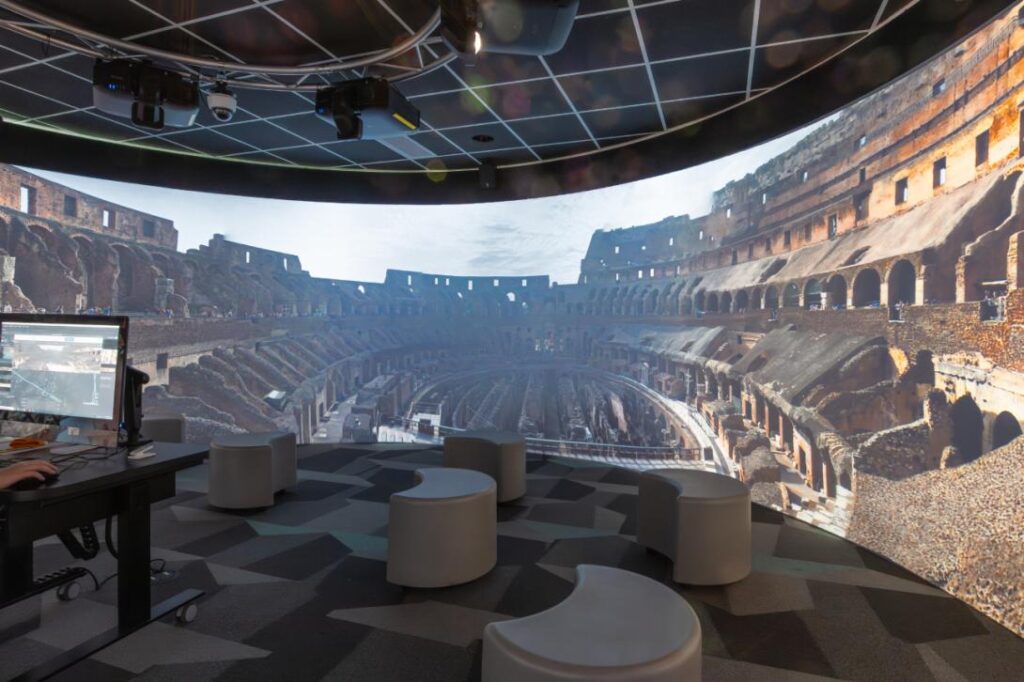
From Virtual Experience to Written Expression in Italian
By Carmen De Lorenzo, Michigan State University, and Valentina Sorbera, College of William & Mary
DOI: https://www.doi.org/10.69732/BVDV6873
Introduction
For many students learning Italian, walking through the streets of Rome and engaging directly with its cultural landscape remains an aspiration, not a reality. While study abroad programs have long been considered one of the most effective pathways to intercultural learning and linguistic development, access to these experiences is not always possible. Financial constraints, scheduling conflicts, family responsibilities, and other personal circumstances can limit students’ ability to participate in overseas programs. Virtual reality (VR) offers a promising alternative, enabling students to immerse themselves in authentic cultural environments and engage with language in context regardless of physical location (Berti, M., Maranzana, S., & Monzingo, J., 2020).
As language educators continue to explore innovative ways to foster intercultural competence and authentic language use, VR has emerged as a powerful tool for creating immersive learning experiences beyond the traditional classroom. Research shows that VR can simulate real-life situations and create authentic training environments where learners engage in meaningful communication while building confidence in the target language (Reitz, Sohny, & Lochmann, 2016). “VR-Based Gamification of Communication Training and Oral Examination in a Second Language” argues that immersive virtual environments offer language practice opportunities that are often difficult to replicate in traditional classrooms, where authentic communication may be limited. (Reitz, Sohny, & Lochmann, 2016).
Beyond supporting language development, VR has also demonstrated significant potential for cultural learning. Berti, Maranzana, and Monzingo (2020) found that highly immersive VR environments enabled learners to explore authentic and contextualized cultural settings and helped them discover cultural dimensions not typically represented in traditional instructional materials. Their findings suggest that VR can promote cultural understanding by allowing learners to observe and interact with everyday aspects of the target culture in ways that foster deeper engagement and reflection.
This article describes a collaborative project between Michigan State University and the College of William & Mary that explored VR as both a global learning experience and a way to assess written language proficiency in Italian. The project grew out of a shared interest in using emerging technologies to create equitable opportunities for students to engage with Italian culture while developing their linguistic skills. Students explored a virtual Rome, encountering cultural landmarks, authentic linguistic input, and contextualized vocabulary in ways that mirrored aspects of study abroad.
Rather than treating assessment as a separate activity disconnected from real-life experience, the project embedded evaluation within the virtual environment itself. Students completed authentic written tasks based on their observations, interactions, and reflections while navigating the VR simulation. This approach aligned assessment with real-world communicative practices, allowing instructors to evaluate language proficiency through meaningful cultural engagement rather than decontextualized grammar or vocabulary exercises. In doing so, the project addressed two central objectives of contemporary language education: fostering intercultural awareness and measuring language performance in authentic contexts.
The collaboration also responded to broader conversations in language pedagogy concerning accessibility, inclusion, and global learning. While physical mobility remains a valuable component of language education, not all students can participate in study abroad programs. VR environments can help bridge this gap by offering immersive experiences that support cultural exploration and linguistic engagement regardless of geographical location. Our project shows how emerging technologies can integrate into existing curricula to expand access to global learning while maintaining rigorous standards for language assessment.
In the sections that follow, we discuss the pedagogical principles that informed the VR experience’s design, the activities in preparation for the VR sessions, and the structure and implementation of the two VR projects. We also share observations from implementing the project and consider the broader implications of VR for intercultural learning, vocabulary acquisition, and performance-based assessment in Italian language education.
Project Design and Implementation at Michigan State University
The project was implemented in two sections of ITL 202: Second-Year Italian (Intermediate Low) at Michigan State University during Fall 2025 and Spring 2026. The initiative grew out of a collaboration between Carmen De Lorenzo and Jessica Toby, who sought to create an immersive cultural experience that would let students engage with Italy beyond the traditional classroom while preparing them for an authentic, performance-based assessment. Our approach drew on previous research highlighting the value of virtual reality in providing authentic cultural contexts, fostering learner engagement, and supporting language acquisition through experiential learning. Studies show that VR environments can spark learners’ interest in the target culture while creating opportunities for meaningful language use in realistic settings (Cho, 2018).
To achieve this goal, we partnered with the Michigan State University Libraries and utilized the University’s 360-degree immersive room located in the Digital Scholarship Lab. Rather than simply exposing students to VR technology, we designed a carefully scaffolded instructional sequence that would prepare learners linguistically and culturally for the experience. Research indicates that successfully integrating VR into language learning requires substantial pedagogical preparation and contextualization, not isolated technological experiences (Xie et al., 2019).
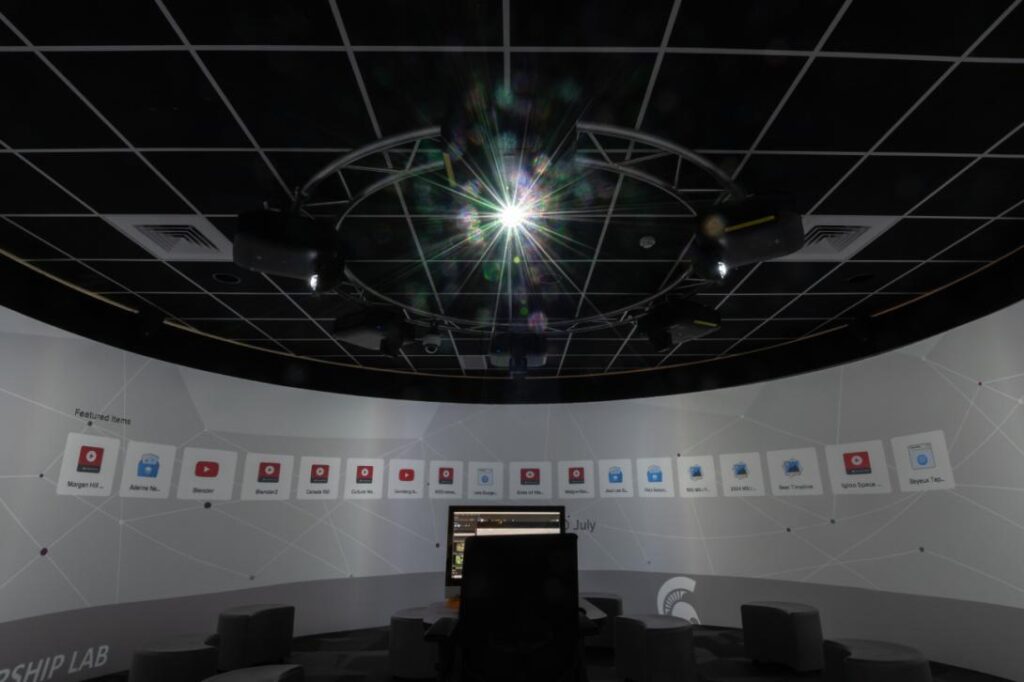
During the week before their written activity, students completed a variety of tasks to build the vocabulary and grammatical structures needed to describe urban environments, discuss cultural landmarks, and make personal observations in Italian. Instructional activities included homework assignments, vocabulary games, music-based activities, short film clips, and classroom discussions focused on Rome. Students became familiar with the names of major monuments, streets, piazzas, and landmarks commonly associated with the city’s historic center. To further contextualize the experience, students read a level-appropriate reader tailored to their language proficiency. This adapted book was about two friends exploring Rome and discovering its food specialties, monuments, neighborhoods, and cultural traditions. These activities gave students multiple opportunities to implement newly acquired vocabulary and build confidence in discussing sites, describing visual details, and expressing personal reactions in Italian.
The immersive experience centered on two 360-degree videos available for free on YouTube: Un giro in Vespa a Roma and Una visita al Pantheon. Before entering the immersive room, we briefly reviewed the locations and monuments students would encounter in the videos. We also discussed practical considerations associated with immersive technologies, explaining that some participants might experience discomfort or motion sickness during the experience. (Xie, Y., Ryder, L., & Chen, Y., 2019).
Once inside the 360-degree room, students found themselves virtually transported to the streets of Rome. As the Vespa tour began, the instructors guided students entirely in Italian, encouraging them to recognize vocabulary and cultural references encountered during the virtual ride. Students identified monuments, described the urban landscape, and observed distinctive features of the Roman environment. The class paid particular attention to culturally significant details such as the pini marittimi, whose presence throughout the city prompted discussions linking linguistic knowledge to cultural observation.
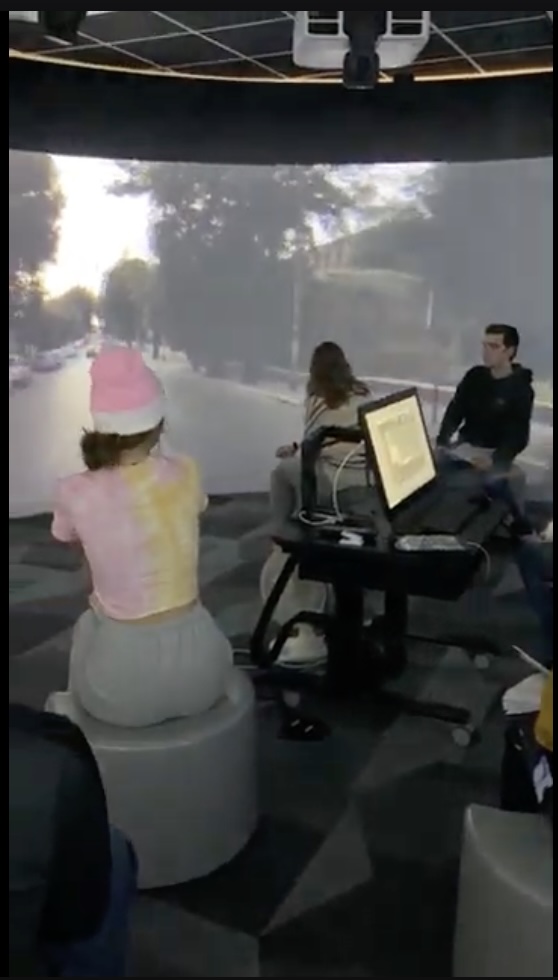
The experience continued with a virtual visit to the Pantheon. Students first explored the exterior space before entering the monument’s interior. In both videos, instructors encouraged spontaneous Italian by prompting learners to describe what they observed, recall target vocabulary, and express personal reactions to the experience. Similar VR language-learning studies have found that authentic visual contexts encourage learners to engage more deeply with vocabulary and cultural content while increasing motivation and participation (Xie, Y., Ryder, L., & Chen, Y., 2019).
After the immersive session, students engaged in a debriefing discussion to reflect on their observations and cultural discoveries. They then completed written assessment tasks based on their virtual exploration, allowing instructors to evaluate language proficiency in an authentic communicative context. Students also completed an anonymous survey regarding their perceptions of the experience. Questions focused on their enjoyment of the activity, the extent to which the immersive environment helped them remember vocabulary and cultural content, perceived educational value, and interest in participating in future VR experiences.
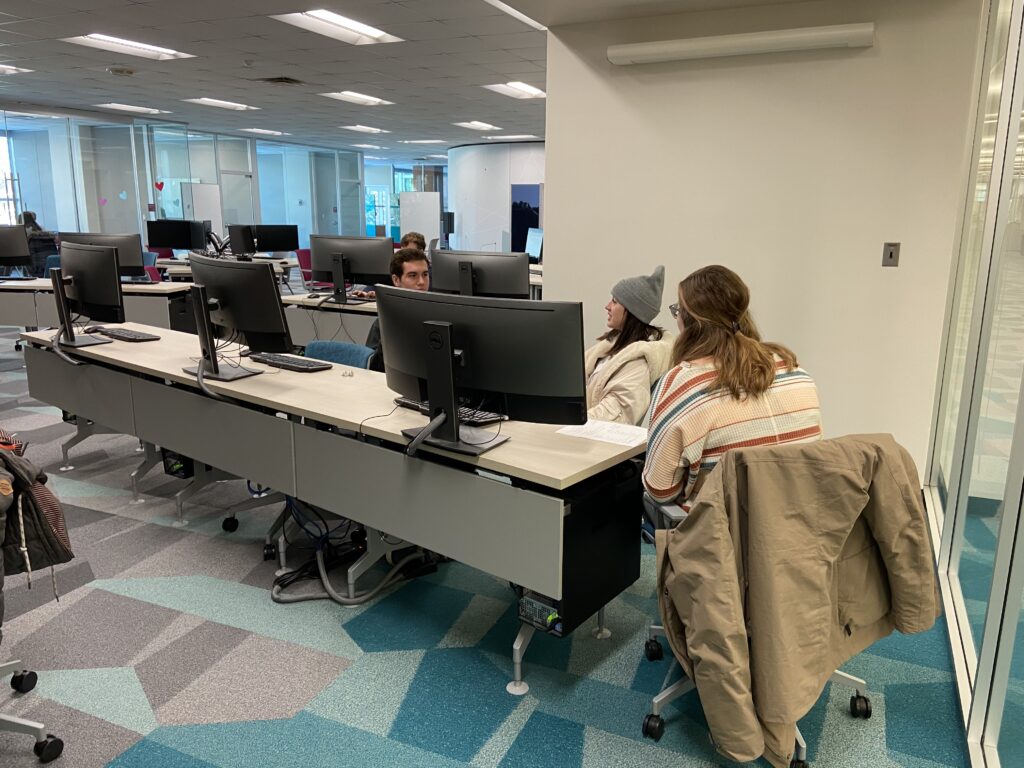
The project included two cohorts: nine students enrolled in Fall 2025 and twenty-two students enrolled in Spring 2026, for a total of thirty-one participants. Survey responses indicated overwhelmingly positive perceptions of the activity. Students reported high engagement; the immersive environment helped them remember vocabulary more effectively, and they expressed interest in participating in similar experiences in the future. These perceptions align with previous research suggesting that immersive VR environments can enhance motivation, enjoyment, spatial presence, and memory retention, all of which contribute positively to language learning outcomes (Cho, Y., 2018).
| Q1 – Have you ever watched a VR video before last Friday’s class? | |||
| # | Answer | % | Count |
| 1 | Yes | 55.56% | 5 |
| 2 | No | 44.44% | 4 |
| Total | 100% | 9 | |
| Q2 – Did you enjoy the experience? | |||
| # | Answer | % | Count |
| 1 | Yes | 100.00% | 9 |
| 2 | No | 0.00% | 0 |
| Total | 100% | 9 | |
| Q3 – Would you like to watch more VR videos in class? | |||
| # | Answer | % | Count |
| 1 | Yes | 100.00% | 9 |
| 2 | No | 0.00% | 0 |
| Total | 100% | 9 | |
| Q4 – How did this experience aid your cultural awareness of Rome? |
| Gave a better visual |
| I was able to see the passage of the monuments in real time, that helped me realize how far apart and how large these monuments are. |
| This was awesome, it really helped me understand the city of Rome without physically going to it |
| It allowed me to life within the shoes of someone living in Rome without having to go there |
| I was able to experience the architecture, landscape, and monuments of Rome without the expenses associated with traveling. |
Responses to Question 4 indicate that the experience enhanced students’ cultural awareness of Rome by providing a more concrete and immersive understanding of the city’s geography, architecture, and historical landmarks. Participants emphasized the value of being able to virtually explore Rome in real time, which helped them better grasp the scale and spatial relationships of monuments and urban spaces. Several students noted that the experience allowed them to feel as though they were living in or visiting Rome, offering meaningful cultural exposure without the financial and logistical barriers of travel. Overall, the comments suggest that the virtual experience fostered a stronger sense of place and cultural connection by making the city’s environment more accessible and tangible.
Project Design and Implementation at the College of William & Mary
The project at the College of William & Mary was embedded in the class of ITAL 202 (our fourth course of a four-semester series), during Spring 2025 and Spring 2026, and therefore targeted to Intermediate-level students. The objective of the lesson, Una gita a Roma, was to immerse students in the city of Rome: they had to find their way around the city and give each other directions, while deepening their knowledge of the culture related to the places visited during the tour. The VR experience involved the use of headsets and took place in the university VR Lab. The Lab offers instructors across the university the opportunity to immerse their students in a Virtual Reality experience during their class sessions, and it can accommodate up to 26 students per session. The integration of headset-based virtual reality into second language acquisition (SLA) has been shown to enhance contextualized learning and spatial engagement (de Paula Forero Pataquiva & Klimova, 2022). In fact, students demonstrated a deeper knowledge of Rome and its culture compared to previous groups of ITAL 202 students, where the VR session was not used to introduce the Rome unit. They seamlessly incorporated information learned during the VR tour and scored higher in their writing assessments.
Activities in Preparation for the VR Class
The classes before the VR session were all dedicated to cultural and grammar activities tailored to prepare the students for the Rome tour. I integrated a reading from Sentieri, 4th edition (Cozzarelli, 2023) “Roma: un museo all’aperto!”, selected vocabulary exercises from Dieci B1 (Naddeo & Orlandino, 2021), and designed original activities on Roman history and music. For example, students were asked to reflect on the meaning of “Roma, la Città Eterna” (the Eternal City) and work on a song by Italian singer Achille Lauro, “Incoscenti Giovani”(Young, Reckless People). The song served as an introduction to the whole Rome unit: at the beginning of the lesson, I played the song in class and asked students to focus on the images of the music video, since some scenes were filmed inside the Trevi Fountain and are inspired by scenes featuring Anita Ekberg and Marcello Mastroianni and their nighttime bathing in Federico Fellini‘s film “La Dolce Vita”.
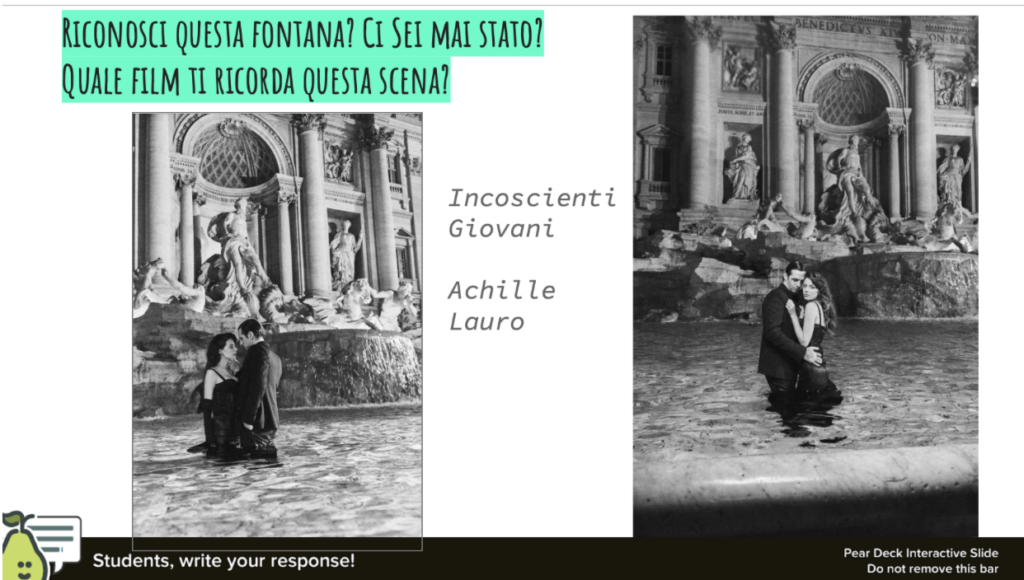
Students were prompted to analyze the significance of the song’s title, “Young, Reckless People.” Following a discussion of their interpretations, I presented the singer’s perspective: “I develop the story of a young girl who could be my daughter, my love, my mother. The most reckless thing that one could do? To love, that is to really allow someone to kill you, and to hope that they won’t do it. It is a song that really takes you back to the great songs that we grew up with. It seems like an Italian classic from the 1960s.”
To introduce Roman food, I used a listening activity from Dieci B1 (Naddeo & Orlandino, 2021) entitled “Cornetto o Brioche?” (Croissant or Brioche). As a closure activity, I asked students to write a dialogue based on the information learned from the listening, in which they had to imagine being in Rome with a friend and asking each other what type of food they would like to try. The dialogue had to include some grammar structures reviewed during the lesson (the use of ‘ci’ and ‘ne’) as well as expressions to give advice.
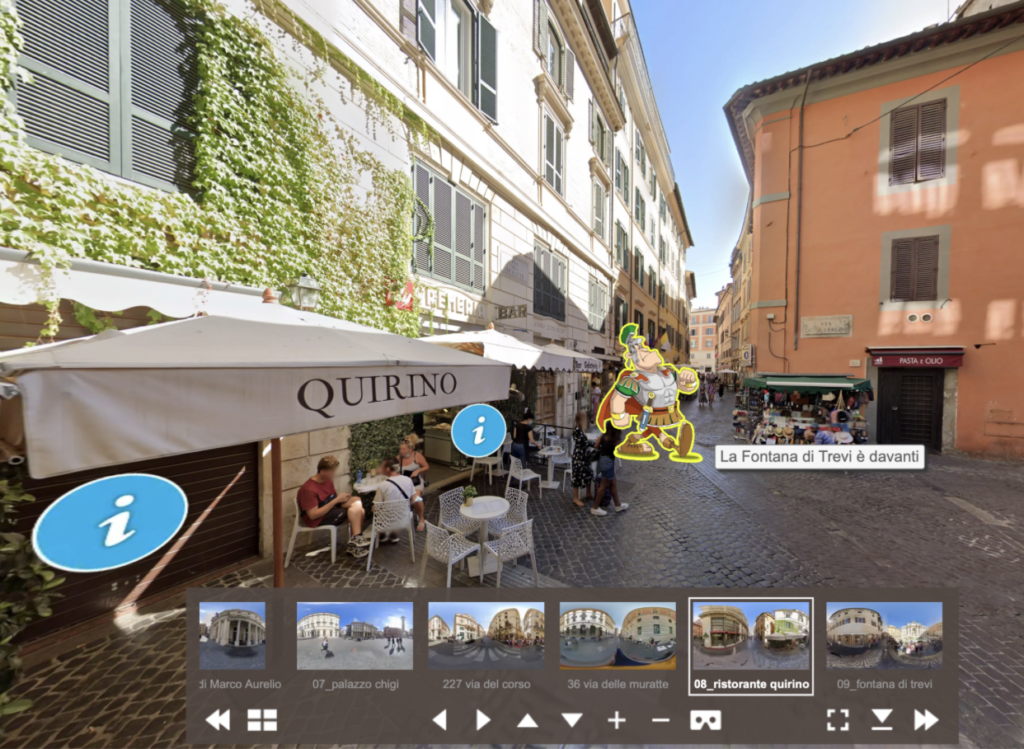
During the VR session, students stop by a restaurant close to the Trevi Fountain: Quirino, where they can find information about some special ingredients for the most famous Roman pasta dishes (Carbonara, Amatriciana and Cacio e Pepe). On their worksheet, students answer the following question in Italian: “Go straight ahead; on the road you will see the Quirino Restaurant. Stop for lunch and look at the pictures of these two typical Roman dishes. What are they called? How do you order them?”
The VR Class
During the VR class, students worked in pairs, alternating roles every twenty minutes. While one student wore the headset, the other read cultural questions from a worksheet based on prior class material and information embedded within the VR tour. In the first half, Student A provided physical directions to Student B as they navigated from Piazza di Spagna to the Trevi Fountain, with both collaborating to answer the related cultural questions. After switching roles, Student B led the navigation while continuing to complete the worksheet about the tour from Piazza di Spagna to the Trevi Fountain together. This collaborative setup highlights the effectiveness of immersive VR in fostering learner-to-learner mediation strategies and peer interaction in Italian foreign language contexts (Compagnoni, 2024).
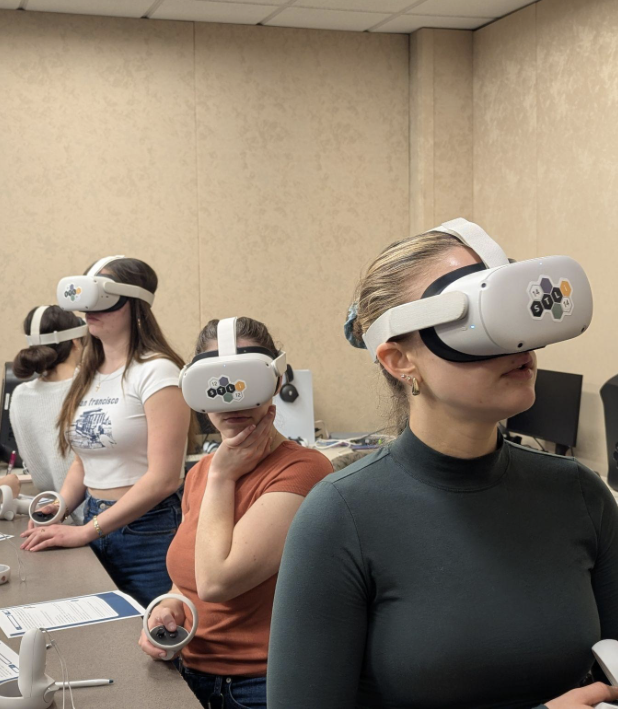
In our project at the College of William & Mary, accessibility was a central priority from the outset. While VR offers immersive benefits, head-mounted displays are not suitable for every learner, particularly students who experience motion sickness or visual discomfort. To ensure full inclusion, we enabled students to navigate the virtual tours directly from a desktop computer without a headset if needed. This dual-modality approach allowed every student to participate fully in the language learning tasks regardless of physical or health-related constraints. Moving forward, offering flexible, non-headset alternatives like this will be essential for making VR-enhanced language learning accessible and equitable for all students.
The tour started in Piazza di Spagna, and students were asked to reach the Trevi Fountain. Along the way, they could listen to songs, watch short video clips, and read information about the site they were visiting. The VR environment was created with the help of the director of the William & Mary’s Virtual Reality Lab. To create the VR environment, I picked the 360 images from Google Street View, prepared a slideshow presentation with all the cultural information that I wanted to include, and provided links to videos and other images, music, as well as street sounds that I wanted to include. Then everything was put together using the 3DVista platform, which allows different types of media and study materials to be embedded in the VR experience.
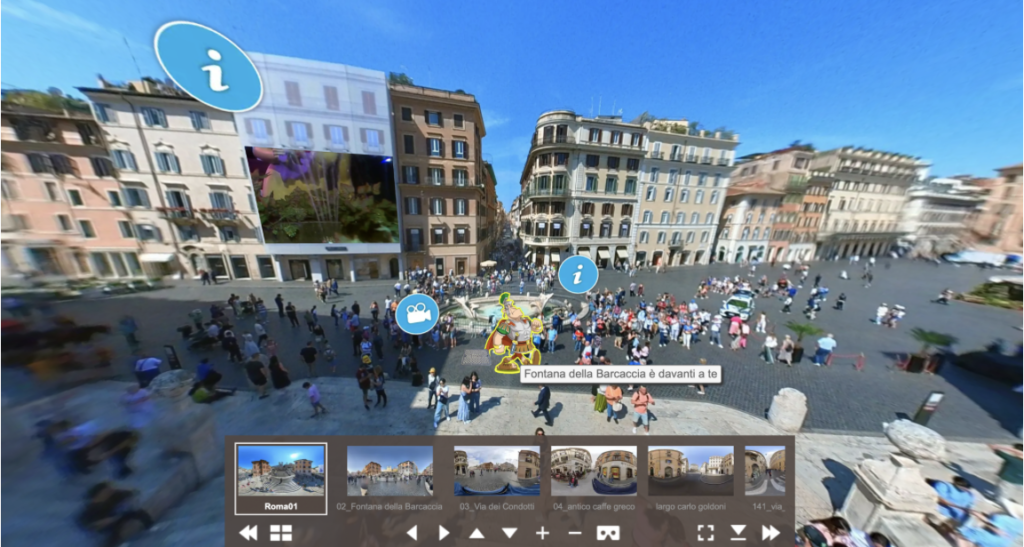
If students got lost, they could consult a cartoon Centurion who provided directions and displayed a city map.
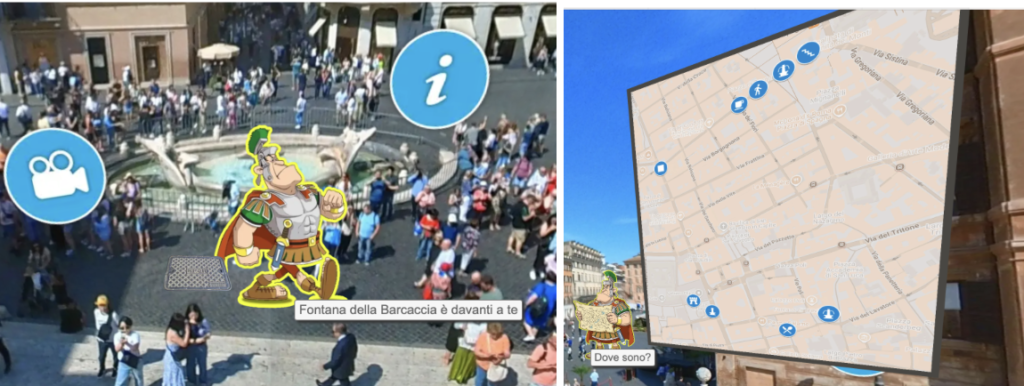
Along the way, students had the opportunity to apply their knowledge of the language and culture in a real-world environment. The VR class provided students who were unable to study abroad with the opportunity to experience Italy directly from campus. Beyond overcoming financial barriers, prioritizing accessibility in this way also helps students navigate physical limitations that might otherwise prevent them from engaging in immersive learning. Moreover, by immersing students in interactive virtual landmarks, VR serves as a scalable tool to boost engagement and make global learning far more accessible. Because VR environments can be easily updated with new informational overlays, the core platform scales seamlessly across evolving curricula and multiple courses without requiring complete re-engineering.
Beyond content adaptability, the platform optimizes institutional resources. By pairing a reusable virtual framework with a pair-rotation model—where students alternate using shared headsets—institutions can expand immersive experiences to larger student cohorts with minimal incremental investment.
If you would like to see the worksheets that were used for the class you can find them at these links:
Survey after the VR Class
After the VR class, students completed a short survey. The results were very encouraging: they expressed unanimous interest in participating in more VR language learning sessions and agreed that the goals of this VR session were clear. The majority of them felt that the challenge of this activity matched their language skills, and they found it helpful working with their partner to navigate the VR session. Having them work in pairs fostered collaborative learning in an environment that could have been isolating.
| Please identify your level of agreement with each of the following statements | |||||
|---|---|---|---|---|---|
| Question | Strongly Agree | Agree | Neither Agree or Disagree | Disagree | Strongly Disagree |
| The goals of this VR session were clear. | 80% | 20% | |||
| Reactions and responses from my partner helped me navigate during this VR session. | 40% | 40% | 6.7% | 6.7% | 6.7% |
| The challenge of this activity matched my language skills. | 60% | 33.3% | 6.7% | ||
| I felt completely focused on the VR language task. | 53.3% | 40% | 6.7% | ||
| I lost track of time during the VR activity. | 33.3% | 40% | 13.3% | 13.3% | |
| I would enjoy this activity even if it wasn’t for class. | 53.3% | 26.7% | 13.3% | 6.7% | |
| The VR technology was easy to use. | 46.7% | 46.7% | 6.7% | ||
| The virtual environment felt realistic and immersive. | 33.3% | 40% | 13.3% | 13.3% | |
| I would like to participate in more VR language learning sessions. | 40% | 53.3% | 6.7% | ||
When asked about “what they enjoyed about the VR language learning experience,” students responded very positively. Multiple students mentioned how realistic, immersive, and engaging the experience was, noting it felt like actually traveling to and walking around Rome, while also valuing the challenge of solving problems directly in the target language.
Moreover, students in their survey answers expressed appreciation for the interactive features (selectable buttons, videos, audio clips) and the background context provided for the locations they were exploring. They found navigating the VR setup process straightforward. Finally, the activity served as a fun, refreshing change of pace from standard lectures and traditional learning environments, lowering their performance anxiety.
The results from the survey confirmed that VR language learning environments enhance contextualized communication and student motivation through collaborative tasks while providing a rich, experiential foundation for authentic, performance-based assessment.
Conclusion
The collaborative project conducted at Michigan State University and the College of William & Mary demonstrates the potential of immersive technologies to support global learning, intercultural engagement, and authentic language assessment in the Italian language classroom. By combining deliberate pedagogical scaffolding with a culturally rich virtual experience, students engaged with Rome in ways that extended beyond traditional textbook representations of culture. The experience provided meaningful opportunities for contextualized vocabulary use, cultural observation, and written reflection, allowing assessment to emerge naturally from authentic communicative tasks.
Student responses suggest that immersive environments can increase engagement and contribute positively to vocabulary retention. Many participants reported that the visual and experiential nature of the VR activities helped them remember cultural information and linguistic structures more effectively than traditional instructional materials. These findings align with previous studies that identify VR as a promising tool for creating authentic contexts for language learning and fostering cultural understanding (Berti et al., 2020; Xie et al., 2019). At the same time, the project highlights how VR can serve as a bridge for students who are unable to participate in study abroad programs, expanding access to global learning experiences while maintaining meaningful connections to the target culture.
Despite these encouraging results, several challenges remain. Implementing VR in language classrooms requires access to specialized equipment and technical support, which may limit adoption at institutions with fewer resources. Accessibility considerations must also remain central, as immersive experiences may not suit all learners, including students with visual disabilities or individuals who experience motion sickness or other health-related concerns. In our project, careful preparation and accommodations helped mitigate some of these issues, but they remain important considerations for future implementations.
Additionally, while enthusiasm for VR in education continues to grow, empirical research on its long-term impact in language learning remains limited. Further studies are needed to examine how immersive experiences affect language acquisition, vocabulary retention, intercultural competence, and proficiency development over time. Future research should also investigate how VR-based assessments compare to more traditional forms of evaluation and whether immersive experiences can consistently replicate some of the linguistic and cultural benefits associated with study abroad.
Ultimately, VR should not be viewed as a replacement for study abroad or face-to-face cultural encounters. Rather, it is a valuable complementary tool that can expand access to authentic cultural experiences and enrich language instruction. As immersive technologies become more accessible and pedagogical research continues to evolve, VR could play an increasingly important role in helping language educators create engaging, equitable, and globally oriented learning environments.
References
Berti, M., Maranzana, S., & Monzingo, J. (2020). Fostering cultural understanding with virtual reality: A look at students’ stereotypes and beliefs. International Journal of Computer-Assisted Language Learning and Teaching, 10(1), 47-64.
Cho, Y. (2018). How spatial presence in VR affects memory retention and motivation on second language learning: A comparison of desktop and immersive VR-based learning. Syracuse University.
Compagnoni, I. (2024). The results of a pilot study on immersive Virtual Reality to boost learner-to-learner mediation strategies in Italian as a foreign language.
Glottodidactica, 51(2), 183–204. https://doi.org/10.14746/gl.2024.51.2.9
De Paula Forero Pataquiva, F., & Klimova, B. (2022). A Systematic Review of Virtual Reality in the Acquisition of a Second Language. International Journal of Emerging Technologies in Learning (iJET), 17(15), pp. 43–53. https://doi.org/10.3991/ijet.v17i15.31781
Reitz, L., Sohny, A., & Lochmann, G. (2016). VR-based gamification of communication training and oral examination in a second language. International Journal of Game-Based Learning, 6(2).
Xie, Y., Ryder, L., & Chen, Y. (2019). Using interactive virtual reality tools in an advanced Chinese language class: A case study. TechTrends, 63(3), 251-259.
Acknowledgements
The authors would like to thank the “Digital Scholarship Lab 360 Room” at Michigan State University for hosting the students and sharing their expertise in virtual reality technologies.
Special thanks to Mike Blum, Associate Director for Faculty Engagement in the Studio for Teaching & Learning Innovation at William & Mary, whose partnership and design work were essential in creating the VR environment for the Rome Tour.
AI disclosure: Generative AI (Google Gemini) was used to assist with bibliography selection, organizing student survey themes, and refining sentence structure and flow. All AI-assisted suggestions were reviewed, verified, and finalized by the authors, who take full responsibility for the content.