
How AI Helped My Son Learn French Through a Story He Already Loved
By Marvin Starominski-Uehara, Temple University Japan

DOI: https://www.doi.org/10.69732/MPXQ7682
In this article, I will give an account of an experience that I had with my own child’s language learning. I would like to offer it as an inspirational story that might inform the creation of assignments for language learners in the classroom.
I do not teach language to my children. I show them what an image sounds like or what a sound connects to. My kids come from a trilingual household and I realized very early on that they do not care which language they are hearing or speaking. They want to connect, and connection happens through sharing what they see or feel, not through the label attached to the words. As they got a bit older, that same instinct just showed up somewhere new. Now they want to make sense of the images in front of them, in this case words and ideograms, or write them, or sing along to sounds they like, whether the sounds are English, Portuguese or Japanese.
This is the main insight that shapes the lesson plan you see below. We, parents and teachers, value culture, symbolism, syntax, grammar, accuracy, intonation, and polish, but a language, whatever it is, is first and foremost a conduit that builds a bond between two people (Dunbar 1993). For young minds, it is very natural and reasonable to want the whole message as quickly as possible before caring about its parts and how to correctly put them together. Once we, adults, come to terms with that, learning alongside children stops feeling like instruction and starts feeling like an organic and enjoyable shared experience, for everyone involved. This sentiment can also inform how we think about our classrooms. Most of all, students want to connect with those that they will use the target language with.
So whatever language I am learning with my children at any given moment, it always starts the same way. I pay close attention to what they like and want to share, in whatever language they talk to me.
Right now, though, the language on my eleven-year-old son’s mind is not a language at all. It is Minecraft. He does not stop talking about it. I know next to nothing about gaming and, if I am honest, do not have much interest in it either. Still, I make the effort to pay attention and pick up what I can from him. And every time I do, every time he sees that I am learning something new because of him, he appreciates it. Not just the exchange itself, but the fact that I bothered to listen closely enough to understand what he was trying to tell me.
That habit of paying attention is also what turns an ordinary moment into a casual, fun opportunity to learn something together. As an educator, I cannot help but look for these openings when they show up in the classroom as well. The lesson below grew out of one of those moments. As you read, think about how a similar activity might work in your language classroom.
Lesson Plan
Time to Complete: Under 45 minutes in one sitting. My version of this took less than that, start to finish.
Who This Is For: Parents, caregivers and teachers who want to catch a child’s natural enthusiasm for something and turn it into their first taste of a new language, using AI as the bridge. This works for children roughly six to twelve years old. You will need: (i) a phone to record audio, (ii) a free m4a-to-mp3 converter, (iii) an AI chat model that can transcribe, correct and translate text (I used Claude), (iv) a text-to-speech app (I used paper2audio) and (v) at least one AI tool that can turn text or images into a short animation or comic (I tried three: dola ai, ChatGPT and fliki ai).
Note: I accessed the free tiers of all these AI tools by logging in with my Gmail account. Teachers will need to verify whether these tools grant their students the same access. Please also note that AI tools have age limits: ChatGPT requires users to be at least 13 years old and Claude requires them to be 18 years old.
Real-World Application
Information sticks better when it is encoded in reference to yourself. This is the self-reference effect (Pruss et al. 2025) on language vocabulary when participants build their own sentence around each target word instead of just reading a translation.
That is the whole engine behind this lesson. My son did not get three French words on a flashcard. He got three French words buried inside a story he told, about a scene he described, from a game only he was playing. Every step below is built to keep the material his, not mine.
Lesson Goal
Take a child’s and student’s already-flowing enthusiasm about something, anything, and run it through a short AI-assisted pipeline that ends with them re-telling their own story, now holding a few new words in a language they did not have that morning. They can learn without any assigned topic and with no vocabulary list handed to them.
How It Actually Went
Here is the full sequence I ran with my eleven-year-old son.
- I just listened. He was already going on and on, in his usual mix of English and some Portuguese, about a video game that he had played the day before.
- I asked for the short version. Once he had talked himself out, I asked him to say it again, but this time in under a minute. He grabbed my phone and recorded himself, no prompting needed.
- I converted the file. It came out as an m4a. I searched ‘convert m4a to mp3’, grabbed one of the many free tools that turned up and downloaded the result.
- I had it transcribed. I uploaded the mp3 to Claude and asked it to transcribe the text.
- He read it and caught his own mistakes. He read the transcript happily, calling it his ‘first formal editing’, and pointed out where it had gotten things wrong.
- We fixed it together, and he signed off on it. I asked Claude to make the specific corrections he had flagged. He confirmed the general idea was still right before we moved on. His approval was the real checkpoint, not a tidy transcript.
- I had it translated. Claude translated the corrected version into French, the language he wanted to learn. See the full transcription with a translation below.
| French transcription:
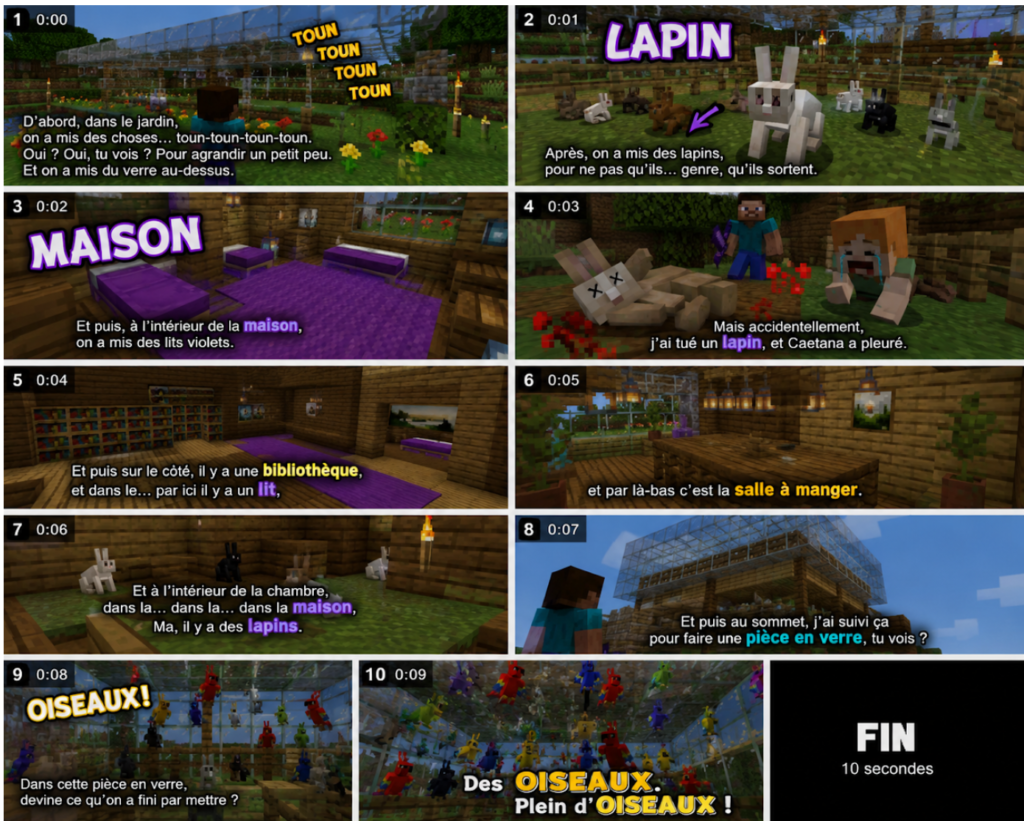
D’abord, dans le jardin, on a mis des choses… toun-toun-toun-toun. Oui ? Oui, tu vois ? Pour agrandir un petit peu. Et on a mis du verre au-dessus. Après, on a mis des lapins, pour ne pas qu’ils… genre, qu’ils sortent. Et puis, à l’intérieur de la maison, on a mis des lits violets. Mais accidentellement, j’ai tué un lapin, et Caetana a pleuré. Et puis sur le côté, il y a une bibliothèque, et dans le… par ici il y a un lit, et par là-bas c’est la salle à manger. Et à l’intérieur de la chambre, dans la… dans la… dans la maison, Ma, il y a des lapins. Et puis au sommet, j’ai suivi ça pour faire une pièce en verre, tu vois ? Dans cette pièce en verre, devine ce qu’on a fini par mettre ? Des oiseaux. Plein d’oiseaux ! English translation: First, in the garden, we put some things down… dun-dun-dun-dun. See? Yeah, you see? Just to make it a little bigger. And we put glass on top. Then we put in some rabbits, so they don’t, like, get out. And then inside the house, we put purple beds. But by accident, I killed a rabbit, and Caetana [his sister] cried. And then on the side there’s a bookshelf, and over here there’s a bed, and over there is the dining room. And inside the room, in the… in the… in the house, Dad, there are rabbits. And then at the top, I followed this to make a glass room, see? In this glass room, guess what we ended up putting? Birds. Lots of birds! |
- We read it out loud. My French is rusty but workable. I read the short text with him and asked if he wanted to repeat after me. He said okay.
- I gave it a voice. I ran the French text through paper2audio and saved the audio to my phone.
- I asked what stuck. I asked which French words he remembered. He named at least three without hesitating: lapin, maison, oiseaux.
- I asked what he wanted to see. He wanted the clip to be him, talking about Minecraft.
- On the first try I used dola ai, a free account. I prompted a ten-second clip emphasizing lapin, maison, and oiseaux, set in a Minecraft-like scene with an eleven-year-old narrating and attached the full transcript. What came back was animation only, no audio. He loved that the lapin lost its head on screen — exactly what he had described.
- Second try: ChatGPT, free account, same prompt. This time it came back as a comic strip instead of an animation (see below). His reaction was much stronger, because the images matched exactly what he had been telling me about the game. He was excited enough to offer to try reading the French dialogue out loud, even though he had had zero contact with French before this beyond hearing Edith Piaf occasionally in the car. He read after me, I made sure to lean into the three words he wanted to learn and I corrected nothing in the moment.
- Third try: fliki ai, free account, same prompt again. I still wanted what I had originally pictured: a short animated clip with actual audio, which neither dola nor ChatGPT had given me. Fliki delivered one, quick to generate, close to what I had in mind, with captions he could read along to. When I showed it to him, though, he thought it moved too fast and the character did not feel like anyone in particular to him. He wanted a kid, ideally himself, in a setting that looked more like the game.
- I closed the loop. Last, I asked if he wanted to tell me the whole story one more time. He agreed but asked if it could be shorter. Of course, I said, and I asked him, deliberately, to work lapin, maison, and oiseaux into it. He did. And, without being asked, he also pulled in two or three verbs and an adverb that had shown up in both the original French audio and the fliki clip.
- I asked, and then I said it plainly. I asked if he had liked doing this. He said yes. I told him: ‘Now you speak French! Voilà!’
What I Took Away
- Follow the kid, not the tool. This was never about teaching a skill. It was about spending a good half hour with him and making sure he had fun. Bring the technology into his world, do not drag him into yours.
- Ask first, and mean it. Explain it briefly and clearly enough that he can decide if it sounds fun. If he had said no, I was not going to push. I would have rethought it instead.
- Show your own fumbling. Hunting for a converter, trying dola and getting no audio, trying again with fliki and still not quite landing it, he watched all of it happen, without it ever becoming too much for him to follow. I am not sure yet what my son learned from watching me move quickly through these steps – I did not ask him directly, as formal AI literacy was not the point of the lesson – but I assume he understood that users have much less control over AI outputs than we think we have.
- Hold the goal but let the detour matter too. What I had set out to make, a short animated clip with sound, only showed up on my third attempt, with fliki. But what stuck with him most was not that clip at all. It was the ChatGPT comic, because the images were so close to what he had imagined. That reaction alone might have been enough. I used it anyway as a way in, since he needed to hear French from something better than my rusty accent, and reinforcing it with the animation seemed to help the words settle in.
By the end, he had picked up the three nouns quickly and was already starting to catch the rhythm of the Asterix world and how to shape the sounds in the back of his throat. His sister, who had been observing the process, said she wants to try this too but with the language of Huntrix, which means our next round is apparently going to be in Hangul.
Roadmap for Your Own Version
- Catch your child mid-enthusiasm about something, no assigned topic, then ask for a one-minute retelling, recorded on a phone.
- Convert the file if needed and transcribe it with an AI model.
- Let your child read and correct their own transcript before you touch it.
- Translate the corrected text into the target language and read it aloud together.
- Turn the translation into audio with a text-to-speech tool, and ask which words already stuck.
- Ask what scene or character they want to see, then generate it with an AI image, comic or animation tool. Try more than one if the first does not land, and let them compare and pick.
- Watch or read the result together, then ask them to re-tell the original story once more, using the words they chose, without correcting them mid-story.
Individual Reflection
- Did your child react emotionally to anything the AI generated, the way the lapin losing its head did here? What made that moment land?
- Which attempt missed before one finally worked, and what did showing the ‘failed’ ones still teach your child?
- Did your child add anything beyond the words you asked for in the final re-telling? What does that tell you about what actually transferred?
- How would you adapt this for a group of students who all have different interests?
A Classroom Version
How could this look in a language classroom? Of course, living with your child every day gives you opportunities to learn about your own child’s interests that do not always naturally come up in the language classroom that has a diverse set of students with varied interests and a whole separate agenda. But you can still do your best to harness your students’ passions. Perhaps have your students choose a topic that they are passionate about, let their imaginations run wild! They could also talk about Minecraft, or their life-long interest in horseback riding, or in throat singing! Depending on their level in the target language, you can have them write something either in L1 or L2 about their topic. They could then put their text into an AI tool and ask it to generate a list of words essential to be able to talk in the target language about that topic as well as a text (or a comic strip or a video) about the topic on their proficiency level. The students could then come up with a presentation (with or without AI assistance) that would teach some of the most important terms to their classmates before using those terms to tell each other about their interests.
The Bottom Line
A child does not need a curriculum to pick up their first words in a new language. They need their own voice, their own game, their own version of events, handed back to them until they can say it themselves. The tools did the mechanical work, converting, translating, rendering. The self-reference effect did the rest. My son did not remember lapin because I told him to. He remembered it because it was his rabbit, in his story, losing its head on his screen. The door to the French world is now, hopefully, wide open to him to explore on his own because his first step into it was his, on his terms, from his own happy place and wild imagination.
References
Dunbar, R. I. (1993). Coevolution of neocortical size, group size and language in humans. Behavioral and brain sciences, 16(4), 681-694.
Pruss, S., Karni, A., & Prior, A. (2025). Self-reference promotes vocabulary learning in a foreign language. Psychonomic Bulletin & Review, 32(5), 2104-2113.
AI disclosure: AI was used for grammar corrections and style recommendations.