
AI as Collaborator: Human-Written Lyrics, AI-Sung Music, and Critical Reflection
By Angela Lee-Smith, Yale University

DOI: https://www.doi.org/10.69732/BRCF8318
Introduction and Rationale
How can students turn their own stories into songs in a language they are still learning? Music has long provided language learners with opportunities to engage with language, culture, and communication in ways that extend beyond conventional classroom exercises. Music can support listening, cultural awareness, pronunciation, communication, and student engagement, while lyrics invite students to experiment with language as creative writing, using narrative, imagery, and rhythm to express their own experiences, ideas, and emotions.
These possibilities have been central to Music Café, a final project in my intermediate-to-advanced Korean course. Students write original Korean lyrics based on a narrative they want to tell and then transform those lyrics into music. The project asks students to apply the language they have learned in a new context while making linguistic, cultural, and artistic choices of their own.
In earlier versions of Music Café, students had several ways to bring their lyrics to life. Some composed and performed their own music, while others wrote lyrics to an existing melody and sang the song themselves. Students could also collaborate with classmates or other student musicians. These options worked well, but they presented a practical challenge: not every language student is a singer or musician—or wants to be one. Finding and coordinating with student performers could also be difficult during a busy semester. I wanted to preserve the central role of students’ own writing without making musical ability or access to a performer a barrier to completing the creative process.
This became one focus of my course revision. Instead of replacing the existing Music Café assignment with an AI-based project, I added SUNO (an AI music generating tool) as one more musical option. Students could still sing their own songs, use an existing melody, compose music, or collaborate with another performer. Those who preferred another way to turn their lyrics into music could use SUNO. They remained responsible for writing their own lyrics and making decisions about the story, message, genre, mood, voice, tempo, and other musical elements.
The revision therefore was not about asking AI to create for students. It was about expanding the ways students could give musical form to language they had already created. Students who used SUNO also reflected on the generation process, the choices they made, the resulting music, and the role AI played in their creative work. This added a new dimension to Music Café: students could experience an emerging technology while also considering critically what it contributed—and what it did not contribute—to their language learning and creative expression.
Background
I incorporated SUNO, an AI music generator, into a course, Advanced Korean I: Korean Language and Culture through K-pop and Music, a fifth-semester college-level Korean course. (For a more detailed introduction to Suno and its potential for language learning, refer to Huang (2024)). The course revision gave students an opportunity not only to experiment with AI-generated music but also to critically examine how the technology interpreted their own creative work. For students who chose this option, SUNO became a musical generator and performer, a creative collaborator, and an object of critical reflection. Students examined how AI-generated music interpreted their human-written lyrics, how closely it followed their artistic intentions, and what questions it raised about creativity, ethics, and human expression.
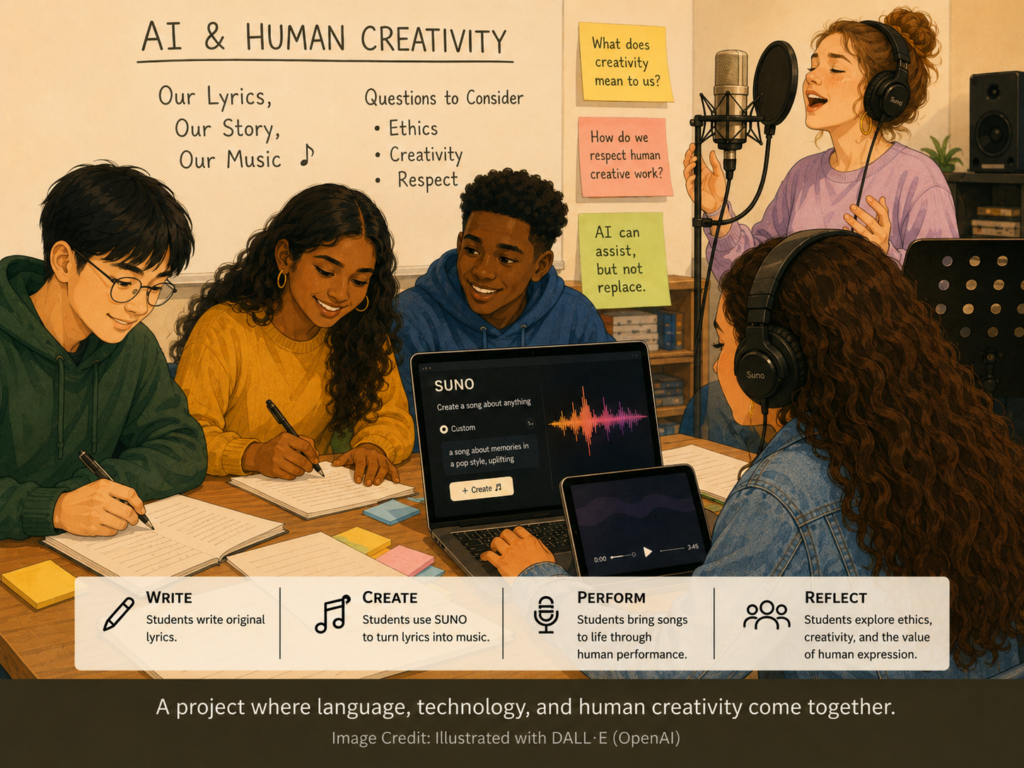
I designed the project around one simple principle—Students as Lyricists and Music Producers. Students wrote their own lyrics independently in the target language (Korean), without AI assistance. The language, storytelling, emotions, and ideas took shape first. Students then decided how to bring their lyrics into music—through their own singing, a human singer, or SUNO. Students who used SUNO took on the role of music producers, making decisions about genre, mood, tempo, voice, instrumentation, and emotional delivery. Each student who chose to use SUNO had access to a paid subscription through the institution’s learning center as part of the pilot. Compared with the free version, the paid access provided more opportunities for repeated generation and access to additional features, allowing students to experiment with different musical interpretations of their lyrics and refine their choices. Some students also created human-sung versions, allowing them to compare different musical interpretations of the same lyrics. The project process is summarized in Picture 1.

The Music Café was the culminating project of the course, but the work leading to it developed throughout the semester. Students first listened to and analyzed K-pop and other Korean popular songs from different time periods, genres, and themes. We examined vocabulary and grammatical expressions as well as how lyrics communicate stories, emotions, and sociocultural perspectives. Students discussed the relationship between lyrics and musical choices and considered how language in song lyrics differs from everyday communication. These interpretive and analytical activities provided models that students could draw on when they later became lyricists themselves.
Building on this analysis, each student selected a story, experience, idea, or message and developed it into original Korean lyrics. Students considered the speaker or perspective of the song, the story or theme they wanted to develop, the message they wanted to communicate, and how Korean expressions could convey that meaning effectively. The writing followed a process-writing approach: students developed their lyrics, received feedback, revised them, and prepared a final version. This stage was completed before music production so that students’ language and narratives remained at the center of the project.
Once the lyrics were complete, students decided how they wanted to bring them into music. They could sing their lyrics themselves, adapt them to an existing melody, compose new music, collaborate with a peer, friend, family member, or student singer, or use SUNO to generate music and vocals. Six students chose to use SUNO, while three created human-sung versions of their songs: two performed their own lyrics, and one collaborated with a student singer on campus. Students who chose SUNO experimented with different musical interpretations of their lyrics and generated multiple versions when needed to find one that best represented their intentions. You can check out one example of a student’s original Korean lyrics transformed into music using SUNO.
Listening and comparison were also part of the process. When both human-sung and AI-generated versions were available, students could compare how different performances communicated the same lyrics. Human-sung versions came from students who performed their own songs or collaborated with other singers. Students considered how voice, pacing, genre, and musical interpretation affected the meaning and emotion of their lyrics. They also considered whether the AI-generated version conveyed what they had intended and what might be gained or lost when human-written lyrics were interpreted by AI.
Students documented and shared their work in a curated Music Café album on Padlet. Each entry included the song audio, original Korean lyrics with an English translation, and information about the lyricist, composer or music source, and singer, with AI-SUNO identified when applicable. Students also prepared an explanation of their lyrics and music in Korean, discussing the story behind the lyrics, their intended message, musical genre and influences, and the choices involved in producing the final song.
Reflection completed the process. Students reflected in Korean on their creative process, challenges, learning, and final product. Prompts asked them to consider what stood out during the creative process, how the final song differed from what they had initially imagined, what challenges they encountered and how they addressed them, and what they learned from the experience. Students who used SUNO also considered how the tool responded to their artistic intentions and what role AI played in the final work. Students first developed and revised their written reflections and then recorded them in spoken Korean.
Music Café therefore brought together the major strands of the course: interpreting Korean popular music; examining cultural products, practices, and perspectives; developing language through writing and revision; using Korean for personal and creative expression; creating multimodal work; and reflecting critically on the creative process. SUNO entered near the end of this sequence as one possible musical tool; it did not replace the language learning, song analysis, or student writing that preceded it.
Students remained the authors of their lyrics, and AI was introduced only after the original Korean lyrics had been developed. SUNO served as one optional tool for musical production and experimentation.
The learning objectives were embedded in that process. I wanted students to:
- apply their understanding of the linguistic, cultural, and musical features of Korean popular music to their own creative work; compare human-sung and AI-sung performances;
- create original Korean lyrics that communicate a story, experience, idea, or message;
- make and explain linguistic and artistic choices in transforming their lyrics into music;
- compare human-sung and AI-generated interpretations of student-written lyrics, when applicable;
- evaluate whether AI captured their intended meaning and emotion; and
- reflect critically on voice, authorship, artistic labor, and human creativity.
What interested me most was not whether students could produce a polished SUNO song. It was what happened when they listened closely to what SUNO had done with their own words.
What Students Learned from Working with SUNO
Six students chose to use SUNO for the Music Café project, and their experiences with the tool varied. In this section, I highlight selected examples from their reflections to illustrate different ways they engaged with and responded to SUNO. These examples include moments when SUNO supported students’ creative intentions, when it did not produce the results they expected, and when its use prompted broader questions about AI and human creativity. The examples represent individual student experiences rather than experiences shared uniformly across all six students.
AI as a Creative Collaborator
One student had a very positive experience with SUNO. The student did not have a particular original song in mind and gave SUNO only two main directions: “the song should communicate homesickness, and it should combine a “pop and indie style.”
The result was surprisingly satisfying. The student reflected: “The song captured the emotion I wanted.” The student even felt that the vocal quality resembled IU, a popular female K-pop singer, and noticed how strongly the singer’s voice shaped the emotional meaning of the lyrics. This reflection caught my attention because the student was no longer thinking only about vocabulary or grammar. The student was thinking about the relationship between lyrics, voice, emotion, and interpretation.
SUNO became a kind of creative collaborator here—not because it created the student’s ideas, but because it allowed students to hear those ideas realized in a form that had previously existed only in their imagination.
AI as an Imperfect Collaborator
Another student, however, had almost the opposite experience. This student generated approximately thirty versions and still was not satisfied. The student kept prompting SUNO for a “sad, slow, moody tone” but many versions came back too upbeat. Some were sung so quickly that the lyrics became difficult to understand. The student even tried giving very specific instructions about where the emotional shift should occur: “Change the vibe to inspiring and add a beat drop.”
The student did not specifically reflect on why SUNO repeatedly produced a more upbeat interpretation, but the experience raises an interesting question about whether AI-generated music may reproduce dominant musical patterns or conventions even when prompted in other directions. Sometimes SUNO followed the direction; sometimes it did not. This was actually one of my favorite moments in the project. The frustration was productive because the student could not simply press a button and accept the result. The student had to listen, judge, reject, revise the prompt, generate another version, listen again, and decide whether the music matched the intended meaning of the lyrics. In other words, the student had to remain the decision-maker.
This reflection helped me see that an imperfect AI collaborator can sometimes create better learning opportunities than a perfectly obedient one. The mismatch between human intention and AI output gave the student something concrete to analyze. And, perhaps just as importantly, thirty versions later, SUNO still did not get the final say. The student did.
AI as an Ethical Question
I found the third reflection particularly impressive. The student shared concerns about AI and emphasized that human creativity and artistic work should be respected, valued, and protected. Instead of concentrating mainly on the experience of producing a song, this student stepped back and asked a much bigger question: “What happens to human creativity when AI becomes part of the creative process, or even begins to replace human artistic work?”
The reflection sounded almost like a public service announcement about AI. The student argued: “Art is not simply a technical product.” and continued, “The meaning of art comes from human experience and emotion.”
The student also questioned how we distinguish AI-generated work from human-made art and argued for continued recognition and fair support for human artists. This moved the conversation well beyond Was SUNO useful?
The project had led the student from experimenting with one AI music platform to thinking about artistic labor, creativity, value, and responsibility. That was exactly the kind of critical AI literacy I had hoped for.
What the Reflections Revealed: A Preference for Human Singing
Looking across the student responses, I began to notice three broad patterns in students’ experiences with AI:
AI as a creative collaborator
One student felt that SUNO helped realize an emotional and musical idea successfully.
AI as an imperfect collaborator
Another student discovered that detailed prompts did not necessarily produce the intended result and had to continually evaluate and revise the output.
AI as an ethical question
A third student moved beyond production and questioned what AI-generated art means for human creativity and artistic labor.
I liked that there was no single “correct” student response to AI. The point was not to convince students that AI is wonderful, nor was it to convince them that AI is terrible. The point was to give them enough experience with it to develop their own critical perspective on when AI can support creativity, where its limitations become visible, and why human creative work still matters.
One of the most important parts of the project for me was keeping human singing in the conversation. Hearing human-sung and AI-sung versions made questions about voice and creativity much more concrete. Students could actually hear differences in breath, pacing, phrasing, vulnerability, polish, emotional nuance, and sometimes intelligibility.
These differences can be difficult to discuss in the abstract. Hearing the human-sung and AI-generated versions side by side made them much more concrete. The comparison gave students something specific to respond to, and their questions became more focused:
“Does this voice sound like what I imagined? Does the emotion fit my lyrics? Is the AI version perhaps more polished—but less personal? Does a human singer interpret something that I never explicitly wrote into the lyrics?” And sometimes, “Why is SUNO making my sad song sound so cheerful?”
These questions brought students back to the language itself. To judge whether the music reflected the meaning of their lyrics, students had to pay close attention to their own language choices, including meaning, tone, phrasing, and emotional nuance. The comparison raised questions about the lyrics as well as the music. When the AI-generated singing did not fit or convey the lyrics as students had intended, they sometimes reconsidered their own writing, changing word choices, phrasing, or rhyme to work better with the music. At the same time, they were thinking about musical interpretation, emotional expression, and how much control they were willing to give to AI in the creative process.
Teacher Reflection
What I Liked
What I liked most was that the project kept the student agency at the center. Students created the core content themselves. SUNO came afterward. That sequence mattered. Students were not asking AI, “What should I say?” Instead, they were asking, “Here is what I have chosen to say. What happens when AI interprets it?” That is a very different relationship with generative AI.
I also liked the range of reflections that emerged. Some students appreciated what AI could do. Others became frustrated with what it could not do. Others questioned whether some forms of creative work should remain distinctly human. Those differences gave us something worth discussing.
I later had the opportunity to share the project and reflect on the experience with colleagues across my institution, including faculty in language education, music, and literature.
What I Would Change
I would definitely continue the project, but I would expand the space for choice and conversation. I plan to keep both human singing and SUNO available as options. Students should be able to decide which form—or combination of forms—best supports their creative goals. I would also like to make more room for in-class discussion and shared reflection, so students can compare their experiences with SUNO, hear different perspectives, and learn from one another as a community of learners. I can imagine a student-organized forum or concert in which students present human-sung and AI-generated work, explain their choices, play different versions, and discuss what worked, what did not, and what questions the experience raised. The concert would not simply be a performance. It could also be a forum. Students might perform a human version, play a SUNO version, and then ask the audience:
Which one communicates the lyrics more effectively?; What changed?; What feels human?; Does that question even make sense anymore?; That kind of event could make critical AI discussion part of a larger community of learners rather than something that ends when the assignment is submitted.
What I Would Need
The resource needs are actually quite modest. Continued small-grant support would help cover SUNO subscriptions, since paid access offers students more flexibility for sustained experimentation. I would also like to provide a small honorarium for student singers or musicians who contribute to the human-performed versions. If we are asking students to think seriously about human creativity and artistic work, it seems appropriate to recognize their creative contributions as part of the project itself.
Finally, modest support for a student-organized and student-hosted forum or concert would allow the project to extend beyond the individual classroom assignment. For me, that may be the most exciting next step.
Conclusion
This project suggests that AI can have meaningful pedagogical value when it is used not simply as a production tool, but as something students can question, evaluate, revise, and sometimes resist. In this case, students remained the lyricists and decision-makers while experimenting with AI-generated music and comparing it with human performance.
The process also showed that working with an AI music tool can lead students back to both language and culture. In shaping and revising their songs, students reconsidered word choice, phrasing, rhyme, and the relationship between lyrics and musical expression, while also thinking about culturally specific musical styles and conventions associated with K-Pop. Human singing was also an important part of the experience, not only as a point of comparison with AI-generated singing, but as a source of enjoyment and a way to deepen students’ musical and cultural appreciation. When the generated music did not reflect their intentions, linguistic, musical, and cultural choices became even more visible. At the same time, comparing human and AI singing raised broader questions about creativity, artistic interpretation, and the value of human artistic work.
The educational value of AI may therefore lie less in what the technology can produce on its own than in the opportunities it creates for students to make choices, evaluate outcomes critically, and develop their own critical perspectives on the appropriate role of AI in creative work.
References
Byung-yeul, B. (2025). Bong Joon-ho expresses AI concerns, championing human creativity. The Korea Times. https://www.koreatimes.co.kr/entertainment/films/20251130/bong-joon-ho-expresses-ai-concerns-championing-human-creativity.
Huang, W. (2024). Suno AI: Language learning with AI songwriting. The FLTMAG. https://fltmag.com/suno-ai/.
Appendix I. Reflective Discussion Questions
Provided to students and discussed in the target language (Korean).
1. Writing Lyrics
2. Singing the Song: Students Who Sang Their Own Lyrics
3. Working with a Human Singer
4. Using SUNO
5. Reflecting on the Overall Experience
|
Appendix II. Sample Student Reflection
The student wrote this reflection in the target language (Korean). The English translation was provided by the instructor.
| “AI is rapidly being introduced into music, film, dance, and visual art. In our Korean class, we also used SUNO AI extensively. AI can be used to create music, automate visual effects in films, and produce artwork and designs.
However, I think this technology can be dangerous. When AI creates art, the value of “art made by humans” may become less clear. The meaning of art comes from human experience and emotion. Art is not simply a technical product. Recently, the well-known film director Bong Joon Ho commented on AI: “My official answer is, AI is good because it’s the very beginning of the human race finally seriously thinking about what only humans can do. But my personal answer is, I’m going to organize a military squad, and their mission is to destroy AI.” (https://www.koreatimes.co.kr/entertainment/films/20251130/bong-joon-ho-expresses-ai-concerns-championing-human-creativity) We need policies that distinguish between AI-generated art and human-created art and that continue to support and compensate human artists. Everyone, technological development and the growing presence of AI in our lives may be inevitable. However, I do not want us to lose human emotion and creativity in the arts. I hope you will think about these issues with me. Thank you.” |
AI disclosure: Generative artificial intelligence was used to create prompted images for Picture 1 and the article summary image using DALL·E (OpenAI).
Congratulations. The project sounds excellent.
You might like to read this paper, where something similar is reported:
https://www.tandfonline.com/doi/full/10.1080/08856257.2026.2668597
Thank you for sharing! It offers a thoughtful and timely perspective. — Angela