
ChatGPT Voice to Assist in German Language Conversation
By Mike Dettinger, PhD, Louisiana State University

DOI: https://www.doi.org/10.69732/KXKM2998
Introduction
Since the spring semester 2024, our Department of World Languages, Literatures & Cultures (WLLC) at Louisiana State University (LSU) has embraced the integration of Artificial Intelligence (AI) into our language courses to better understand its role and purpose in higher education, its impact on student learning, and navigate a new layer of technological landscape. In our first semester using AI, a cohort of instructors from the WLLC decided to integrate ChatGPT’s free version into multiple language courses to function as a tutor, study guide creator, and writing assistant. Results from a survey administered at the end of that semester indicated that the majority of the 124 students (nearly 70%) who participated found that using AI was a positive experience. Since then, many in our department have continued using AI to see how it could benefit student learning, including the use of ChatGPT Voice Mode, which is a mode within ChatGPT that users can initiate to launch a live, spoken conversation with a chatbot versus a typed interaction (this will be discussed in further detail below). I have found this tool to be particularly fascinating, especially with its capability to allow for conversational practice. In the 2025 spring semester, my upper-level German language course (nine students) used ChatGPT’s Voice mode to serve as a conversation partner, and this experience led again to positive results.
Empirical research on the effects of AI on oral skills development, though limited (Santoso et al., 2025), does show promise on the impact AI tools can have on student learning. Santoso et al’s., 2025 study on the use of ChatGPT’s Voice mode found that this tool “is helpful in promoting oral proficiency” (p. 119) and that AI tools can make substantial contributions toward building confidence in speaking a foreign language. Moreover, Wu and Yu’s (2023) meta-analysis on the use of AI chatbots found that “students assisted by AI chatbots could achieve better learning performance” and that these tools “could lead to significantly higher learning motivation among students” (p. 25). While these examples only indicate a few instances as of yet, it is clear that the potential of implementing AI into learning scenarios can have a broad impact on student learning. Therefore, the project that follows specifically highlights the integration of ChatGPT Voice mode into an upper-level German language course. For clarification, I will use both ChatGPT Voice and AI interchangeably throughout this paper; both refer to the chatbot my students used in this course.
Integrating ChatGPT Voice Mode
The course highlighted here was titled “German Discourse” and took place during the 2025 spring semester. It is a 3000-level course for students who have completed their first two years of German and it places a heavy emphasis on communication, covering the following themes: geography, media and politics, film, sports, music, and cuisine. After the first two years of German at LSU and entering a 3000-level course, most students tend to be at the Intermediate Mid to High level in listening and reading, and Intermediate Low to Mid in writing and speaking ability, per the ACTFL Proficiency Guidelines. Some students may also exhibit lower levels, while some potentially exhibiting Intermediate High to Advanced Low for writing and speaking, especially by the end of the semester or if they have spent time in a German-speaking country.
This course placed a heavy emphasis on interpersonal and presentational communication as well as writing, and the various assignments included grammar exercises, written blog entries, essays, presentations, and a final speaking examination. Additionally, students were also assigned to complete conversation tasks interacting with ChatGPT Voice Mode. The goal of integrating ChatGPT Voice mode was to accomplish the following goals: to help students practice speaking and presenting scenarios to prepare for their essay topics; and for my own research – to observe whether this technology served as a means to help students increase confidence and improve their speaking, as well as to see if students perceived it as an effective tool to help with their German language communication.
In this course, students wrote four essays and also gave a presentation on each topic. Students were also required to use the Voice mode as separate assignments prior to each essay for two reasons: to assist them in brainstorming their project, and to practice their presentation verbally in advance. Upon completing the Voice mode assignment, students were required to save the auto-generated transcripts from their conversations and submit them to our course Moodle page. This allowed me to review their work, which we discussed and practiced as a group in the next class meeting.
Since this was an upper-level language course focusing on speaking and writing, I had some flexibility of going beyond rigorous grammar work and explanations one may find in an introductory or intermediate courses. The topics we explored for the essays and presentations included: geography, politics, sports, and music. The ChatGPT Voice assignments allowed students to explore a geographical location in Germany where they asked the bot to serve as a tour guide, to initiate a conversation about the 2025 German elections, to inquire about a sport, athlete, or specific professional team, and to learn more about a well-known German musician.
I even consulted ChatGPT to assist with some ideas on how to best implement the Voice assignments. In addition to helping them prepare for their topics verbally in advance, ChatGPT explained that by having students use the Voice mode, it could benefit them by functioning as a role play where topics could come more to life, fostering spontaneous language production between the students and the chatbot, where the chatbot served as a conversation partner. And it could also serve as a means for students to hear language that required immediate application – even if it is computer-generated.
Getting the Students Started
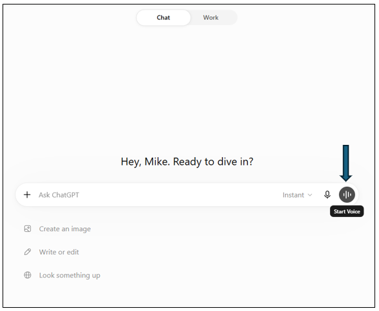
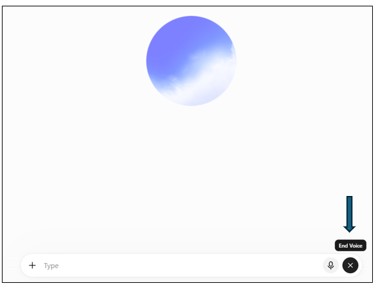
Before assigning the first speaking task, I used class time as a working lab session, and reviewed with students how to access the ChatGPT Voice mode, where they could use either their phones or laptops. For those reading this who have never used this mode, it is quite simple to initiate. Here are some brief tips; By pressing the Voice Mode button (see Picture 1) a blue sphere will appear indicating that the Voice Mode is activated. Now a user can begin speaking to the chatbot, similarly to how one would type a prompt. To stop the conversation, simply press the X (see Picture 2), and doing so will save the conversation transcript, which is provided only after the conversation has been stopped. You can continue interacting with the bot in the same saved chat both by either typing a new prompt or relaunching Voice Mode.
In this initial training session, students were able to adjust their settings to select the “Voice” they wanted to interact with. ChatGPT offers nine voices (See Picture 3), all with different accents and genders, and selecting one can be done through the account settings.
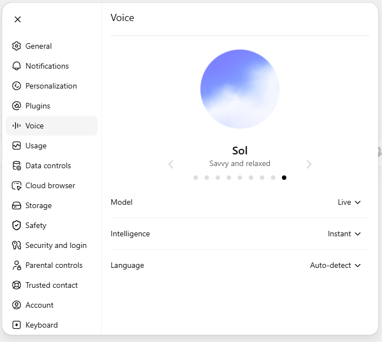
While the voice options varied in their accents; for instance “Sol” (Picture 3), who has a “savvy and relaxed voice,” each spoke a standard high German, which was auto-detected by ChatGPT, and it spoke clearly and coherently. German is one of 72 different languages that this AI can detect, making this tool appealing for a variety of language instructors.
I felt that having students select their choice of voice would help make it more of an authentic interaction, like with a friend or tutor. Once this step was completed, students then were required to initiate a conversation with the ChatGPT Voice about any topic they wished, so that they could get a sense of the flow of the conversation, work on their prompt, and direct the chatbot to make any adjustments to make the conversation as fluid as possible, including directing it to either slow down or to provide more or less information in its responses. After completing this step, students were then directed to complete some research for their first essay topic, which focused on a German-speaking location such as a city or region. They were required to prepare three to four questions and to then chat with the bot, asking it to function as a local tour guide of their location, asking for recommendations and descriptions of landmarks, cultural events, or local cuisine. Students were also instructed to ask it to offer suggestions and corrections as a way to rate their use of German, and to adapt to their pace and ability, encouraging them with their German along the way. Finally, students were required to save a text copy of the transcript provided after their conversation and upload it to the course LMS.
Results of ChatGPT Voice Mode Integration
This first conversation task led to some positive results that provided me with a good understanding of the potential of integrating this type of exercise. Students were able to ask the bot multiple questions, some as many as 16, which indicated it could allow students additional practice speaking outside of the classroom meetings. The chatbot provided students with a plethora of information and background on German-speaking locations, which helped them better frame their essay responses. Finally, the AI challenged students to think and respond quickly.
While there were positive experiences from this task, it should also be noted that some challenges existed. For instance, some students’ conversations were relatively short, with some not extending beyond two or three questions. Some students also stated that they ran out of free monthly minutes and were unable to completely fulfill the task, a downside of using the free version. Some of the AI’s responses were quite challenging, where students claimed the length of the response was simply too long that they lost track during the conversation, that the vocabulary and context of the AI responses led to either confusion or difficulty remaining on track to complete the next step of the exercise. And some students said that the AI had difficulty understanding students or replied with a hallucination, where the bot responded with inaccurate information (Finio and Downie, 2021).
The exchange in Picture 4 below highlights one instance of a complicated dialogue, where “S3” indicates the student:
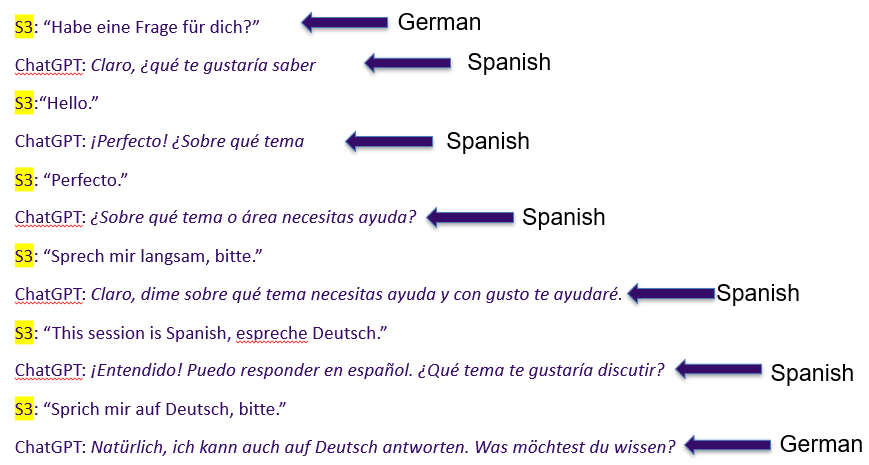
Based on this exchange, the student attempted several times in German to initiate a conversation, while the chatbot responded in Spanish. It was not until the sixth attempt that the bot responded in German. While this was an unexpected challenge, which led to some frustration on the student’s part, it could be argued that this was also a successful exchange, one that represents the difficulty one must occasionally overcome communicating in the target language. The student struggled to get the bot to understand her, but it shows how she persevered and ultimately “won over” the bot, eventually getting it to understand her willingness to converse in German. This student in particular explained that while reading comprehension and writing ability were her stronger and preferred modes of communication, her spoken German is something she struggled with. I believe this represents a very realistic episode in language acquisition, and can be seen as a victory in overcoming a difficult situation finding common ground in spoken communication. It also represents a good learning lesson in designing such a task in a language course, one that may require additional training of the obstacles students and educators may face when dealing with this type of technology.
Having experienced this in the first assignment allowed me to adjust future tasks using ChatGPT in order to get the most out of the student exchanges. There were some interesting takeaways from the first exercises that are worth noting. The students mostly had questions prepared ahead of time versus having prepared a more defined prompt with more clearly defined guidelines for the chat bot. Students experienced that simply asking questions versus framing a more carefully designed prompt led to the AI to provide a large amount of output in its responses rather than a more natural dialogue. While some students experienced information dump from AI, others were able to establish a dialogue and answer several questions.
This led me to pivot my approach and work more closely with the students in preparation for the subsequent ChatGPT Voice tasks. To work around these obstacles, I consulted ChatGPT on how to better approach the next rounds of conversations, and the tool provided some useful advice. ChatGPT offered suggestions to “reduce friction” for students when beginning such tasks. To accomplish this, I helped the students frame their prompts with specific templates used to “plug-and-play”, and to add scaffolding, per the chatbot’s recommendations. These included specifying to the bot that the students wanted to “interview you” (the chatbot) and that ChatGPT should do the following: speak only in German, unless providing feedback after a response, to not speak very quickly, to adjust its answers, for instance, to “provide short answers”, and to direct the bot to “ask questions in return.” Prior to students beginning their final ChatGPT Voice task, which was about music in the German-speaking world, I used these recommendations to prepare individual sessions with my students, where I met with each of them in order to observe their interaction with the bot and to assist them in navigating any difficult scenario.
Each meeting lasted roughly 15 minutes and I reviewed this new approach with each student, providing them with a template of material to use for their interaction with ChatGPT, which included the following steps:
- Ich bin Student/Studentin …und möchte über Musik in Deutschland / deutsche Musik sprechen. Was kannst du mir erzählen? (I am a student …and would like to talk about music in Germany / German music. What can you tell me?).
- I then instructed students that if the AI defaults to English, they should simply say or copy/paste the following: Sprich nur Deutsch mit mir / Sprich langsam / Gib mir kurze Antworten / Frage mich über das Thema (Only speak German with me / Speak slowly / Give me short answers / Ask me questions about the topic)
- Do 3-4 mini conversations about this topic (aim for up to 2-3 minutes each), where each is completed one after the other instead of one long discussion.
- Consider what you want to accomplish with this topic and think of your main and sub topics
- Introduction / background of musician (school)
- Main – overview of career (albums, songs, tours, solo or band(s), and influences)
- Conclusion – where are they now and where is their career going
- Five Question Challenge
- Ask ChatGPT 5 questions about your topic (Peter Fox, Falco, Nena, etc) and try to get ChatGPT to answer these and ask you 5 questions.
- Ask ChatGPT 5 questions about your topic (Peter Fox, Falco, Nena, etc) and try to get ChatGPT to answer these and ask you 5 questions.
- Lastly, students were to try to keep the conversation alive for up to 2-3 minutes (or longer!!).
Fortunately, the class size of nine students allowed me to have individual sessions and share this information with them for the first time, which was a valuable experience for me to assist and observe their voice sessions and witness how each approached interacting with the chatbot.
Each student had done some preliminary work ahead of these tasks, so they already had an idea of the topic. As expected, a few struggled and felt intimidated by the immediateness of the chatbot’s response. Even when these instances started with a confident prompt, the quickness in the bot’s response led the students to feel panicked, which led them to almost force a response. When this happened I asked them to pause the conversation, take a moment to gather their thoughts, and try it again from where they left off.
Conversely, several excelled and were able to have several-minute long dialogues about their topic, some lasting five to seven minutes. This led with a good introductory prompt, followed by several questions from the bot which they were able to answer as naturally as possible and without any prepared notes on the spot.
Conclusion and Discussion
My goal with these individual sessions – as well as those assigned over the semester – was to get a better sense of how each approached their interaction with the chatbot, and to encourage them to become comfortable being in a situation where they had to think more spontaneously and adapt to the language. I had taught the majority of these students in previous semesters, so they were accustomed to the German that I speak. Being put into a scenario to speak in a natural context with a different “native” speaker – even if it is a machine – can be daunting, so I wanted them to witness how they could successfully navigate such an experience and to hopefully gain the confidence needed to speak in a foreign language.
At the conclusion of the semester I administered a survey to the nine student participants, and while this sample size is quite small, the data still provided me with a better understanding of how students perceived using the ChatGPT Voice mode.
Nearly half of the students indicated their experience was somewhat positive, with one rating it as extremely positive. Conversely, two of the participants rated their experience as somewhat negative, with the remaining two rating it as neither positive nor negative. One interesting result was that four of the nine students had never taken a course that had integrated the use of AI, one of whom consistently expressed her dislike for it as “it is not human, and not normal to be interacting with a robot.” The same student also shared her “environmental concerns and feeling guilty” for using AI. Despite her criticism for using AI, which I found helpful, those who responded positively revealed how such a tool can have an impact on their learning a second language. Nearly all students (89%) indicated using ChatGPT Voice had a positive effect on improving their overall language skills.
Their testimonies. I believe, provide a clearer image on the potential of using Voice mode in a language course:
“ChatGPT Voice made me more aware of my pronunciation.”
“It was nice to be able to talk to someone in German without the pressure.”
“It’s nice being able to use ChatGPT Voice to actually speak German one-on-one without needing to go through the trouble of finding a real native German speaker.”
These results align with the survey, mentioned in the introduction, that our department conducted in the spring of 2024, when we implemented a pilot project on the use of AI on student learning. In that semester, 10 sections from our department (eight Spanish, one Italian, and one German) integrated AI, mostly ChatGPT, to assist with writing and to serve as a language tutor. Of 124 participants, nearly 70% rated their overall experience as either extremely positive or as somewhat positive.
Both studies show that ChatGPT Voice (and AI) can have an overall positive impact on students’ language communication skills. In addition to utilizing such tools to leverage practice in the target language, students also had the opportunity to improve their skills, learning how to best navigate AI. This aligns with Alharbi (2023) who encourages students and educators to enhance their digital literacy, and that second language learners and instructors need to be aware of the potential AI tools offer. During this course, students practiced interacting with ChatGPT Voice Mode, which accomplished the main goal of the course, to improve their German. Moreover, students also gained valuable experience enhancing their prompting, as well as making adjustments with how they interacted with their chatbot, getting it to do what they wanted, as we saw in the dialogue of my student’s interaction with ChatGPT Voice in Picture 4 above. During this course, I was able to witness students’ development in these areas, as well as improve my own interaction with ChatGPT. As mentioned previously, I consulted with ChatGPT to assist with adjusting my approach throughout the course of the semester. While I could have approached a colleague, be it a technology or pedagogical specialist, who just as well would have offered salient advice on how to best proceed, choosing to consult ChatGPT was more out of curiosity to see what the chatbot would suggest. Its advice turned out to be quite helpful and it shows the range of what AI is capable of doing. The experiences I learned from this current study will allow me to design future courses that integrate AI in a more careful manner, where I can implement the proper training and guidelines from the very start, so that students and I can leverage the use of AI to its maximum potential. It will be advantageous to continue using such tools into language courses and to measure their effects on student learning.
References
Alharbi, W., AI in the foreign language classroom: A pedagogical overview of automated writing assistance tools, Education Research International, 2023, 4253331, 15 pages, 2023. https://doi.org/10.1155/2023/4253331
Finio, M. & Downie, A., Chatbots, defined (2021). https://www.ibm.com/think/topics/chatbots
Kusumo Hadi Santoso, M. Saunan Al Faruq, Karisma Kurniawati, Sabar, Salila Prasidya Hidayati, & Yoon Mee Mee Aung. (2025). Leveraging ChatGPT’s advanced voice mode for enhancing oral-aural skills in higher education language learning: A mixed-methods study. Improvement: Jurnal Ilmiah Untuk Peningkatan Mutu Manajemen Pendidikan, 12(2). https://doi.org/10.21009/improvement.v12i2.62614
Wu, R., & Yu, Z. (2024). Do AI chatbots improve students learning outcomes? Evidence from a meta-analysis. British Journal of Educational Technology, 55, 10–33. https://doi.org/10.1111/bjet.13334
AI disclosure: Moderate use of AI: During the preparation of this article, the author(s) used ChatGPT to generate some sections of text. After using this tool, the author(s) reviewed and edited the content as needed and take(s) full responsibility for the content of the article.
I’m really intrigued by how ChatGPT Voice can enhance German conversation skills! How does it adapt to different accents? Also, do you think it’s more effective than traditional methods?
I’ve been curious about using ChatGPT with voice, and this was an interesting read. Being able to have a more natural back-and-forth conversation seems especially useful when you’re practicing speaking or brainstorming ideas. I’d definitely like to give the voice feature a try!