
Cheating With AI? If You’re Serious About Language Learning, Sure!
By Richard Robin, George Washington University

DOI: https://www.doi.org/10.69732/FTHK2466
In fall 2022, teachers across the globe woke up in a cold sweat to the debut of ChatGPT: this was the end of essay-writing, the death knell for homework, a stake in the heart of critical thinking, and a mortal wound for academic integrity (Blose, 2023; Colby, 2023; Shaw & Yuan, 2023; Smouh, Belahyane et al., 2024; Alm & Ohashi, 2024; Angehr & Bloem, et al., 2026; Watson & Rainie, 2026). Prohibitions on the use of AI soon followed: even at the end of 2025, we were told “at least 84% of faculty agree that AI makes students overly dependent on technology for basic tasks as well as reduces students’ development of critical thinking abilities, ability to express original ideas, and level of engagement with course material” (Angehr, Bloem, et al., 2026). Many of the instruments in the language teacher’s toolbox became useless in an instant. Under threat were a panoply of assignment types, from mechanical cloze exercises to the most creative template-based activities. Even before the arrival of predictive text in 2022, the same large-language models (LLMs) fueled free translation/transcription bots that made mincemeat of translation exercises and recorded dictations. YouTube’s autogenerated captions put a dent into home-based listening comprehension assignments. Today, voice-cloning allows students to sound perfect on any home-based oral assignment that is not tightly controlled. The remaining traditional language-learning assignments are limited to classroom production: oral assignments such as memorized dialogs and role-plays as well as writing done during class time. For anything else, teachers are forced to turn to threats of charges of academic dishonesty.
The Language Learning Enthusiast
For enthusiastic (and effective) language learners, however, the notion of academic dishonesty in pursuit of language acquisition is irrelevant. Language enthusiasts are casual plagiarizers. They notice a new word or phrase and add it to their repertoire. What once belonged to a native speaker is now theirs. When they want to express an idea, they search their repertoire of stolen expressions to see what they can make use of. Less effective language learners determine first what they want to convey and then try to put that message together from scratch. Both kinds of language learners might turn to AI, whether in the form of a translation bot or a text generator to produce output. But weaker language learners do so only to get the assignment done. And if the assignment goes beyond mechanical manipulation, the use of AI is obvious from the first sentence. Such shenanigans help no one and are easily defeated. The instructor has only to tell students that anything they turn in is subject to a live replication test in a face-to-face setting, whereby the student is required to reproduce something that resembles a paragraph from the work that was submitted, perhaps using an English retranslation of what they wrote.
Such practices reward the diligent language learner and go beyond more cautious suggestions about the use of AI in support of a flipped classroom (Panagiotidis & Sampson, 2023) or reliance on translation bots as training wheels for composition. Even before the appearance of ChatGPT, research on the student use of translation bots provided some grounds for their use. In their summary of the research on the use of translation bots, Jolley and Maimone (2022) reported that while over 80% of L2 students turned to translation bots to help with words and phrases and with paragraph construction, few used online translators for an entire composition. In one cited study, Kol, et al. (2018), the use of Google Translate resulted in richer vocabulary profiles. On the other hand, O’Neill (2019) examined the compositions of students of French and Spanish who were trained to use machine translation. Their MT-supported writing was better than those who used MT and received no training. But the use of MT did not result in better writing once the online translation crutch was withdrawn.
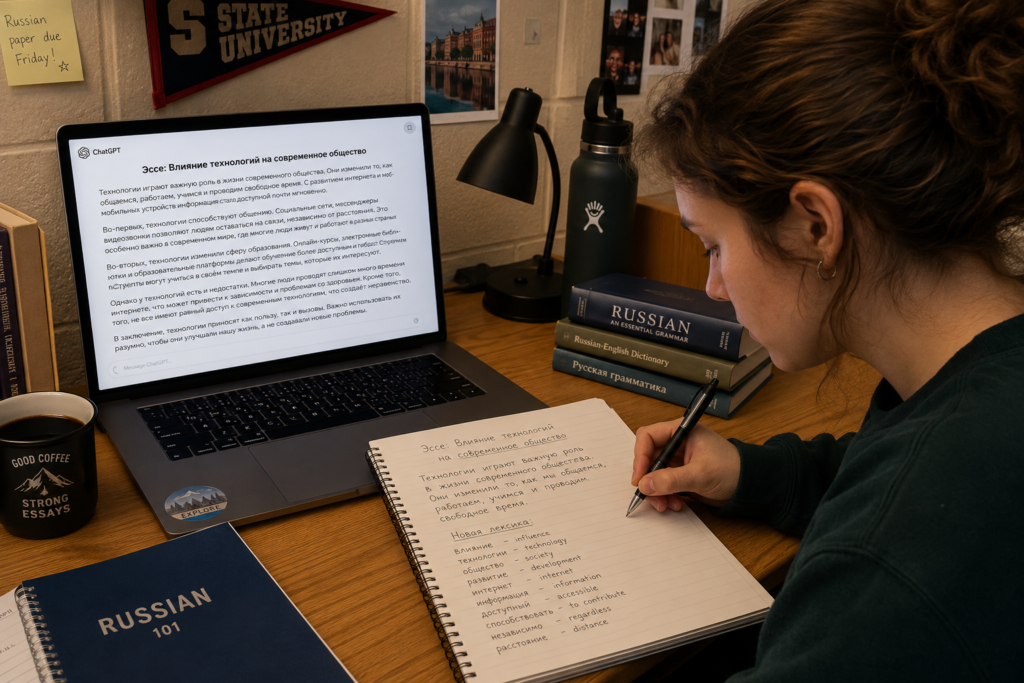
Like their less talented peers, strong language learners want to produce a well written composition. But their metalinguistic knowledge helps them “fool” the teacher. They know that without modification the text they import from AI will look out of place for their level of writing proficiency and they take the necessary measures. They can start by telling AI to write in simple prose. They must edit the initial AI product attentively, stripping out “unbelievable” sections of a passage — deleting not only unfamiliar vocabulary and set expressions but also native-like syntax that students might recognize but not readily produce themselves, e.g. the switch between SVO and OSV in a language that accepts both. Students will also have to add some original language to add the final touch of credibility.
The learning is in the editing. Efficient language learners are noticers (Schmidt, 1990). The familiar language that they kept from AI is reinforced for active use. Much of the unfamiliar language — the material that ended up on the cutting room floor — is likely to be retained, because by cutting it, the student has made it salient. Some of that salient material will be easily chunked as reusable formulaic expressions, a valuable tool on the path to fluency (Pawley & Syder, 1983; Lewis, 1993, pp. 19-20; Boers, Eyckmans et al., 2006; Conklin & Schmitt, 2012).
Requiring students to re-present that potential language acquisition in handwriting as a condition for the final assignment holds some promise of reinforcement. The act of rendering communication by hand has been shown to promote retention. (Mueller & Oppenheimer, 2014; Mangen, Anda et al., 2015; Ihara A.S., Nakajima, 2021; Lee, B., 2021; Wiley & Rapp, 2021; Van der Weel F.R.R & Van der Meer A.L.H., 2024; Marano, Kotzalidis et al., 2025). Such a student has nothing to fear from the threat of an in-office rewrite.
Finally, once students are required to master any language output they get from AI, they will quickly learn to pace themselves for the amount of AI they use.
Concrete Assignments
If language teachers accept the concept outlined above, we can make some modifications to ensure that those who use AI “ethically” (i.e. in a realistic attempt to fool the teacher) get the most for their efforts.
Assignment: Write a review of your favorite movie or TV series. You must turn in a handwritten copy. You may use translation bots or predictive AI as you see fit. This is not a research paper. You do not have to be candid about your sources. You may also lift language from online reviews about the movie or series. In short, in this class, and for this assignment you are allowed (even encouraged!) to plagiarize. (Please don’t generalize this to your other classes!) Here’s the catch: after you have handed in your work, you are expected to be able to reproduce what you wrote, either in class or during office hours, in handwriting, and without access to any other aids, including hardcopy dictionaries. As your instructor, I also reserve the right to ask you about the lexical and grammatical content of your writing, like “Why did you use this form of the verb here?”
Though our students are understandably sensitive to being accused of using AI, in this situation the teacher explains everything up front, saying something like: “In this class, I will encourage you — yes, not just approve — but encourage you to use AI to complete assignments. I will never consider it cheating. Nor, for the purposes of this class, is it cheating to lift someone else’s words, whether from your Russian friend or Alexander Pushkin, and drop them into a composition. But — and this is a huge “but” — conditions apply, and you will be held to them strictly. (1) Whatever you yourself did not author must become part of your active language repertoire. I will test for that constantly. (2) You own what you take; you cannot blame the AI (or your Russian friend). (3) There are tricks for getting to the sweet spot where both AI and “educational plagiarism” provide language gains. We will now talk about some of those tricks. But before we do, I must promise you: properly used AI is not a shortcut; if you use AI properly, you will be spending more time doing your assignments, not less. If you struggle to master a new language, you should probably talk to me before turning to AI to map out strategies that match your learning style. And one more thing: the rules for this class have to do with certain language-learning strategies. They do not apply to any other academic pursuits!”
Students who feel confident about writing from scratch could try a more challenging approach: an independently written passage submitted to AI for grammatical and stylistic correction. Students can also query the AI on the reasons for suggested changes.
Assignment: In any text editor, write a review of your favorite movie or TV series. Avoid AI and translation bots. Limit yourself to your text editor’s most primitive tools: spelling and grammar (which in Word and Google Docs mostly means punctuation and capitalization, not endings). Then ask any AI platform to correct your writing for grammar and style. Afterwards, accept or reject the AI suggestions. But be aware that any AI suggestions that you include must become part of your active vocabulary and are subject to testing. But before you reject an AI suggestion, ask the AI if your alternative is at least grammatically intact and to what extent your alternative sounds natively Russian.
Of course, students must specify the target style — from the simplest expository prose to conversational narrative to “college writing.” But for most undergraduate writing, students can provide a generic prompt: Please check the following Russian passage for spelling and grammar mistakes as well as stylistic and idiomatic problems. All of the current popular AI platforms will return a corrected passage and detailed commentary on every change, including to what extent the suggested changes are merely suggestions.
Workload Management: Debriefings
Obviously, such a set-up is easy to manage in smaller classes, such as an advanced course in a less-commonly taught language. However, even in large language classes numbering in the twenties, an audit of ten dubious submissions is likely to serve as a deterrent to the unproductive use of AI. To ensure that students take such a novel set-up seriously, instructors could make the first written homework assignment fairly short so that they could reasonably review everyone’s submission, followed by a class session or office hours to individual debriefings. Students would come to see the debriefings not just as testing, but also as think-alouds.
This kind of acquisition through copying has no small amount of precedent, beyond the mim-mem of the earliest stages of language learning, reflected in devices such as dialog memorization, recital, and sentence manipulation. Shekhtman and Leaver (2002, pp. 134-137) describe the final stages of the approach to take learners to higher levels of language complication as they increase their proficiency to professional levels. In one exercise, students produce a paragraph in their best attempt at professional speech, then hear the instructor rephrase the paragraph in a native-like professional description. The students’ task is to repeat verbatim as much of the paragraph as possible.
AI-aided Outcomes for Various Types of Writing
The use of AI in writing has potential positive language-wide outcomes: (1) an earlier introduction to authentic writing and (2) the expansion of writing as an organizer for paragraphed orality.
Authentic writing. First off, “authentic” does not mean human-produced as opposed to AI, but rather writing for the purposes of written communication, not as an activity to promote some other aspect of language acquisition, as is the case with morphosyntactical manipulation (e.g. “Write sentences that answer the question negatively.”). In the early and intermediate stages of language learning, the authenticity of written assignments is a bit dodgy. Some common “real” writing tasks designed for the language classroom don’t hold up to reality, especially communication between friends (e.g. Write a note to a friend about postponing a meeting. That would in fact be a text message, probably automatically translated on the phone). Other authentic writing assignments include texts from various genres: e-mail queries, advertisements, announcements, etc. Such assignments might be considered low-stakes in terms of grades, but in the real world, these are socially high-stakes events: an “authentic” advertisement on a website full of errors, both non-native, e.g. the misuse of articles, and native, such as homographically based misspellings: their, they’re, there. Here AI helps to mitigate such mistakes.
Writing as an organizer for paragraphed speech. The bulk of “inauthentic” student composition can be viewed this way. For example, writing about one’s favorite movie is excellent preparation for talking to an audience about the same topic. It is precisely in this context that AI shines. Students use AI to produce the original written text to be edited as described above. There is no need to wait for massive corrections from the teacher. Instead, students can be expected to immediately work on an oral presentation based on the written text. In fact, students can be required to prompt the AI platform for a second version of the text with appropriate oral discourse markers. In paragraphed speech, discourse markers, which beginners (and linguistic non-noticers) perceive as unnecessary for fundamental communication, often show up late (Hellermann & Vergun, 2007; Fung & Carter, 2007). AI suggestions can help speed them up and dovetail well with the noticing we find in expert learners.
Beyond Writing
Language enthusiasts can already embrace AI for other language acquisition activities. The most obvious of these is chatting with an AI in the target language. Google Translate has now incorporated a free primitive conversation partner, but users can have more authentic conversations with the major AI platforms, albeit with limited engagement in the free tiers. But AI in the service of language-learning enthusiasts is available in more esoteric forms:
Accent diagnosis. AI will listen to a text to diagnose phonetic errors. This feature is now in development for Google Translate. But even before its general debut, learners can prompt AI platforms for a sample TL text to record and upload. The AI will listen and give detailed feedback. My own limited observations of Gemini’s analysis of non-native phonetics in Russian and Spanish is that at the moment, the feedback is accurate for heavy accents but somewhat hallucinatory for near-native accents.
Recommendations for extended input. Enthusiastic language learners understand the importance of large amounts of input that is both engaging and comprehensible. Our textbooks are full of comprehensible material whose level of engagement can only be guessed at. A favorite staple for reading is the area studies passage: perhaps a biography of the Brothers Grimm in a German textbook, or of Eva Peron for Spanish, or a history of the Moscow metro for Russian. Such input might align with the instructional goal of integrating the TL with its surrounding culture and history. But that is no guarantee that any particular passage will engage any given student. Before AI, online searches for useful material was a matter of trial and error. AI can pinpoint appropriate input by modality, proficiency level, and the students’ individual interest. Or it can simply create the text from scratch. That possibility accelerates the timing of one of the first breakthroughs in mastering a new language: the moment that the student acquires new real-world knowledge not necessarily related to the target culture, from a TL source that was not assigned for class.
Once interesting input is found, AI can further map input to comprehension through devices such as:
- Instant scaffolding. AI can analyze a print passage or a YouTube video and compose pre- and post-text activities. (Of course, it can be argued that proficient language learners don’t need the scaffolding; they provide their own.)
- AI summaries. Background knowledge and predictability are the two fundamental pillars of comprehension. AI insists on giving us spoilers for almost everything we read on a screen. It would be foolish not to let L2 students use summaries as their main advance organizer. Obviously, if students limit their efforts to TL;DR synopses and skip the text entirely, they defeat the purpose of pedagogically planned advance organizers. Nor do they benefit from post-text scaffolding, whose purpose is what we could call forced noticing.
- Modality shifts — the exchange or addition of written and spoken text. SLA researchers have suggested that captions as scaffolding could undermine the development of unscaffolded L2 listening comprehension skills. (Diao, Chandler et al., 2007; Korucu-Kış, 2021). But recent research suggests that bimodal input (e.g. audio + TL captions) has distinct benefits, especially in low-intermediate learners. Karabıyık, Arslan et al. (2022) found bimodal input reduced the perception of listening comprehension difficulty without damaging listening comprehension skills. Numerous studies confirm that such bimodal presentation — captions or screen tips — enhances vocabulary retention (Brown et al., 2008; Webb & Chang, 2015; Teng, 2016; Malone, 2018; Chen, 2021, Vu & Peters, 2022; Montero-Perez & Pattemore, 2025). AI now allows modality shifts in two directions. We can get AI to read texts aloud at almost any rate of delivery. In the opposite direction, AI can provide captions where none were available (a rapidly shrinking number). Of course, auto-generated captions are clunky and sometimes incomplete or inaccurate. Such choppiness can be a dealbreaker for the non-language learner interested only in the content. But it’s a good crutch for someone who already understands large parts of the script.
AI Means More Work, Not Less
It is to be emphasized that the use of AI in concert with the philosophy outlined above is no shortcut to proficiency gains. These suggestions hold promise for the opposite reason: they are meant to increase, and not decrease, time on task, both in quantity (greater input that students can be actively engaged with) and quality (better output, for example, in compositions, so as to expand repertoire). Another way of examining this is to ask which is better: for a student to write a composition from scratch, much of which is likely to be gibberish, or to expect an unoriginal piece which students are now required to mine to expand their active repertoire? That question goes to the essence of second language acquisition, differentiating it as a skill from most other disciplines that require a different kind of reflective thinking.
Why Target the Talented?
At this point, some readers are sure to ask if it is appropriate to divide a group of learners into haves and have-nots based on the language learning readiness they bring to the classroom. Indeed, the idea that we should aim our teaching towards the best students runs counter to current instructional trends, which emphasize the learner at risk and the desirability of a compassionate classroom. In short, we are urged to direct our efforts to the very students who would most likely turn to AI shortcuts — not to learn more efficiently, but to get the assignment done. But those are not the language learners of tomorrow’s classrooms; the language learning enthusiasts are. The same AI that scares teachers today will in the not-so-distant future curtail the entire enterprise of classroom language acquisition. Formal language instruction is sure to take the same path followed by music instruction at the beginning of the twentieth century. Before that, pianos were a fixture in middle-class households. Those who wanted to make music outside a concert hall had to make it themselves. Children across the country learned piano, regardless of musical talent. The technology of the early twentieth century narrowed the audience for piano instruction to “enthusiasts.” These were not young people who planned a career in music but rather those who were willing (or forced by their parents) to go beyond the phonograph and radio and learn to play an instrument. John Philip Sousa feared for the future of music instruction (Thompson, 2016); proponents of the phonograph as a device for the promotion of music education argued that the new technology would bring music to the masses and promote music appreciation (Symes, 2004). In other words, more people would be motivated to take up music. So it will be with language study. Our future classrooms will be sparser but filled with “enthusiasts.” For those enthusiasts AI will be a powerful teacher.
References
Alm, A. & Ohashi, L. (2024). A worldwide study on language educators’ initial response to ChatGPT. Technology in Language Teaching & Learning 6(1):1-23. https://doi.org/10.29140/tltl.v6n1.1141
Angehr, E., Bloem, M., Howell, J., Radford, A.W. (2026). College faculty perceptions of generative artificial intelligence in higher education College Board research. https://research.collegeboard.org/media/pdf/airesearchbrief3_vf.pdf
Blose, A. (2023). As ChatGPT enters the classroom, teachers weigh pros and cons. NEA News, NEA Today. https://www.nea.org/nea-today/all-news-articles/chatgpt-enters-classroom-teachers-weigh-pros-and-cons
Boers, F., Eyckmans, J., Kappel, J., Stengers, H., & Demecheleer, M. (2006).
Formulaic sequences and perceived oral proficiency: Putting a lexical approach to the test. Language Teaching Research, 10(3), 245–261.
Brown, R., Waring, B., & Donkaewbua, S. (2008). Incidental vocabulary acquisition from reading, reading-while-listening, and listening to stories. Reading in a Foreign Language, 20, 136–163. http://hdl.handle.net/10125/66816
Chen, Y. (2021). Comparing incidental vocabulary learning from reading-only and reading-while-listening. System, 97, 102442. https://doi.org/10.1016/j.system.2020.102442
Colby, E. (2023). Generative AI already being used in majority of college classrooms, according to new Wiley report. John Wiley & Sons. https://johnwiley2020news.q4web.com/press-releases/press-release-details/2023/Generative-AI-Already-Being-Used-in-Majority-of-College-Classrooms-According-to-Instructors-in-New-Wiley-Survey/default.aspx
Conklin, K., & Schmitt, N. (2012). The processing of formulaic language. Annual Review of Applied Linguistics, 32, 45–61.
Diao, Y, Chandler, P., Sweller, J. (2007). The effect of written text on comprehension of spoken English as a foreign language. The American Journal of Psychology 120(2), pp. 237–261. https://doi.org/10.2307/20445397
Fung, L., & Carter, R. (2007). Discourse markers and spoken English: Native and learner use in pedagogic settings. Applied Linguistics, 28(3), 410–439. https://doi.org/10.1093/applin/amm030
Hellermann, J., & Vergun, A. (2007). Language which is not taught: The discourse marker use of beginning adult learners of English. Journal of Pragmatics, 39(1), 157–179. https://doi.org/10.1016/j.pragma.2006.04.008
Ihara A.S., Nakajima K., Kake A., Ishimaru K., Osugi K. and Naruse Y. (2021) Advantage of handwriting over typing on learning words: Evidence rrom an N400 event-related potential index. Front. Hum. Neurosci. 15:679191. doi: 10.3389/fnhum.2021.679191
Jolley J. & Maimone L. (2022). Thirty years of machine translation in language teaching and learning: A review of the literature. L2 Journal, 14(1), pp. 26-44. http://repositories.cdlib.org/uccllt/l2/vol14/iss1/art2
Karabıyık, C., Arslan, S., Ulutaş, N.K. (2022). Comparison of input modes: L2 comprehension and cognitive load. Participatory Educational Research (PER) 9(6), pp. 173-191, November. http://dx.doi.org/10.17275/per.22.134.9.6
Kol, S., Schcolnik, M., & Spector-Cohen, E. (2018). Google Translate in academic writing courses? The EuroCALL Review 26(2), 50-57, cited in Jolly and Maimone (2018).
Korucu-Kış, S. (2021). On the effectiveness and limitations of captioning in L2 listening. International Journal of Modern Education Studies. 5., pp. 497-516. 0.51383/ijonmes.2021.153
Lee, B. (2021). Comparing factual recall of tapped vs. handwritten text. Acta Psychologica 212. https://doi.org/10.1016/j.actpsy.2020.103221
Lewis, M. (1993). The lexical approach: The state of ELT and a way forward. Language Teaching Publications. https://www.scribd.com/document/482737921/Lewis-Michael-the-lexical-approach
Mangen, A., Anda, L. G., Oxborough, G. H., & Brřnnick, K. (2015). Handwriting versus keyboard writing: Effect on word recall. Journal of Writing Research, 7(2), 227-247. https://doi.org/10.17239/jowr-2015.07.02.1
Marano, G., Kotzalidis, G. D., Lisci, F. M., Anesini, M. B., Rossi, S., Barbonetti, S., Cangini, A., Ronsisvalle, A., Artuso, L., Falsini, C., Caso, R., Mandracchia, G., Brisi, C., Traversi, G., Mazza, O., Pola, R., Sani, G., Mercuri, E. M., Gaetani, E., & Mazza, M. (2025). The neuroscience behind writing: Handwriting vs. typing-who wins the battle?. Life (Basel, Switzerland), 15(3), 345. https://doi.org/10.3390/life15030345
Montero-Perez, M and Pattemore, A. (2025). Effects of captioned video on L2 speech segmentation in intermediate learners of Spanish. Language Learning & Technology 29(3), pp. 205-225. https://www.lltjournal.org/item/10125-73653
Mueller P. A. & Oppenheimer D. M. (2014). The pen is mightier than the keyboard: advantages of longhand over laptop note taking. Psychol. Sci. 25 1159–1168. https://doi.org/10.1177/0956797614524581
O’Neill, E. (2019). Training students to use online translators and dictionaries: The impact on second language writing scores. International Journal of Research Studies in Language Learning, 8(2), pp. 47-65. https://www.researchgate.net/publication/334430744_Training_students_to_use_online_translators_and_dictionaries_The_impact_on_second_language_writing_scores/link/5d6e831e45851542789f2f05/download?_tp=eyJjb250ZXh0Ijp7ImZpcnN0UGFnZSI6InB1YmxpY2F0aW9uIiwicGFnZSI6InB1YmxpY2F0aW9uIn19
Panagiotidis, C., & Sampson, D. G. (2023). Teachers’ attitudes towards AI integration in foreign language learning: Supporting differentiated instruction and flipped classroom. Research Papers in Language Teaching and Learning, 14(1), 89–110.
Pawley, A., & Syder, F. H. (1983). Two puzzles for linguistic theory: Nativelike selection and nativelike fluency. In J.C. Richards & R.W. Schmidt (Eds.), Language and Communication, pp. 191–226. Longman.
Schmidt, R. (1990). The role of consciousness in second language learning. Applied Linguistics. 11(2), pp. 129–158. doi:10.1093/applin/11.2.129. S2CID 16247450
Shaw, C., Yuan, L., Brennan, D., Martin, S., Janson, N., Fox, K., & Bryant, G. (2023). Generative AI in higher education. Tyton Partners. tytonpartners.com/time-for-class-2023/GenAI-Update.
Shekhtman B., Leaver, B. L. et al. (2002). Developing professional-level oral proficiency: The Shekhtman method of communicative geaching. In Shekhtman B., Leaver, B. L. (Eds.) Developing Professional-Level Language Proficiency., pp. 119-140. ProQuest Ebook Central
Smouh, Z., Belahyane, I., Aarab, A., & Ikkou, L. (2024). Perceptions of higher education faculty on ChatGPT: An empirical analysis. International Journal of Innovative Science and Research Technology, 9(11), 1230–1237.
Symes, C. (2004). A sound education: the gramophone and the classroom in the United Kingdom and the United States, 1920–1940. B. J. Music Ed. 21(2), pp. 163–178.
Teng, F. (2016). Incidental vocabulary acquisition from reading-only and reading-while-listening: A multi-dimensional approach. Innovation in Language Learning and Teaching, 12, 1–15. https://doi.org/10.1080/17501229.2016.1203328
Thompson, C. (2016). How the phonograph changed music forever. Smithsonian Magazine, January. https://www.smithsonianmag.com/arts-culture/phonograph-changed-music-forever-180957677
Van der Weel F.R.R & Van der Meer A.L.H. (2024). Handwriting but not typewriting leads to widespread brain connectivity: a high-density EEG study with implications for the classroom. Front. Psychol. 14:1219945. https://research.collegeboard.org/media/pdf/airesearchbrief3_vf.pdf
Vu, D. V., & Peters, E. (2022). Learning vocabulary from reading-only, reading-while-listening, and reading with textual input enhancement: Insights from Vietnamese EFL learners. RELC Journal 53, 85–100. https://doi.org/10.1177/003368822091148
Watson, C.E. & Rainie, L. (2026). The AI challenge: How college faculty assess the present and future of higher education in the age of AI. The American Association of Colleges and Universities. https://dgmg81phhvh63.cloudfront.net/content/user-photos/Research/PDFs/AI_Challenge.pdf
Webb, S., & Chang, A. (2012). Vocabulary learning through assisted and unassisted repeated reading. The Canadian Modern Language Review, 68, 276–290. https://doi.org/10.3138/cmlr.1204.1
Wiley, R. W., & Rapp, B. (2021). The effects of handwriting experience on literacy Learning. Psychological science, 32(7), 1086–1103. https://doi.org/10.1177/0956797621993111
AI disclosure: Beyond Word’s spellchecker, I used no AI in the composition of the article — not to plan, organize, compose, or revise. I consulted AI platforms in search of relevant source materials, all of which I verified by reading the originals, either directly from the source site or, in most cases, as direct downloads.