
Lessons from a Year with Speakology AI in the Language Classroom
By Sarab Al Ani, Yale University

DOI: https://www.doi.org/10.69732/SFZP9372
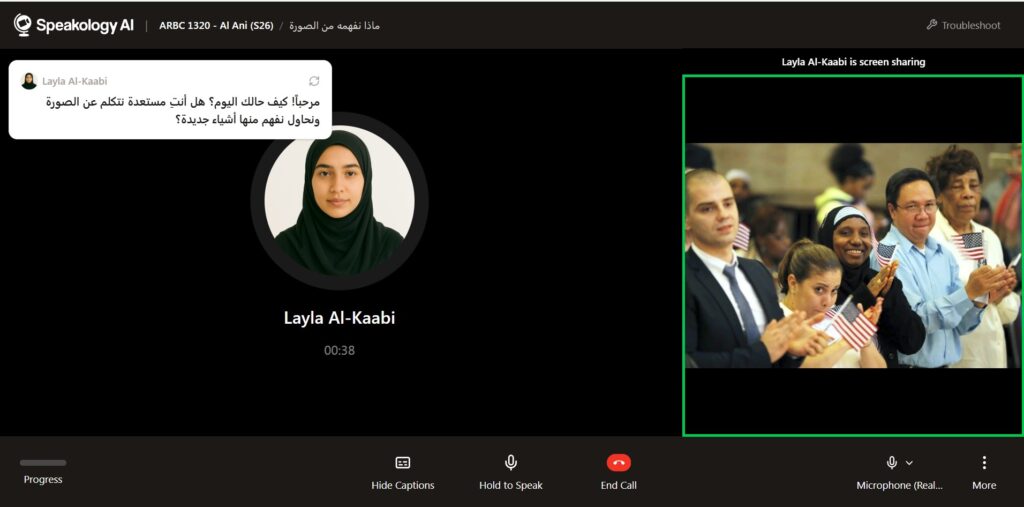
Over the past academic year, I have integrated Speakology AI into my curriculum for Intermediate Heritage Arabic learners—a project made possible through the Yale Poorvu Center AI Course Revision Grant. This grant supports faculty in exploring the pedagogical implications of generative AI by providing the resources necessary to rethink teaching strategies. A critical component of the Center’s role involved vetting the AI tool to ensure it met rigorous standards for student privacy, data protection, and universal accessibility. This oversight ensures that our adoption of AI remains purposeful, ethical, and strictly aligned with our core student learning objectives. Speakology AI itself is an immersive conversation platform where students interact with AI-driven avatars in task-based simulations, as detailed in a previous article in The FLTMAG by Lauren Rosen. Throughout the implementation phase, I took an active role in designing—and sometimes redesigning—the input parameters. This involved curating specific details such as topics, vocabulary, grammar, and question lists, while providing explicit instructions for the avatars to adhere to these constraints. Despite the significant time investment required to design these tasks, the results were clear to me: students demonstrated a noticeable increase in communicative breadth, greater confidence in interpersonal interaction, and an observable easing of speaking anxiety. My journey has been one of constant discoveries, revealing that AI integration is as much about managing change as it is about mastering technology.
The first and most important lesson for any educator venturing into the AI space is the necessity of embracing rapid, real-time evolution. Unlike traditional software, these tools develop so quickly that features available at the start of a semester may be rendered obsolete by its end. For instance, Speakology recently underwent a massive speech recognition upgrade—an update transparently communicated to users—shifting from traditional transcription to a system based on phonemes. By interpreting the actual sounds students produce rather than relying on text output, the AI now achieves significantly higher accuracy, even in noisy environments, while reducing conversation latency (the time it takes the avatar to reply) by nearly 50%.
Instructors must remain agile and prepared to redesign assignments on the fly; technical hurdles, such as an awkward avatar head tilt or a slight audio delay, can be resolved in a single update, shifting the learner experience overnight. For our Heritage Arabic course, this agility was particularly vital in managing the relationship between Modern Standard Arabic (MSA) and regional dialects. As the AI’s linguistic capabilities matured, it was sometimes necessary to adjust assignments to ensure phonetic accuracy. For example, because the pronunciation of some words differs between MSA and regional dialects, I found that I sometimes had to include short vowel indicators in the prompt —markers usually omitted in standard writing—to ensure the AI correctly understood the input and that learners heard the intended pronunciation.
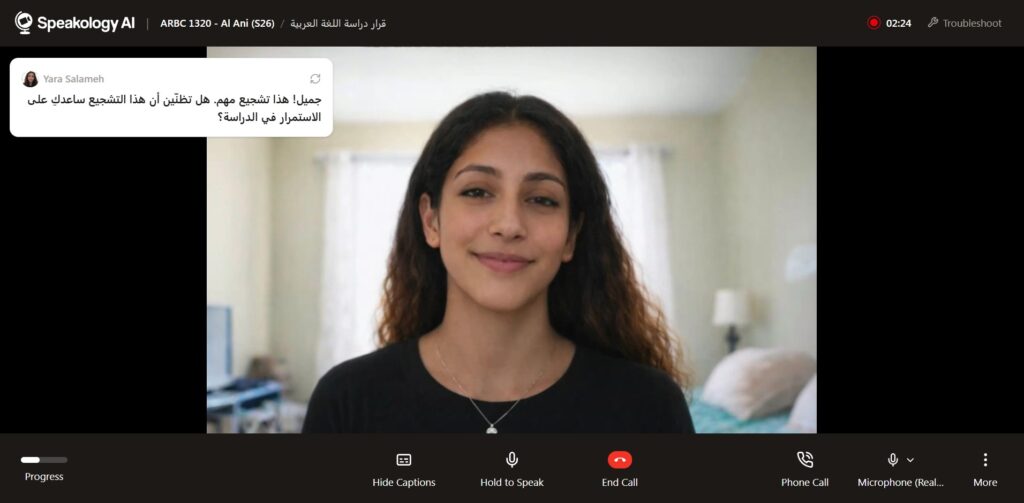
Being an early adopter also demonstrates the value of active participation in the development process. For me, this meant engaging in brainstorming sessions with developers to address the unique needs of the Arabic language—conversations that led directly to the enhancement of specific avatars such as Yara Salameh from Lebanon and Omar El-Masri from Egypt. To reflect an authentic linguistic identity, Yara’s profile is being developed with the capability to respond in the Levantine dialect when specified during the task design phase, while Omar’s avatar is being programmed to incorporate the Egyptian dialect alongside Modern Standard Arabic (MSA). Although these personas are still evolving and not yet 100% perfect, they offer a vital opportunity for students to navigate the crucial intersections of MSA and regional varieties, ensuring the tool reflects the true complexity of the language and its diverse identities. This emphasizes a second lesson: educators must be proactive partners with developers. Faculty feedback represents the collective needs of the teaching community, shaping these tools to serve real classroom realities. To effect positive change, educators must be active participants, dedicating deliberate effort to represent the instructors who will eventually utilize these technologies.
This collaborative spirit requires a significant degree of patience, leading to a third lesson: perfection should not be expected from the tool or the students. Especially when first adapting the tool, the most effective approach is to frame AI assignments as low-stakes, incentive-based tasks. This strategy is designed to mitigate ‘AI anxiety’ and grant students the same experimental flexibility that developers enjoy as they refine the technology. By discussing these issues with students and enabling students to submit second or even third attempts at a task, instructors can practically acknowledge that learners are active participants in a live experiment, fostering a growth mindset rather than a fear of technical or linguistic error. To facilitate this, the platform recently launched a “Student View” interface, allowing educators to see exactly what the student sees with one click. This transparency helps the instructor guide the student through the learning curve without the frustration of navigating blind.
Integrating this technology successfully also depends on a transparent feedback loop. Dedicating class time to discussing the tool directly informs instructional design. Student feedback can lead to refined prompts—such as ensuring an avatar remains on topic—and influences technical enhancements like improved microphone handling. A fourth lesson, now more critical than ever due to the adoption of AI, is to treat students as co-researchers. Using their insights to continuously redesign the pedagogical approach ensures that students feel heard as they witness enhancements, such as new drag-and-drop module management or detailed proficiency analytics.
The fifth and final lesson is that AI serves as a bridge to human interaction rather than a replacement for it—a distinction that must be explicitly communicated to students. As learners grow accustomed to interacting with avatars and mastering specific tasks, they reach their communicative potential with less fear of judgment. However, these assignments are never intended to replace human conversation. They are a technological scaffold designed to provide focused practice so that when students communicate with real people—the ultimate goal—they do so more successfully. Interpersonal communication remains the staple of our class time, where we monitor and celebrate authentic progress.
In conclusion, integrating AI into the language classroom requires a mindset shift from a consumer of software to a pioneering collaborator. One should not be afraid to step into this role, even when the technology feels in flux. By remaining flexible, involving students as active participants, and contributing directly to the development of these tools, educators ensure that innovation is steered by pedagogical expertise rather than technical capability alone. Ultimately, AI acts as a powerful support system that can help empower students to overcome speaking anxiety and reach their linguistic dreams, while keeping the human heart of language education at the center of the experience.
AI disclosure statement
- Generative artificial intelligence was used in the preparation of this article only for brainstorming ideas or for spelling and grammar suggestions.
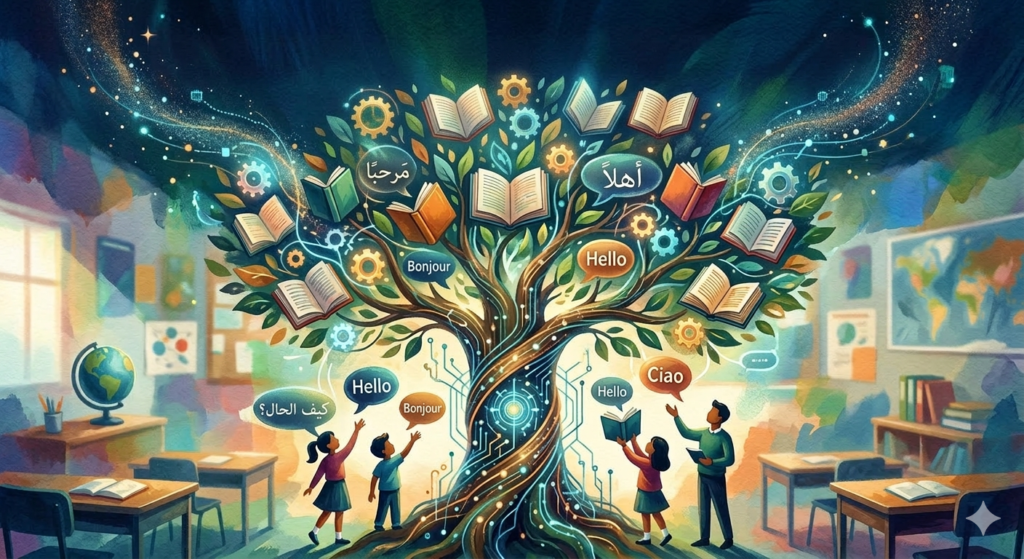
- Generative artificial intelligence was used to create the image used at the top of the article.