
Interview with Lauren Rosen: IALLT, AI, and the Future of Language Education
DOI: https://www.doi.org/10.69732/AWQC1960
In May 2026, I interviewed Lauren Rosen, IALLT (International Association for Language Learning Technology) President. We talked about her career, her vision for IALLT as its president, and her take on how technologies such as AI have changed the way we teach…for the better!
Lisa Frumkes: Lauren, you’re currently serving as IALLT President, and I want to hear all about that! But first, let’s talk about your day job. The FLTMAG interviewed you six years ago. How have things changed since then: pedagogically, technologically, and administratively?
Lauren Rosen: Fundamentally, from a pedagogical standpoint, things really haven’t changed. The focus is still on building proficiency in a communicative, interactive learning environment, integrating the available technologies. What’s really changed is the technology.
Speakology AI has become the newest addition to the technologies we integrate at the University of Wisconsin (UW). After first practicing with the AI, the students we surveyed reported feeling significantly more confident when speaking to a real person, whether that person was a fluent speaker of the language they’re learning or a peer in class. Our research is also showing differences in Avant STAMP 4S scores. Second-semester students using Speakology were outperforming some fourth-semester students who didn’t have access to it. When we compared second-semester students from the same instructor before and after Speakology AI, we again saw a significant difference in speaking. That makes us think about how AI is going to impact the field.
Another big change is that we developed a badging system – a microcredentialing system for all students who take the STAMP 4S test. Even if they do not earn the Global Seal of Biliteracy, all students now receive a digital badge for each of the four skills based on their score, backed by Can-Do statements and proficiency language from ACTFL. Students can walk away with proof of their skills, and they have language they can use in a job interview to describe those skills, explaining what they can actually do in speaking, reading, listening, and writing – not just that they sat through several semesters of language courses. Some students even realize they are close to the proficiency benchmark and take another course if they can fit it in. The level-up sheet helps them know what they can do to keep growing, and that motivation has been worth it.
Lisa: I love that! When they fall just short of the goal, it actually becomes an impetus for some of them to study a little more. That shows that our students have grit that we don’t always give them credit for.
Lauren: Some of it is really about time, having a free spot in their schedule! There have been reports showing that students want to take language, but they don’t, because they do not have room in their schedules with everything else required for their majors and minors.
Lisa: That is so interesting! I guess that means students these days have to take more classes for their majors and their distribution requirements, and that’s part of what’s squeezing language enrollments.
Lauren: Right. When language study is not required, and other things are, students have to make sure they focus on those other courses first.
Lisa: So, let’s turn to the Collaborative Language Program at the University of Wisconsin (UW). As you’ve shared previously, this is a program that has allowed the UW to flexibly offer a diversity of languages to students across its system. What’s the status of the program currently? Where is it headed?
Lauren: It has been a 27-year ride for me because I have been there from the beginning – I started it! I was the first and only hire for about 25 years. Building this program from scratch has basically been my career.
Up until now, even though it has been a UW system-wide offering, the program itself has been housed at individual UW campuses on a rotating basis. But as of July 1, it is moving to a division for online learning at the university system level. The reason this is happening now is that the university started looking at what the program does and how it supports undergraduate education in general, and they want to replicate the concept across disciplines.
As of June 2nd, I will be transitioning away after 35 years in public education to the private sector, and it is up to the UW to carry this forward however they decide.
Lisa: That’s a major change! You had mentioned to me that, with your departure, the UW is hiring someone to administer the program, but not necessarily provide thought leadership for it, as you have done since the beginning. Do I have that right?
Lauren: That is what it sounds like from the job description. When I first took this position, it was actually the idea of the deans of the College of Letters and Sciences who wanted a way to offer languages so more students, especially in rural Wisconsin, could have access.
They hired me because I was a linguist with a background in technology integration, and I was able to take off with it. Several consortia around the country have since been modeled after this program, so it has served many institutions and instructors. Right now, the new position is listed more as a program manager with organizational duties. I hope they hire somebody with a background in language pedagogy and instructional technology who can keep it growing.
Lisa: That’s a major new path for the Collaborative Language Program. And it’s a good example of the challenges the field is facing right now: the effects of Artificial Intelligence (AI), the defunding of some centers and the rethinking of others, as well as funding cuts in higher education generally. Can you talk more about that as a whole? What can we do as a profession?
Lauren: As far as AI goes: don’t fight it. AI is like the World Wide Web was when it first became available, or Google Translate later. These are all major turning points that have impacted our field, and we need to use those technologies to help students become more proficient, more quickly and help educators become more efficient at their jobs so we can provide students with what they need. AI gives us an opportunity to differentiate and individualize more easily than before, but to do that, we need to let go of control and truly become guides on the side. AI does not have emotion, but communication does, and that matters in human conversation, whether it’s facial expressions or intonation or any of those things. Those factors matter when you’re having a conversation with a real human in developing mutual understanding. AI is not going to be able to replace all human factors. So we need to use it strategically and show our students how it can serve as an assistant to them.
We can’t build real relationships with AI. After all, if you tell AI you went to the dentist for a root canal, it might respond empathetically, “So sorry, I know how painful that is.” But AI doesn’t actually know how painful it is. It’s never had a root canal. We need people for relationship building, and people with real skills in problem-solving and critical thinking and cross-cultural understanding.
I actually have a broader vision for education overall. AI is, I think, going to move all of education. In language learning in our country, I can see that it’s a tool that can help everybody become better, more quickly, at the skills they’re learning. We’ll need champion educators to help make that a reality.
With regards to just overall cuts in education and the destruction – I don’t know what else to call it – of the National Foreign Language Research Centers (NFLRCs): the bigger picture is this; everyone needs to vote, and not vote just on a single issue. I don’t really want to get political here, but we have to recognize that programs like the NFLRCs are federally funded. We need smart people to lead in our government and understand the full impact of the choices they’re making at a federal level, at a state level, at a local level…all of those things matter. And this country doesn’t value education right now.
Education is really a stepping stone to being able to peacefully live in a global community. Protecting our world for decades and centuries to come is so essential for just being humans and being on this planet. The decisions our leaders make aren’t always going to be perfect for everyone, but if they are at least educated decisions, ones that fix a problem and that positively impact the majority that are affected – that’s really the best they can do.
But lately, that vision – at least around education – seems to be very narrow and not really focused on where we need to go in a broader sense, and that’s not just in languages, but overall. It’s going to take people who can critically think and problem solve, and those are the skills that are fostered in an educational environment – especially in courses like languages.
Speaking more specifically about languages: I think the system needs to change and take a different approach. In nearly every country in the world except for the US, people learn more than one language from a very early age. In those countries, the goal isn’t to get a major or a minor in a language. Here in the US, we’ve kind of lost sight of the fact that proficiency in another language is a skill that supports all disciplines. Here in the US, if you don’t have enough majors in a discipline, the university decides to cut the program altogether. But the goal shouldn’t be to be a major in a language, just like the goal of taking math classes isn’t always to be a math major. Math supports every other discipline, right? Our universities need to see language in the same way.
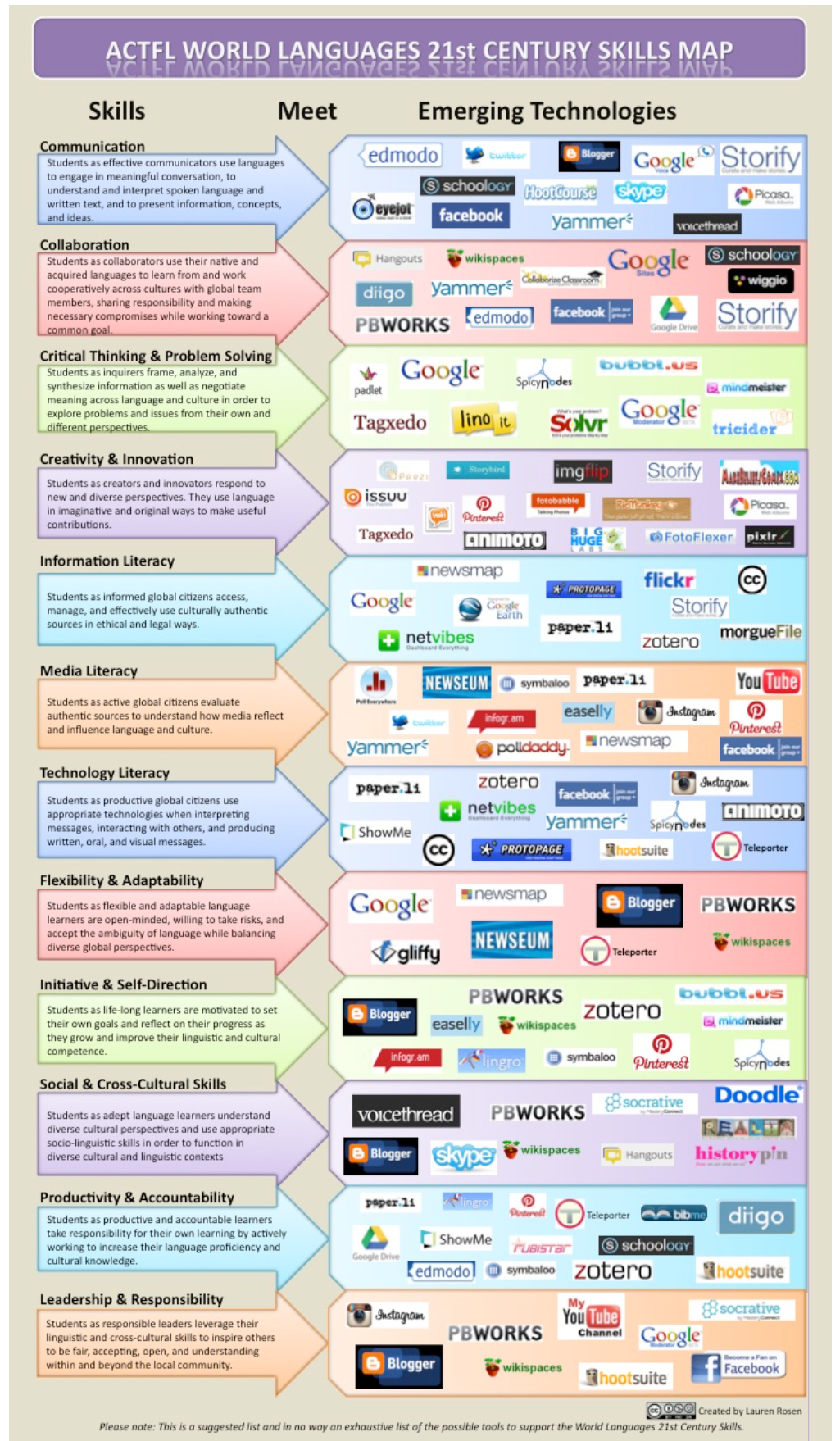
Years ago, I created this infographic (see below) that was basically an intertwining of the ACTFL Standards for Foreign Language Learning with the 21st-century skills and the technologies that could support those skills. The purpose was to show that the 21st century skills, which had been identified as the overarching skills all students need, could be achieved in a language learning environment, just like in every other discipline.
| Text from the infographic:
ACTFL World Languages 21st Century Skills Map Skills Meet Emerging Technologies Communication: Skills: Students as effective communicators use languages to engage in meaningful conversation, to understand and interpret spoken language and written text, and to present information, concepts, and ideas. Technologies (examples): edmodo, schoology, facebook, yammer, blogger Collaboration: Skills: Students as collaborators use their native and acquired languages to learn from and work cooperatively across cultures with global team members, sharing responsibility and making necessary compromises while working toward a common goal. Technologies (examples): Google Drive, Storify, wiggio Critical Thinking & Problem Solving: Skills: Students as inquirers frame, analyze, and synthesize information as well as negotiate meaning across language and culture in order to explore problems and issues from their own and different perspectives. Technologies (examples): Google, padlet, Tagxedo Creativity & Innovation: Skills: Students as creators and innovators respond to new and diverse perspectives. They use language in imaginative and original ways to make useful contributions. Technologies (examples): issuu, Pinterest, Picasa Information Literacy: Skills: Students as informed global citizens access, manage, and effectively use culturally authentic sources in ethical and legal ways. Technologies (examples): zotero, flickr, Creative Commons Media Literacy: Skills: Students as active global citizens evaluate authentic sources to understand how media reflect and influence language and culture. Technologies (examples): Newseum, newsmap, polldaddy Technology Literacy: Skills: Students as productive global citizens use appropriate technologies when interpreting messages, interacting with others, and producing written, oral, and visual messages. Technologies (examples): netvibes, Instagram, hootsuite Flexibility & Adaptability: Skills: Students as flexible and adaptable language learners are open-minded, willing to take risks, and accept the ambiguity of language while balancing diverse global perspectives. Technologies (examples): gliffy, Teleporter, pbworks Initiative & Self-Direction: Skills: Students as life-long learners are motivated to set their own goals and reflect on their progress as they grow and improve their linguistic and cultural competence. Technologies (examples): lingro, symbaloo, mindmeister Social & Cross-Cultural Skills: Skills: Students as adept language learners understand diverse cultural perspectives and use appropriate socio-linguistic skills in order to function in diverse cultural and linguistic contexts. Technologies (examples): voicethread, socrative, Doodle Productivity & Accountability: Skills: Students as productive and accountable learners take responsibility for their own learning by actively working to increase their language proficiency and cultural knowledge. Technologies (examples): ShowMe, bibme, paper.li Leadership & Responsibility: Skills: Students as responsible leaders leverage their linguistic and cross-cultural skills to inspire others to be fair, accepting, open, and understanding within and beyond the local community. Technologies (examples): Google, Socrative, Instagram Please note: This is a suggested list and in no way an exhaustive list of the possible tools to support the World Languages 21st Century Skills. Creative Commons license, Created by Lauren Rosen |
In primary schools, students are always learning all disciplines within basically one classroom. But when they get to secondary school, everything is siloed into different disciplines (math, science, language) taught in different classrooms. What if, instead of a credit-per-discipline system, if we could be looking at credits for skill building? We already offer competency-based programs, but those are still counting credits towards individual disciplines, rather than seeing which skills and competencies are available via all disciplines.
If we had a system where students could choose courses based on the skills they needed in order to graduate, but in the disciplines that interested them, they could build a learning path for themselves. They could be getting math, physics, and chemistry by studying culinary arts or industrial arts. They need to build logic skills, they need to develop writing and communication skills – and those can be built in all disciplines. Even in theater! When would improv not help you? The next time you have a meeting and somebody says something you weren’t expecting, and you have to respond – improv skills will help you handle it.
If every discipline could just list their courses and the skills fostered in those courses, then students could pick. They could say: “I need five courses that will help me with critical thinking, and I’ll take these three to start.” That would be a big change. I think that’s where ultimately our education needs to go. I realize that’s a huge undertaking, and it’s going to take decades and some real champions to make it happen.
We could start looking at languages the way we look at math – that is, not as a field that lots of people major in, but as a skills-development area that can support learners in other areas they study. But there are things we‘d need to do in our profession to make that happen. We’d need administrators to realize languages aren’t about just a bunch of words and structures. I think we’re going to need to rename our field, because when people hear “language” as a field of study, what do they think? They think about words and structures. What if, instead of “language,” we called our field something like “global understanding and communications”?
We need to get better at describing what students learn when they’re in our classes, and how what they learn in our classes supports their work in other disciplines. Maybe micro-credentialing systems would be the way to help people see that. We need our students today to understand what skills they’re getting when they are taking languages, so someday, when they’re parents, when they’re administrators, when they’re in charge, they can articulate how languages are more than just a bunch of words and structures.
We don’t have to wait until fourth or fifth semester to allow students to be thinking about and discussing their career interests in a language class. We can help students integrate their language study with their academic interests as early as in the first semester, encouraging students to say “I like” and “I want” in conjunction with their academic interests. And we can use AI to build vocabulary lists that support students’ explorations of interests, disciplines, careers and jobs that interest them. It doesn’t all have to come from the textbook, and it doesn’t all have to come from the instructor. I don’t know all the terms needed for engineering or agriculture in Spanish. But if my student likes to garden, why not let them learn how to say “I like to garden” early on, and help them learn the names of the tools they need? Then every student can start building their own vocabulary set, instead of waiting until they’re at “the right level” to get those words – because most of them never get there.
Lisa: We’ve been focusing on how students aren’t getting the language education that could be useful to them. But they’re also not learning other skills that used to be taught in American schools, like the ones taught in auto shop or wood shop. What is your take on the status of education in the United States in general?
Lauren: This is probably due to my upbringing, but education has always been what was most important. And that doesn’t mean just traditional higher ed education. Education can mean developing skills, doing an apprenticeship, learning to do manual work, and so on.
But even in industries that don’t require a four-year degree, it is often vital to be able to speak another language. For example, in construction, in this country, you may need to be able to speak to a client, a supervisor or an employee in another language. And for that conversation, you need to have an understanding of where somebody comes from, who they are, and what their background is. It’s more than just words. If you’re going to solve a conflict in the workplace, whether it’s in an office or on a construction site, you have to have some ability to communicate. And sometimes, you have to do that in a language other than the one you were born speaking.
So the trades could use language study, too. As I mentioned before: in basically every other country in the world, they start learning other languages at an early age, because they don’t see it as something that you just major in. They see it as something that’s valuable as a skill underlying everything, and useful regardless of what kind of work you do. Learning another language and understanding other cultures opens the mind to seeing the world from a different perspective. This completely changes one’s approach to conflict and communication.
Lisa: We could discuss this particular topic forever! But let’s move to another question: to organizations. What organizations do you belong to, and what do you get out of your involvement with them? Do we need more or different organizations today?
Lauren: Ever since I graduated college, I’ve been part of my state language association, WAFLT. That’s logical, right? And then there’s ACTFL; because I’m in the Midwest, there’s Central States and there’s MWALLT, and CALICO. I’ve been a member of all those organizations, on and off, through the years.
I recently joined the Modern Language Association (MLA). I did a program review of an online language program for the MLA because of my experience with the Collaborative Language Program. Now, the MLA is focusing on some AI stuff, and they brought me in for that. It seems the MLA is starting to add in pedagogical interests, which I find really fascinating. I suspect the MLA is seeing the same writing on the wall that we are. There’s nothing wrong with studying medieval literature, if you think about what that literature is meant to teach. It gives us a chance to think about what events and historical references have repeated themselves and how those insights and experiences apply today.
And of course, IALLT. IALLT has been my backbone for the past 31 years. When I have a professional concern or question, I can turn to any of my IALLT colleagues for anything – and I often do! There’s always somebody there to turn to, and if they don’t know the answer, we work together to find that answer. IALLT people are my chosen family, really. And as a result, I have friends all over the world, which is really awesome. With IALLT, there’s this level of comfort where you can be vulnerable, you can be yourself, and you’re also still respected for the work you do. There’s no airs, there’s no eggshells. We’re all colleagues, and we feel like we’re all in it together. I don’t necessarily feel that with other organizations.
You asked about future organizations that I could envision. I don’t know that there’s a need for more organizations, but I could see, perhaps, a switch in the focus of organizations. Getting rid of the Department of Education is not going to help our country, right? But maybe changing its focus or rethinking education in the country could be a responsibility of those organizations. States have their own departments of education; in Wisconsin, it’s called the Department of Public Instruction, and other states call theirs by other names. I think those organizations still have a lot of value, but they might need to change their focus.
Lisa: Coming back to IALLT as an organization:, you just said why you love it, but as president of IALLT, tell me: how is IALLT doing?
Lauren: As the president, I don’t feel particularly presidential, but I can say that currently, IALLT is healthy! One of my goals, as president, was to build stronger connections with our international partners, to put the “I” back in IALLT. We’ve created some mechanisms that allow us to hear more often from our regional groups and our council members, so we’re getting a better sense of what’s happening out there. We’re building better channels of communication across the IALLT Council, so we communicate more often than just in a once-a-year meeting.
We’re currently working on a face-lift to our website, so keep your eyes open for that!
Lisa: What IALLT events are happening that people should be aware of?
The IALLT leadership summit is coming up very soon! It will be held here in Madison, Wisconsin, on June 18 and 19. All IALLT board and council members are expected to attend.
At the summit, we’ll do some strategic planning, look at what’s going on now, and what we want to do moving forward. The leadership summit particularly focuses on those who might be interested in taking a leadership role or a supporting role within the Council, so it’s open to all members. As part of the summit, we will be touring some of the 2027 conference facilities at UW-Madison!
IALLT 2027 will take place in Madison, Wisconsin, June 16th through 19th of 2027. The program committee will be announcing the theme soon and opening a call for proposals in the fall, so look for that. The conference itself should be easy to navigate – everything is within walking distance, so no need for a car.
Madison in the summertime is an idyllic place, so don’t be afraid to come just because it’s up north! In the summertime, it’s sunny. The campus sits right on a lake and it’s just a beautiful place to be. We anticipate a good conference, so please join us!
Lisa: You mentioned earlier that one of your goals as the president of IALLT was to put the “I” back in IALLT, by making connections with our international partners. I’d like to hear more about that, as well as about other side projects you have going.
Lauren: I’m working with the programs director – one of our board members – who is developing a survey we can use when we reach out to our affiliates and find out what their organizations are doing and try to discover ways we can collaborate, whether that’s through, say, publications or shared conferences. We want to make sure their members know they are invited to our conferences and vice-versa. We also want to get a little information about the different organizations: we’re finding that some are very stable and solidified, but others are maybe less so.
What the collaborations look like may vary; we’re really at the information-gathering stage right now. I’ve been discussing this with Jeff Samuels, who’s IALLT’s President-Elect. He’s also interested in this initiative, so it’s something he will likely continue to pursue during his IALLT presidency.
But right now, I’m really looking forward to our leadership summit and the strategic planning that goes on there. This organization exists for the people who belong to it, so I really want to listen, and hear what everybody else’s ideas are, and where they want to go.
Lisa: And coming back to you, Lauren: What else are you working on right now, IALLT-related or otherwise, that really inspires you?
Lauren: Just for fun, I’m teaching myself to crochet! As far as languages go: I’m working on becoming more fluent in German.
It’s going to sound cheesy, but something that inspires me is watching my kids adulting. They have a connection to IALLT too! My now 25-year-old daughter was a baby in a stroller IALLT at Rice; LeeAnn Stone basically took charge and was pushing her all over the place. My other daughter was born when I was doing my first stint on the board as the business manager; she’s now 23. So, both of them are done with college and finding their way. I’m thinking about where I was in my IALLT journey at the time that they were just infants and where they are now. I guess we’ve all come kind of a long way, right?
From a professional standpoint: I’m just going to keep digging into AI and seeing where it takes the field and where it takes me. It’s definitely a game changer. I think people who are motivated to learn can become more skilled at learning anything. They can become more skilled more quickly with the support of AI as a partner, not as something that’s doing the work for them.
And then retirement, right? My plan is to buy a place in Spain, and spend time in Germany to solidify my German.
Lisa: When I got involved in CALL in the late 1980s and early 1990s, I felt like language teachers were the real scouts, in the true vanguard in ed-tech. Do you agree that was the case? Do teachers of languages still play that leadership role, or have we been overtaken?
Lauren: We 100% are the leaders, and not just in ed-tech! I think we’re the leaders in pedagogy in general. The idea of interaction – getting away from the “sage on the stage” as the way of offering instruction – this became a language teaching best practice as far back as the 1960s and 70s. (Even though there are still educators who haven’t yet gotten that memo.) So there’s a piece of pedagogy where language teachers have been the leaders.
In my years – decades actually – at the UW, it’s been interesting to see how the Center for Teaching and Learning (other campuses have similar centers with different names) has evolved a bazillion times over the years. A significant number of the people who are hired to work at those centers to do general ed-tech work actually come in with a language-teaching background. But they are hired for general ed-tech because of their pedagogical knowledge and approaches. And it’s also been very interesting to observe the number of people coming into those positions from the secondary classroom – because that’s where pedagogy happens.
Some of my closest friends at UW are people that came from some sort of secondary background and oftentimes a language teaching one – because we talk the same talk. We get it, and we see how these things can be done. We think more broadly, we think beyond the idea that we should teach a certain way because that’s the way we were taught. That evolution, especially in a giant university like UW-Madison, has been very slow, but they’re starting to value pedagogy more, a little bit at a time. They’re starting to reward good teaching and learning. It still doesn’t help, necessarily, with the tenure track and publications, but the topics of the publications are shifting – the focus of research no longer has to be a non-teaching topic. That’s been interesting to watch.
Lisa: That is an inspirational, hopeful, and forward-thinking place to end. Thanks for sharing all these perspectives with me! It’s been really wonderful and enlightening to speak with you.
References
Murphy, D., Sarac, M., & Sedivy, S. (2022). Why U.S. undergraduate students are (not) studying languages other than English. Second Language Research & Practice, 3(1), 1–33. http://hdl.handle.net/10125/