
From Accessible Materials to Shared Practice: Redesigning Four Levels of Spanish Through UDL and Generative AI
By María Datel, Carmen Torre Pérez, Philip Noonan, Pau Cañigueral Batllosera, and Edgardo Tormos Bigles, Boston University

DOI: https://www.doi.org/10.69732/VURL7927
The Question that Changed our Work
What makes a language activity accessible? Is it a transcript accompanying a recording, a choice between written and oral responses, or a document that a screen reader can navigate? All three may matter. Yet none, on its own, tells us whether students can participate in the intellectual and communicative work the activity was designed to foster.
At Boston University, the first four semesters of our Spanish language sequence serve approximately 1,800 undergraduates annually across about 100 sections. Students enter with different linguistic histories, experiences of disability, levels of confidence, and ways of engaging with written, auditory, and visual information. Their variability is predictable; the barriers embedded in our materials should not have to be a surprise.
This was the starting point for our Shipley Center–supported project, Redesigning Spanish Language Courses Using UDL and Generative AI (2025–26). Five instructors working across the sequence undertook a shared experiment guided by Universal Design for Learning (UDL), a framework that helps educators anticipate learner variability and reduce barriers by providing multiple ways to access information, participate in learning, and demonstrate understanding. Together, we redesigned existing materials, explored where generative AI could support the labor of accessibility, and built resources other instructors could reuse.
From the outset, we understood that a few excellent but isolated activities would not be enough. For accessibility to last beyond one course, instructor, or grant, we needed shared design practices, materials others could use and revise, and a way to make our work available outside our team.
The project generated more than 28 redesigned or newly created instructional materials across four course levels, a developing series of faculty-development videos, and a public repository built with Omeka, an open-source platform for creating and sharing digital collections. Yet our most consequential result may be a change in our collective habits. We learned to ask not How do we accommodate a student after a barrier appears? but What in this activity might prevent someone from reaching the learning goal, and how can we redesign it before that happens? Just as importantly, we began asking how that redesign could become part of a shared, sustainable curriculum rather than disappearing at the end of a semester.
Start with the Learning Goal, Not the Format
UDL offers three interconnected principles: multiple means of engagement (how learners become motivated and involved), representation (how information is presented), and action and expression (how learners participate and demonstrate their understanding). CAST, the nonprofit organization that developed the UDL framework, also gives renewed attention to identity, bias, belonging, and systemic barriers—such as institutional practices and assumptions that may exclude certain learners—in its 2024 UDL Guidelines 3.0. These commitments are particularly consequential for second-language teaching, where a student may be trying simultaneously to decode unfamiliar sounds, interpret cultural references, formulate a response, and negotiate the social risks of speaking in an emerging language. Our goal was not to sort students into presumed learning types. It was to anticipate variability and design meaningful routes into a common, rigorous learning objective.
Our working distinction was between productive difficulty and avoidable barriers. Finding the words to express uncertainty in Spanish is productive difficulty because the linguistic challenge is part of the learning goal. By contrast, asking a student to interpret essential visual information in an image without alternative text, or to navigate a worksheet whose reading order is confusing when accessed with a screen reader, introduces avoidable barriers. The linguistic challenge supports the learning goal; these accessibility barriers may prevent students from reaching it.
That distinction also showed us that multimodality and accessibility are related but not interchangeable. A slide rich in images, music, and movement may be engaging, but if essential instructions are conveyed only visually, it remains inaccessible to someone who cannot see them. Conversely, a technically accessible text document does not, by itself, offer varied opportunities for engagement or expression. We therefore put UDL into conversation with digital accessibility: structured headings, meaningful alternative text, captions, transcripts, clearly labeled fields for student responses, and activities that can be completed using a keyboard without requiring a mouse. The point is not to multiply formats indiscriminately, but to ensure that each learning pathway is usable. This is where an inclusive pedagogical intention encounters the material realities of access.
Across the team, a common design process emerged. We began by identifying the linguistic and cultural objective, then examined how the existing material presented information and required students to respond. We asked ourselves whose participation the format assumed, what information was available through only one sense or interface, and which changes could open another route without lowering the intellectual demand. Meaningful choice was not an unlimited menu of outputs: if the goal was oral negotiation, a written paragraph could support preparation but could not replace the speaking task entirely.
A further commitment shaped our content choices. Access is not only a matter of how students encounter course materials; it is also a matter of who and what those materials represent. A language curriculum can make disability visible as a dimension of cultural life, while also asking students to consider the audiences and access requirements of their own communication. In our project, inclusion factored into both the design of activities and the topics students discussed.
What Redesign Looks Like Across Four Courses
Our work ranged from Novice-level vocabulary and listening activities to Intermediate-level engagements with topics such as historical memory, art, activism, and identity. The four courses were not made identical. We shared design questions, not a template that flattened their different learning goals.
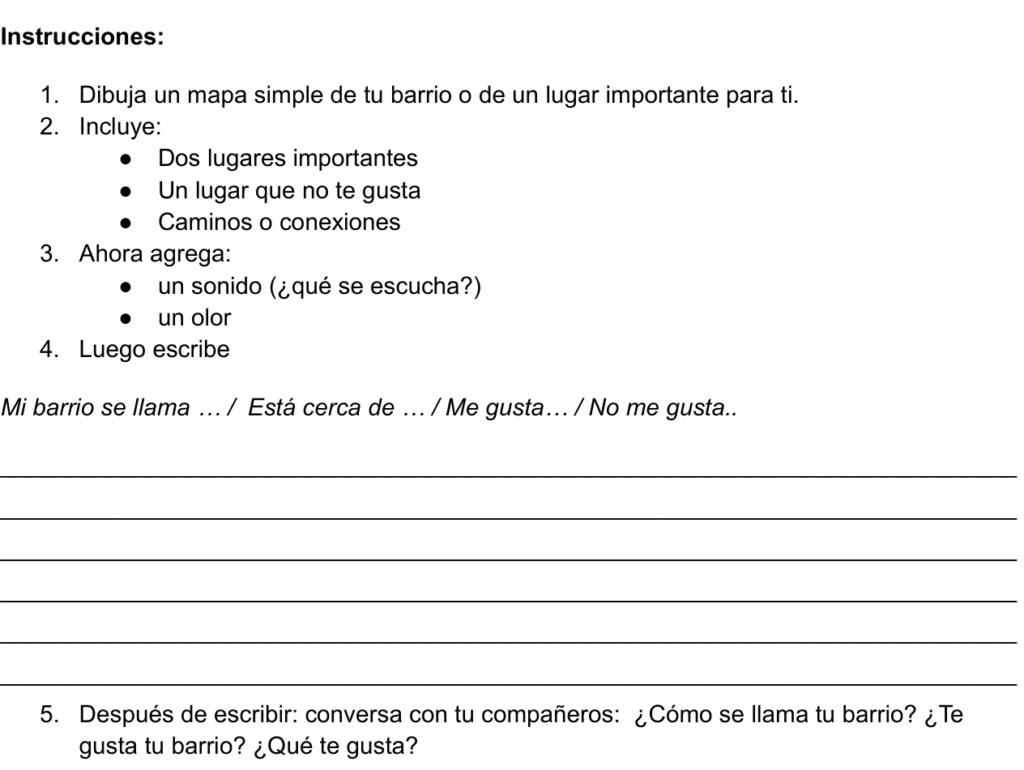
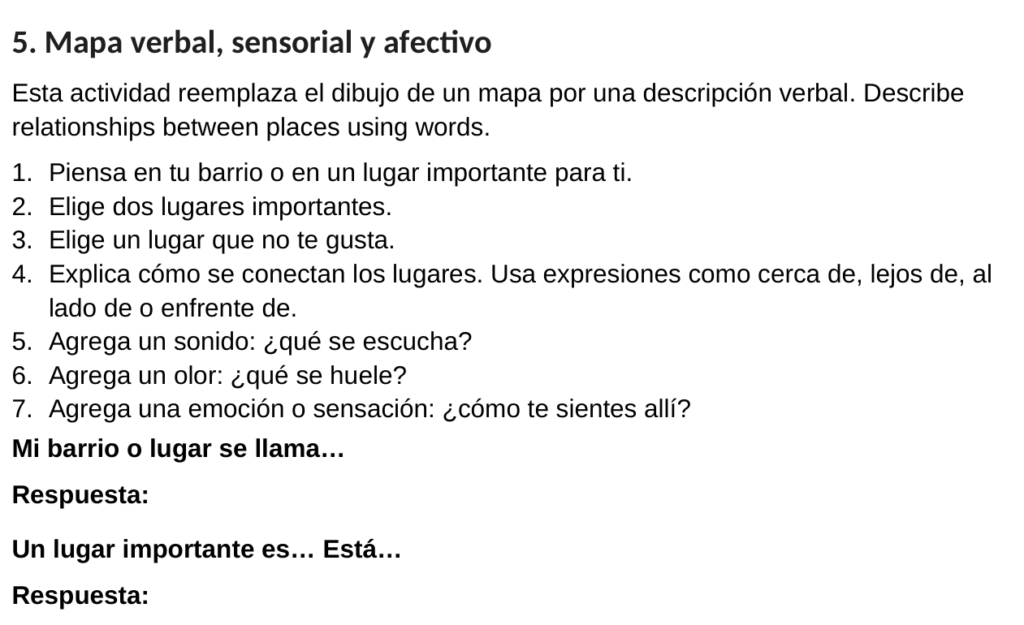
In the first-semester course, a lesson on neighborhoods offers a clear illustration. Students practice location expressions, describe places, and imagine the neighborhoods in which they want to live. In the original version of the activity, the worksheet combined a campus map, visually arranged questions, boxes to check, and a drawing task. These are familiar classroom devices, but several presume that students can see the map, follow a two-dimensional layout, and respond by drawing. In the redesigned version, a text-based campus map describes locations and their spatial relationships in words, using expressions such as “next to,” “across from,” and “between,” rather than relying on visual positioning. Properly structured headings and lists make the sequence navigable, while clearly labeled response fields help students identify where to enter their answers. An earlier UDL-informed version invited students to draw a sensory and affective map of their neighborhood (Picture 1). When adapting the activity for a blind student, we replaced the drawing requirement with a structured verbal mapping task that preserved the spatial, sensory, and emotional dimensions of the exercise (Picture 2). The learning objective—using Spanish to situate and describe places—remains intact. What changes is the route to it.
Other materials in the first-semester course bring the same principles to songs, daily routines, food, commands, and accessibility in public space. In an activity titled ¿Es mi barrio accesible a todes?, for example, neighborhood language becomes a way to consider who can move through and participate in a community. A grammatical or lexical objective need not be divorced from a question that matters beyond the classroom.
In the second-semester course, materials explore inclusive Spanish, peaceful activism, memory, children’s literature, and soccer as a space of inclusion. Rather than simply adding videos or images to existing lessons, we redesigned activities by considering how spoken, written, visual, and gestural communication could complement one another, support specific learning goals, and offer students different ways to engage with the content. An important further step was inviting students to create accessible materials themselves. A project involving captions, transcripts, or audio description, for instance, asks students to think about audience, select meaningful information, and communicate it in Spanish. Accessibility becomes both a condition for their participation and a communicative problem they learn to address—not something the instructor does invisibly on their behalf.
The work in the third-semester course extended these questions to lower-Intermediate-level materials that foreground experiences and voices often underrepresented in Spanish curricula, including Afro-descendant experiences in Spain, racism and gentrification in Peru, and contemporary popular culture through queer and trans artists such as Puerto Rico’s Villano Antillano. These content choices were informed by critical pedagogical approaches, while UDL guided how students could access and engage with them through scaffolded activities, opportunities for choice, and connections between classroom learning and questions beyond it. Together, these approaches allowed us to address two related dimensions of inclusion: whose experiences are represented in the curriculum and how students can meaningfully engage with them.
At the next level, fourth-semester activities address Latinx activism through figures such as Dolores Huerta in the United States; historical memory and fascism through Pablo Picasso’s Guernica (1937), painted in response to the bombing of the Basque town during the Spanish Civil War; and contemporary issues of displacement and struggles for land, natural resources, and belonging in Puerto Rico. When designing activities around complex cultural works, our goal was not simply to make images or texts available in alternative formats. We also needed to consider which details and historical contexts students would need to access in order to interpret, discuss, and engage meaningfully with the material. Edgardo, one of our team members, posed two guiding questions—Who are we designing for? and How are we designing it?—that kept our learners at the center of the design process. His additional insistence that technologies be evaluated at “the intersection of access and relevance” helped us connect multimodal representation to students’ lived experience. In an activity involving visual art, for example, expanded access to artworks and their historical context opened routes into interpretation while leaving students space to develop their own connections to contemporary political issues.
These examples point to a shared principle: accessibility does not require impoverished materials. It asks us to identify what makes them intellectually rich and make that richness available through usable pathways.
Where Generative AI Helped—and Where it Did Not
We named AI in the project because the labor of redesign is real. Creating transcripts, drafting audio descriptions, reorganizing documents, developing vocabulary support, and producing several representations of a lesson all take time. That burden can make UDL feel unsustainable when accessibility rests on one instructor’s extra hours.
Our approach therefore focused primarily on supporting instructors as they redesigned materials, rather than on having students use AI directly. Generative AI and related tools helped us explore first drafts of transcripts, captions, alternative representations, vocabulary supports, and supplementary activities. They could suggest ways to sequence an activity or expose assumptions in a draft. But an AI-generated transcript still needs to be checked; a description of an image may omit precisely the cultural or visual detail an instructor wants students to analyze; and an apparently simpler text may remove the very linguistic challenge a lesson was meant to preserve. Neither accessibility nor relevance can be determined by an automated output alone.
Our working sequence was pedagogical rather than technological: establish the objective, identify the barrier, select a suitable access route, and then decide whether AI can help produce it. Faculty retained responsibility for linguistic accuracy, cultural interpretation, accessibility testing, and decisions about student learning. As Carmen observed, “sometimes simpler is better.” A well-structured, shareable Google Doc may serve the goal more effectively than a complicated new platform. We also remained cautious about privacy, bias, and the temptation to let AI generate the language that students need to work toward producing themselves.
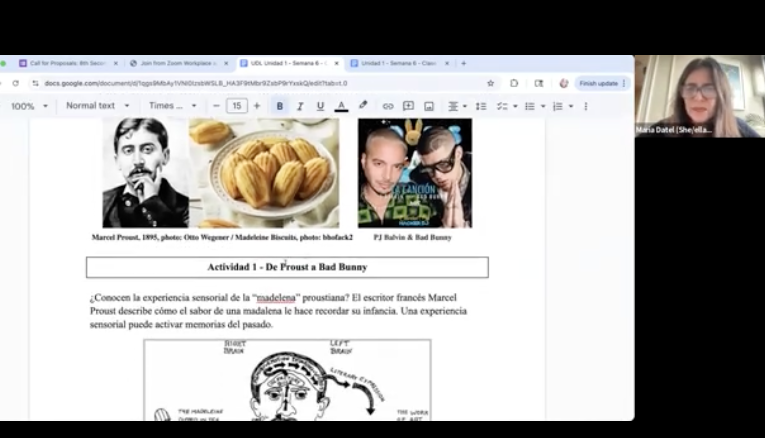
Our faculty-development video walkthrough illustrates this decision-making process through a lesson that brings Proust and Bad Bunny into conversation (note that the video is in Spanish). Rather than presenting a polished worksheet as if redesign were automatic, it examines how context, explicit sequencing, vocabulary scaffolding, and accessible presentation can change the routes into a complex activity while retaining its goals. Showing the process matters: we want colleagues to be able to redesign their next lesson, not merely reproduce ours. The original worksheet combined questions about memory and cultural references with a grammatical reflection on Spanish past tenses. The redesigned version introduces more explicit scaffolding, including a visual organization of the preterite and imperfect, structured response prompts, and an activity connecting sensory experiences to personal memories.
Ultimately, what matters is not the technology itself, but the pedagogical judgment behind its use. Tools will change; the ability to judge when a proposed alternative is genuinely accessible and pedagogically appropriate must remain with educators and learners.
Five Instructors, a Shared Practice
We initially imagined the project in terms of materials: colleagues would redesign activities across four course levels, and together we would assemble a repository. What developed instead was a community of pedagogical inquiry. We returned to one another’s questions, challenged familiar habits, and built a shared vocabulary for discussing access. The collaboration did not simply make the work more pleasant; it altered how we understood teaching and how our materials could circulate.
For Philip, the value of working with colleagues was the opportunity “to challenge one another in a collaborative, constructive space.” Their questions made it easier to reconsider established habits rather than assume that materials refined over years no longer needed examination. He also emphasized an insight that reshaped our timelines: accessibility begins at the moment of conception, not when an existing lesson becomes difficult for a particular student to use.
Carmen identified a structural change in our working relationships. Previously, she wrote, “sharing felt more like an afterthought”; even when colleagues exchanged plans, design often remained individual work. Shared objectives and a common Google Docs format allowed us to edit one another’s materials, notice weaknesses, and create continuity across course levels. Our collaboration became part of the curriculum’s infrastructure rather than an informal exchange at the edges of our teaching.
For Pau, the conversations rekindled his excitement about second-language teaching and led him to organize courses around purposeful multimodal communication. Bringing UDL into students’ assignments was a further transformation. As he explains, “They went from just completing assignments to actually thinking about how to communicate effectively with different learners.” Students were not merely recipients of accessible materials; they became participants in creating them.
Edgardo described a related shift in both the intended audience and the design process. His emphasis on variety, choice, and relevance pushed us beyond adding a second format to a conventional task. A technological tool mattered only when it opened access to meaningful input and helped students connect new language with social experience. His perspective reminded us that multimodal teaching cannot be reduced to the number of media included in a lesson.
For María, the work in the first-semester course also exposed the limits of relying on UDL alone. A classroom task may offer multiple ways to encounter content yet still be impossible to navigate with a screen reader. Revisiting actual documents and interactions therefore brought concrete digital accessibility into our collective framework. Across all four levels, our different challenges became mutually instructive: a problem exposed by an elementary worksheet might return in an intermediate art lesson, demanding a different but related solution.
Sustainability by Design: Sharing the Work and Opening the Process
Sustainability was never a final administrative task to address once the grant ended. We built it into our methods at three connected levels: instructors designing together, students learning to create accessible communication, and an open repository through which others can adapt the work. Each level makes the next possible. A collection of accessible worksheets is valuable, but the capacity to produce and improve them collectively can outlast any individual worksheet.
Our common, editable Google Docs format was deliberately unremarkable. It brought a lesson’s narrative, instructions, materials, and supplementary links together so another instructor could understand the pedagogical decisions behind an activity and revise it without starting from scratch. Having several instructors work in a shared format also helped us identify errors, exchange adaptations, and sustain continuity across the four-course sequence. Of course, using Google Docs does not automatically make a document accessible: source files still require appropriate headings, reading order, meaningful links, accessible media, and testing. The practical advantage was that we could improve the same source together instead of distributing isolated, difficult-to-edit files.
Sustainability also depends on involving students. When assignments ask learners to produce accessible captions, transcripts, audio descriptions, or other multimodal explanations, they must make deliberate choices about audience and meaning. Such projects combine language practice with an understanding of communication as a shared responsibility. They also make accessibility visible as something students can question, evaluate, and create—not merely a service they may or may not receive.
Finally, we created UDL in Action: Inclusive Pedagogy for Language Classrooms, our public Omeka repository, to make the work discoverable and open to reuse beyond our group. It brings together course materials, inclusive activities, instructor resources, and examples of student-created accessible content, including captions, transcripts, and audio descriptions. Alongside the archive, a developing series of short faculty-development videos documents the design process, not just its products. A complementary practical guide, Accessible Second-Language Teaching for Blind and Low-Vision Students, addresses the concrete digital-access requirements that UDL intentions alone cannot satisfy. Our hope is that instructors in other languages, institutions, and disciplines can adapt the underlying questions rather than copy a lesson unchanged.
We can document our current curricular products, collaboration across four course levels, the public repository, and the transformations described by participating instructors. We cannot yet claim that this work has caused measurable improvements in language proficiency or belonging across the full student population. Those questions call for sustained classroom evidence and student feedback, not extrapolation from the number of materials we created.
For colleagues who want to begin, we suggest starting with one activity already in use. Name the learning goal. Identify information or actions available through only one route. Ask what alternative preserves the same challenge, whether students can navigate it independently, and where human expertise is indispensable. Revise it, teach it, learn from the experience, and share both the new material and the decisions that shaped it.
The product we most want to share is therefore not a platform, worksheet, or even an archive. It is a transferable practice: design for variability and actual access from the beginning, let students participate in the work of accessibility, and build a community capable of continuing the redesign long after the original project ends.
Project Resources:
- UDL in Action: Inclusive Pedagogy for Language Classrooms — Omeka project site
- CAST Universal Design for Learning Guidelines 3.0
- W3C Web Content Accessibility Guidelines 2.2
- UNESCO, Guidance for Generative AI in Education and Research
AI disclosure: During the preparation of this article, the authors used OpenAI’s ChatGPT to assist with revising portions of the manuscript based on their original project documentation, instructional materials, and written reflections, as well as for spelling and grammar suggestions. ChatGPT also assisted in correcting the transcript and preparing subtitles for the accompanying instructional video. All AI-assisted content was reviewed, fact-checked, and edited by the authors, who take full responsibility for the final manuscript.