
When Objects Speak: Exploring German Texts Through Object and Shadow Theater
By Pia Banzhaf

DOI: https://www.doi.org/10.69732/NPOV9663
When teaching literature in a language classroom, one challenge is finding ways for students to move beyond reading about a text and instead engage with it as something lived, interpreted, and experienced. I wanted students to develop a deeper relationship with literary works, make interpretive choices, take linguistic risks, and communicate their understanding to an audience. Object theater, a form of visual performance in which found objects are used for storytelling, proved to be an unexpectedly powerful way to achieve these goals. My interest in object theater emerged from my background as a language educator and puppetry scholar whose practice is rooted primarily in shadow theater, an art form in which performers manipulate objects, cut-out figures or their own bodies between a light source and a projection surface.
What attracted me to object theater was a quality that is easier to demonstrate than explain: to create an object-theater performance, one must first develop a felt sense of a character and then search the material world for an object that somehow embodies it. The selection process is partly intuitive, and the correspondence between object and character often only becomes clear through experimentation. This embodied and exploratory mode of interpretation seemed ideally suited to literary study.
Creating theatrical productions was never the primary goal. Rather, object theater offered students a different way into a text. Instead of producing a written analysis that only the instructor would read, students translated their interpretations into visible, embodied performances. Because the literary text already existed, they could continually return to it, adapting and refining their understanding as they worked. They engaged in deep reading, strengthening both comprehension and language retention. Just as importantly, students spoke as characters rather than as themselves. The protective distance provided by a role often gave them greater freedom to take linguistic risks. Errors belonged to the frog prince, not to the student.
The course that emerged from these ideas was called Mit Texten spielen (Playing with Texts), first taught at Michigan State University (MSU) in spring 2024 and later at the Academic Year in Freiburg (AYF) program in 2024–25. Both versions engaged students with German literary texts through performance and play, with object theater serving as a central organizing principle. Students read, analyzed, and discussed literary works before finding objects that could embody characters, evoke atmospheres, or represent abstract ideas. They then presented and discussed their interpretations in German with their peers. The object-theater activities were embedded within a broader course structure that included collaborative annotation on Perusall, student-led discussions, presentations on genre and historical context, and ongoing vocabulary development. This article describes what happened in both iterations of the course and reflects on what object theater contributed to students’ literary and linguistic learning.
From Paper Theater to Object Theater
My original plan was to spend the semester working with paper theater, a form with deep roots in German cultural life which had been added to the nationwide Register of Intangible Cultural Heritage in 2018. Students would cut out characters, design sets, and perform well-known texts. In the first week, that plan collapsed. Faced with scissors and blank paper, students balked. I honestly had not anticipated that, but they felt that they were not artistic, they could not draw. Pressing through this would have meant spending the semester managing anxiety about artistic skill rather than engaging with texts. I pivoted to everyday objects instead, and within a session it was clear something more interesting was happening. The barrier that paper theater erected, that one must be able to make something, vanished once we shifted to object theater. The objects already exist. One only has to observe closely and choose wisely.
Starting with Archetypes
Fairy tale and folk tale archetypes are, I am convinced, the best entry point for object theater in the language classroom. The characters are already distilled to their essential qualities. Students do not have to construct an interpretation before they can begin. The cultural memory of the archetype frees their attention for the object-finding process and for language production. Once they have developed that muscle, more psychologically complex texts become possible. Since Grimm tales are generally connoted as children’ s stories, they invited the students to play.
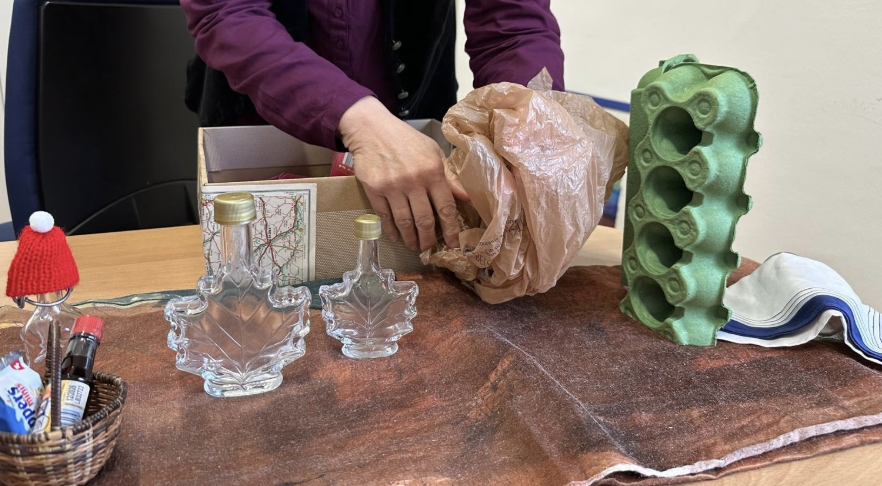
Little Red Riding Hood, the story we had started with in our paper theater attempt, offers a good illustration of how object theater works in practice. When we abandoned paper theater, I needed objects quickly, to show them an example of what could be. So I looked around my house. Glass containers became the characters, except for the wolf, he needed to be a different kind of material. Since he had to swallow the grandmother and Little Red Riding Hood, he needed to be expandable. I settled on a plastic shopping bag, the one synthetic, disposable thing in a world of more naturally recyclable domestic objects. Only later did I realize the symbolism went deeper than I had planned. Maple syrup bottles became the forest. A Brie cheese cardboard box served as the meadow where Little Red Riding Hood picks flowers, because it allowed me to plant flowers, represented by lollipops. A cereal box and later an upright egg carton became grandmother’s house in the forest. A handkerchief was her bedcover. For the huntsman I had originally set aside a large green bottle, but later I found a tiny Jägermeister liquor bottle which added a lot of humor for the students as “Jäger” means hunter in German.
Object theater is not a rigid set of rules. The performer’s body can enter when the object alone is not enough. In the scene where the grandmother asks why the visitor has such big eyes, I used my own eyes and a magnifying glass. For the hands, plastic forks.
At MSU, Little Red Riding Hood served as a rapid warm-up. Students performed the story at the German program book fair using my objects, which gave them an immediate, low-stakes introduction to the medium without the pressure of finding their own. The focus was on getting comfortable with object animation and language production quickly, with a real audience and a real deadline as motivation. In Freiburg, for the first class, I asked students to bring five objects, without telling them why. After the Little Red Riding Hood demonstration, I asked them to work in groups and decide which of their objects could belong to the same family and argue for their decision in German. The families were not predetermined. Objects could be grouped by material, structure, rigidity, or their relationship to light. A glass bottle, a marble, and a piece of plastic might belong together because of transparency. A wooden spoon, a cardboard box, and a cork because of their organic origin. The same object could belong to different families depending on the principle of categorization. The point was not classification but attention, learning to see the material qualities of ordinary things rather than just their function. This is a crucial exercise for the introduction of object theater.
In Freiburg, I gave students a list of Grimm fairy tales from which to choose. The results were inventive in ways I had not anticipated. For Rapunzel, one group reached for hair curlers, an apt solution, though of course it required someone to see it first. For the Froschkönig (The Frog Prince), two students who were not quite sure what to do grabbed objects at the last moment: two Monster energy drink cans, their size and different graphic designs distinguishing king from princess, and a small chewing gum container for the frog. There was something about the container that was unmistakably frog-like, a quality the students discovered in the moment of handling it, not in advance. Other groups brought Aschenputtel (Cinderella), Frau Holle (Mother Holle), and Hänsel und Gretel (Hansel and Gretel) to life with equal inventiveness. A student who thinks they are not creative may still pick up a chewing gum container and find it really is a frog.
Exploring More Complex Texts with Objects
Moving from fairy tales to Kafka required a different kind of object search. “Der Jäger Gracchus” (The Hunter Gracchus) tells of a hunter suspended between life and death, arriving by boat at a small harbor town, ascending stairs to a building where the local mayor receives him. The story is surreal and opaque, its atmosphere dense with specific material details: a monument on the quay, a two-story yellow house, a bier covered in a silk cloth, doves settling before a black oak gate, and a great staircase on which Gracchus wanders endlessly, never arriving.
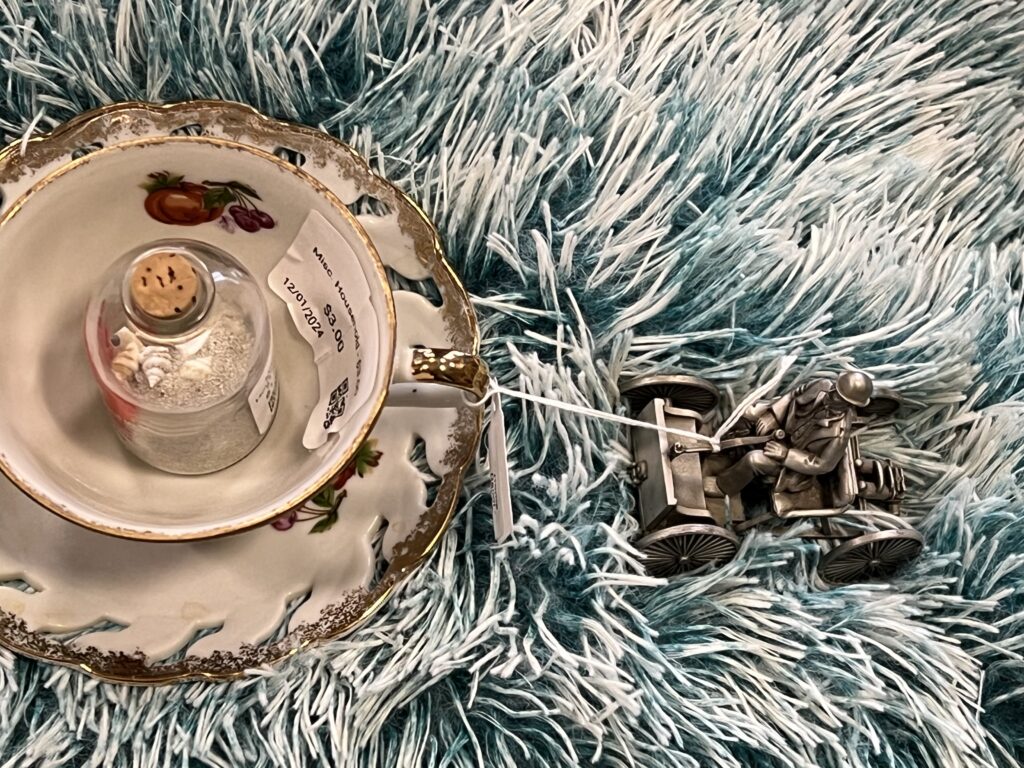
At MSU, we began in our classroom, which happened to be a classroom stocked with board games. Students initially worked with what was there but quickly felt the limitation of the objects at hand. That instinct itself was a form of textual understanding. I contacted the MSU Surplus Store (a store that sells a great variety of things that are no longer of use to various university departments), which generously allowed us to use their education space during class time. Even on days closed to the public, students could come in and take whatever they wanted from an extraordinary accumulation of objects: lab equipment, donated furniture, things left behind after moving day. A blue fuzzy fabric became the ocean. A teacup became the boat, fragile and slightly absurd, exactly right for a vessel carrying someone between worlds. An old, smallish cash register became the staircase, its rows of keys suggesting something mechanical and bureaucratic, a structure you ascend not toward transcendence but toward an official encounter. White branching forms served as birds.
In Freiburg, working without access to a surplus store, students found different solutions from what a student dormitory and classroom could offer. The Freiburg students brought their own familiarity with the landscape into play. We could see real chamois from the cable car that took visitors to a hill in the Black Forest from the city. Gracchus fell from a cliff in the Black Forest while chasing a chamois, which appears briefly in the story as the mundane cause of an extraordinary metaphysical condition. I do not think that this animal would appear in a term paper but because of our location and because of the fun of playing with objects, it became a character, and in the hands of that particular group, a somewhat comical one. Nobody could have planned for that reading. One group chose to depict the scene of Gracchus’ death after chasing the chamois. They stepped up on a chair and let a mandarin drop from the height of an outstretched arm. It fell with a thud and then the fruit was replaced by a small bottle of juice that was ferried away. It was a viscerally experienced moment. The class understood something about death and transformation that a written analysis could not have evoked in the same way.
Shadow Theater and a Brecht Parable
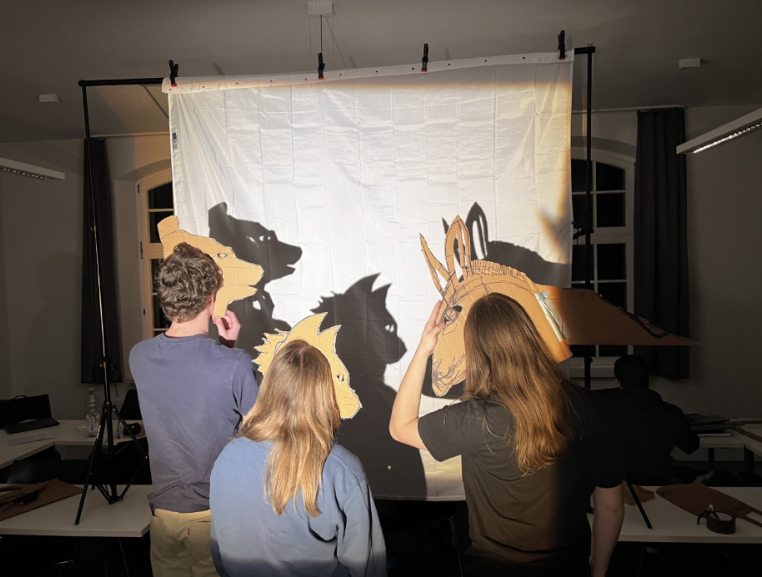
Both courses moved into shadow theater using Brecht’s parable “Wenn die Haifische Menschen wären” (If Sharks Were People). Theater was again not the primary goal. Students were translating a political text into a visual story, finding through light and shadow what they might otherwise have written in an analysis. Shadow theater offered something new: the transformation of familiar objects through light into pure image through shadow projection, reflection, and refraction. A piece of cut plastic could become a shark in silhouette. A net held between light and screen filled the scene with its texture. In shadow theater, objects can lose their identity as a specific thing and become simply what they look like in shadow.
These transformations require more precision than object theater. As an instructor, testing materials before class is imperative. Two things matter above all: the screen material and the light source. If you are interested in learning the details behind creating shadow theater, you can refer to this link to shadowlight resources. For screens, I brought a set I had made from cardboard science fair triptychs fitted with translucent material. These are portable, self-supporting, and reusable. Bedsheets, sports jerseys, shower curtains, and butcher paper also work. For light sources, what is needed is a point light source, a single LED emitter that casts one clean, crisp shadow. In the classroom, students mostly used the flashlights provided by me that have removable optical lenses. Phone lights also work remarkably well. Phones also served a second purpose: students filmed their scenes as they worked, playing back the footage immediately to evaluate the shadow effect and adjust.
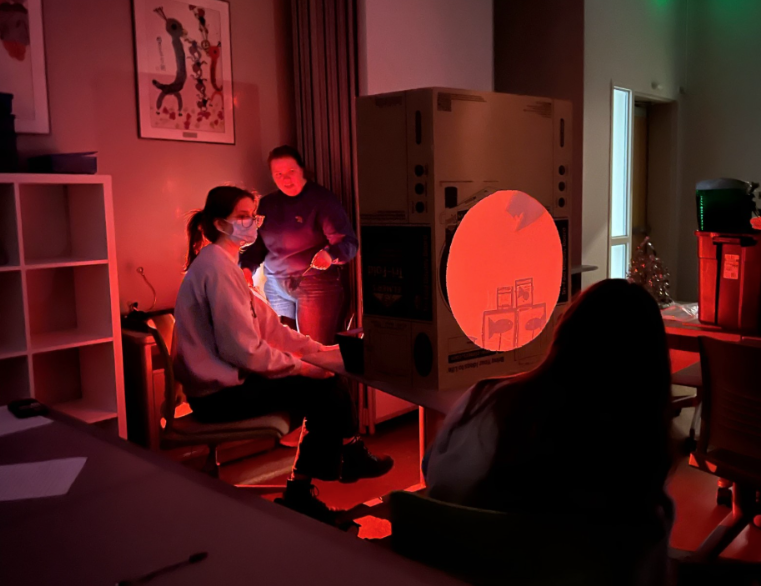
In addition, a point light source can be used like a camera. Students learned that moving it changes the scale and focus of the shadow, adding another layer of direction alongside the movement of the objects themselves. Color came from gels, cellophane, or transparent and refractive objects placed between the light and the screen. The technique had to be in service of the text. What both courses discovered in engaging with the Brecht text was that by trying to find visuals for the text, they had to go deeper into the text. One student noted that her group used lighting gels and refractive glass to set a different tone for each scene, helping distinguish the little fishes’ experience of art from their experience of war. Deep reading of the text made these choices possible.
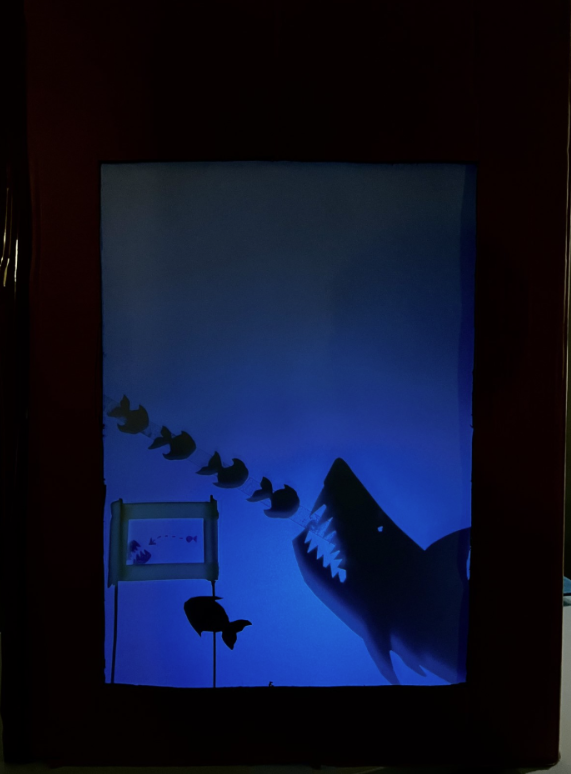
Shadow theater also made students feel more at ease during the sharing of explorations. Behind a screen in a darkened room, the performer disappears entirely. For students who found object theater in full view of their peers difficult, the world of shadows allowed them to be more free. Some who had been more quiet before took more initiative in the dark.
In Freiburg, where the class was larger, the staging of the Brecht took an additional step. Students had read about the Verfremdungseffekt (distancing effect or alienation effect) and were now making their audience experience something close to it. Each group had their own screen and stood in a circle around the room. The stages were not presented in narrative order. At each station, two students performed the vignette while others voiced the text, standing at their own screens. The audience would be surprised with where the next action was happening, turning to look.
In Freiburg, a visit to a local performance of the Bremer Stadtmusikanten (The Bremen Town Musicians) in a Brechtian Verfremdungsästhetik (distancing aesthetic) inspired students to make their own version. Without being assigned a medium, three groups formed around three different approaches: shadow theater with cut puppets and a performer in a cardboard animal headdress, object theater with found domestic objects, and hand puppets made from fists with cut ears and googly eyes attached.
Exploring Non-Narrative Texts
The last text at MSU was by Yoko Tawada, a Japanese-German writer who thinks deeply about language, translation, and identity. Students could choose between her essay “Von der Muttersprache zur Sprachmutter” (From Mother Tongue to Linguistic Mother), which plays with German grammatical gender in ways that resonate with English-speaking learners, and her poem “Diagonal,” evoking mystery through strangely juxtaposed images. For the essay, the class worked with shadow theater, thinking through Tawada’s images and finding visual equivalents for them. Since drawing was not the point, students printed images from the internet and cut them out as shadow figures: a typewriter, a key bearing the female symbol, lipstick, pencils.
A Crankie for Judith Herrmann’s “Rote Korallen”
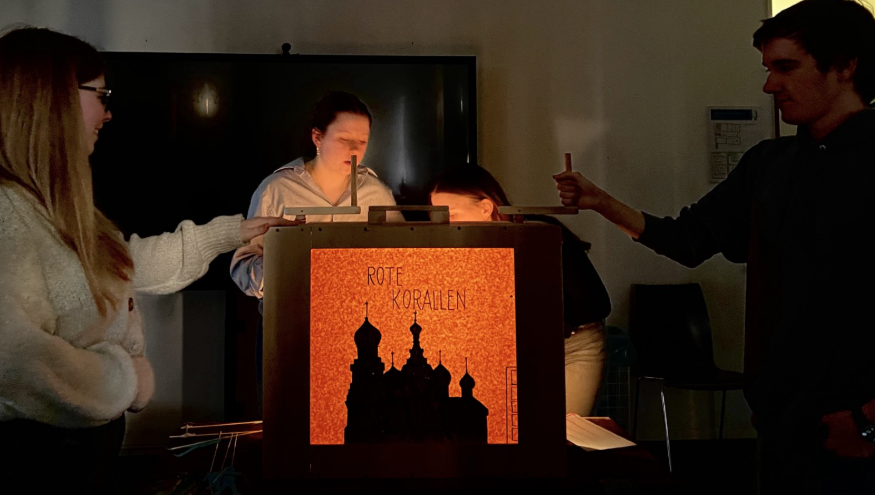
The last exploration in Freiburg took the course in a different direction. After attending a performance that featured a crankie, a scrolling panorama in which illustrated scenes move through a backlit box, students were fascinated by the form. I built one together with the program director in his woodshop. Judith Hermann’s surrealist short story “Rote Korallen” (Red Corals) has three distinct parts, so I divided the class into three groups, each responsible for one section of the scroll. Students drew their scenes on translucent packing paper and added cut shadow figures. When the three sections were glued together, they came together remarkably well. The story’s distinct parts meant the seams felt intentional rather than disruptive. Students performed the crankie for an audience twice. It was visually compelling, but unfortunately the language production got lost. The reading and discussions were in German, but the making absorbed the time and attention that in object theater goes into speaking.
What the Course Taught Me
After exploring different media across both courses, my preference remains object theater. It asks three things of students: heightened attention to the material world around them, deep reading and genuine thinking about character and action presentation, and language production. A crankie is visually compelling but the making absorbs the time that in object theater goes into speaking. Shadow theater opens possibilities that objects alone cannot offer, but it requires more precision and pulls toward technical problem-solving. For me, object theater keeps the focus where it belongs in the context of a language class: on the text, language production, and what students discover when they look closely at the real world around them.