
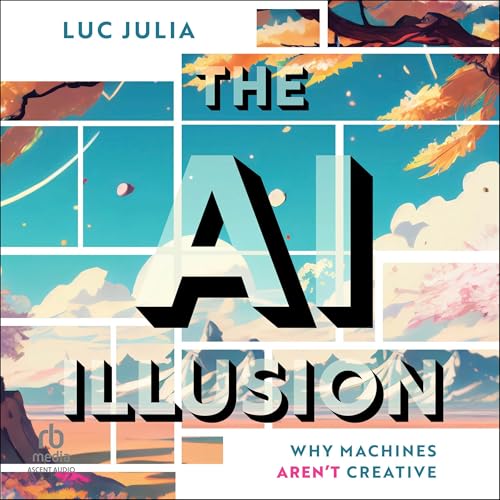
5 Takeaways from The AI Illusion: Why Machines Aren’t Creative by Luc Julia
By Gisele El Khoury, St. Lawrence University

DOI: https://www.doi.org/10.69732/BZTI1063
Introduction
This article presents 5 takeaways from the 2026 book The AI Illusion: Why Machines Aren’t Creative by Luc Julia (Wiley, ISBN: 9781394412174). Julia, an AI industry insider with over 35 years of experience, notably the co-creator of Siri and the former Chief Scientific Officer of the Renault Group, offers a compelling, skeptical take on generative AI. The book is written for a general audience of business leaders, technologists, and decision-makers. Still, it is also highly relevant to language educators who are increasingly asked to integrate AI tools within their teaching practice or to evaluate tools marketed to their institutions. Throughout the book, Julia dismantles seven widespread myths about what AI can do, arguing that current generative AI tools do not create, understand, or reason; they recombine existing data in response to prompts, that’s it! Now, whether or not you agree with all his conclusions, this book offers language teachers a much more grounded framework for thinking about the AI tools entering our classrooms.
Takeaway 1: Generative AI does not create, it recombines.
The book’s main argument is also its most immediately useful for language educators: AI tools like ChatGPT or image generators do not produce anything genuinely new. Instead, they identify statistical patterns in huge datasets of human-generated text and images and recombine them in response to a prompt. Julia, drawing on his deep technical background, makes this point clearly and repeatedly throughout the book.
I believe this distinction is important because it marks a significant difference in how we (as educators) approach and discuss AI in the language classroom. When a student turns in a paragraph generated by AI, they aren’t turning in the result of machine “thinking” or “creativity”; instead, they are turning in a combination of text that the model has seen. Knowing this allows for much more honest discussions with our students about what the machine is doing, instead of framing it as some sort of magic trick. It allows us to ask better questions: if the machine is only recombining text it has seen, which prompts generate the most useful responses, and which tasks remain exclusively human?
Takeaway 2: AI “hallucinations” are a feature, not a bug.
One of the most interesting moments in the book is Julia’s explanation of why AI systems confidently produce false information, what we call “hallucinations.” Because these tools are optimized to generate an answer, their training tends to penalize them for admitting uncertainty. Julia writes: “Saying ‘I don’t know’ loses points! Instead, AI will produce a plausible but incorrect answer because it lacks an internal mechanism to distinguish true from false statements. The model has no concept of truth; it only has a sense of which words tend to appear together.”
This is very important information to share with our students. Many AI writing tools can produce grammatically acceptable, contextually believable output that is simply factually incorrect (historically, culturally, or linguistically). Perhaps if we show our students examples of this hallucination, they will think twice before using it to complete an assignment.
Takeaway 3: AI cannot understand language; it models it.
In the book, Julia spends considerable time distinguishing between modeling a language and understanding it. Current large language models are extremely skilled at the former: give them a prompt or a text, and they can generate coherent chunks of text with impressive proficiency. However, they lack a cognitive model of word references to the world. They have no conceptualization of the author’s communicative intent, nor do they reason about meaning in the same manner that human readers do.
But why should this concern us as language teachers? Our field has a long tradition of focusing on meaningful interaction, comprehensible input, and communicative competence, all of which require the assumption that language has meaning and does not simply reproduce patterns. AI language tutors can provide plenty of input: grammatically correct, pragmatically appropriate, and fluent in the target language. But that is not the same as meaningful interaction. Our AI can only fake comprehension; it cannot comprehend. In any discussion with our colleagues and administrators about the merits of AI conversation partners and tutoring systems, Julia’s book encourages teachers to pose a simple but effective question. “Does it produce output or does it converse?” Julia’s view is that AI will never replace humans as long as it doesn’t know how to think on its own.
Takeaway 4: The environmental cost of AI is substantial and largely invisible.
One of the most surprising sections of the book, at least for me, is Julia’s account of the power demands of training and running large AI models. I obviously knew there was an ecological burden of generative AI in terms of cooling and water consumption, but I admit I didn’t know the extent of it. Julia frames this as one of the more urgent, underreported consequences of the rapid expansion of generative AI tools.
This made me think that we, as educators, are increasingly being asked to adopt AI-powered tools as part of pedagogical innovation, and this book serves as a reminder to ask tougher questions about the true cost of that process. It makes sense to wonder whether the environmental costs of using power-hungry AI tools truly outweigh the potential pedagogical benefits when less demanding, more energy-efficient instructional methods might suffice. These points are not an argument against the use of AI in language teaching, but rather an argument against its wholesale adoption.
Takeaway 5: Artificial General Intelligence (AGI) is not around the corner.
The book concludes with Julia’s assessment of where AI is headed, and the argument is sharply restrained: machines that can reason, learn, and create across domains, i.e., Artificial General Intelligence (AGI), are not going to be produced by present methods, no matter the increase in data or processing. These devices can currently only grow to be bigger, better “pattern finders” and are thus nowhere near intelligence or creativity.
For language educators, this may be reassuring news. There is significant anxiety in our field and across education about AI fundamentally undermining the value of human language use and instruction. Julia’s argument suggests that this anxiety is at least somewhat rooted in a misunderstanding of what AI is. The tools we have now are genuinely useful for certain tasks and genuinely limited for others. Rather than anxiously waiting for an AI that can do everything, we can focus on understanding the tools that exist, using them where they add value, and holding onto the parts of our teaching practice that depend on real human understanding, creativity, and communication.
Conclusion
Language teachers will benefit from reading The AI Illusion, not to get ideas for incorporating AI into their teaching, but to gain a much clearer sense of what they are really dealing with when working with it. Much of the hype in the educational AI debate is countered by Julia’s well-informed point of view, which is critical but not panicked, technical but not difficult to understand. Anyone looking for pedagogical inspiration should seek it elsewhere, but those looking to think more clearly about what AI is before making teaching or institutional decisions would do well to read this.
Reference
Julia, L. (2026). The AI illusion: Why machines aren’t creative. Wiley. ISBN: 9781394412174
AI disclosure: Generative artificial intelligence was used in the preparation of this article only for spelling and grammar suggestions.