
Managing the Muchedumbre: Low-Anxiety Tech Tools for SLA
By Sonya Nankin, M.S., Spanish Teacher and Writer

DOI: https://www.doi.org/10.69732/VDLS8975
Target Audience and Instructional Context
This article is specifically pitched at 6th-12th grade language educators working with Novice to Intermediate second language learners. It is necessary to distinguish the high school L2 learners referenced throughout this article from advanced higher-education students or multilingual L3+ adults. Advanced multilinguals have already spent time developing cognitive mechanisms that aid them in navigating language-processing bottlenecks related to short-term memory and retention, and this article does not address that level of SLA performance. In contrast, 6th-12th grade language-learning beginners face considerable cognitive vulnerabilities and have not yet had time to develop these mechanisms; when they encounter rapid target-language input, comprehension is not feasible, whereas at upper-Intermediate and Advanced levels it would be. Without deliberate scaffolding, the pressure of real-time processing can bring about overwhelming muchedumbre.
In Spanish, the word muchedumbre describes a dense, busy crowd – a sea of voices pushing and shoving in every direction. When I observe my Novice High school students during fast-paced listening exercises, I can see and nearly feel the muchedumbre. Foreign phonemes begin to clash with English translation; grammar rules collide and impact performance anxiety, and in seconds, the quiet mental space turns chaotic.
As language educators, we often tell students to listen and interpret instead of trying to translate everything in your head. This is tried-and-true advice, but for a high school language-learning beginner, the cognitive working-memory bottleneck is real and unremitting. By providing digital scaffolds, educators subsequently limit the opportunity for anxiety to rise, avoiding a situation where real language acquisition shuts down before it even begins.
Second Language Acquisition (SLA) researchers have identified that language co-activation requires continuous cognitive management (Marian, 2023). In the processing of language, working memory is greatly affected by what Christiansen and Chater (2016) termed the now-or-never bottleneck. This term refers to the momentary nature of oral input that lingers in working memory for less than two seconds before fading (Field, 2008). When Novice learners are inundated with fast speech, extended reading, and writing, their mental effort becomes taxing. It triggers an emotional reaction that Stephen Krashen defined as the affective filter. The digital scaffolds discussed in this article are one remedy against this shutdown. Rather than treating listening and vocabulary as final assessments, teachers can use simple digital tools to give students low-stakes practice opportunities. These opportunities can reduce the affective filter and still scaffold challenging cognitive intake.
Segmenting Audio Input in EdPuzzle
By focusing on bottom-up processing skills (decoding phonemes, syllables, and word boundaries), we can scaffold listening instruction and improve SLA outcomes. EdPuzzle is a versatile learning management system that supports formative assessment. It transforms educational videos (music videos, cultural news briefs, or native dialogues) into segments and, as the video plays, automatically pauses at predetermined checkpoints to prompt students with multiple-choice questions, open-ended reflections, or voice notes, furthering active engagement and greater comprehension.
Notably, EdPuzzle doesn’t just allow self-pacing; it explicitly encourages it. Instructional design research demonstrates that forcing learners to slow down and process input deliberately is helpful for deep learning. By enabling unlimited audio rewinds and auto-pausing at critical checkpoints, EdPuzzle turns what would otherwise be an intimidating stream of sound into segmentable, manageable intake. Students experience formative learning exercises in this landscape rather than high-stakes summative assessments.
Lowering the Affective Filter through the Use of Anonymous Word Clouds
While EdPuzzle scaffolds receptive listening, it does not directly ease another primary source of anxiety: oral production. Anonymous word clouds provide a low-stakes written stepping stone toward oral participation. By allowing students to test ideas anonymously on screen first, educators reduce the anxiety surrounding evaluation that typically would freeze hesitant speakers when asked to talk in front of peers. In a traditional classroom, asking open-ended questions is enough to get the wheels moving, but it results in the same three students raising their hands, while more hesitant learners choke on the silence out of fear or peer ridicule.
For this reason, online Word Cloud Creators, like those found on Menti Meter or Slido, bridge this gap through their real-time interactivity. During brainstorming or formative comprehension checks, students anonymously submit target vocabulary or reactions from their personal devices. Since contributions populate the screen anonymously, the affective filter drops to zero. No one can delete a response, and everyone can see every response. Students who are typically resistant to sharing their ideas can see their thoughts alongside everyone else’s on the collective screen, allowing them to feel more confident in orally sharing their ideas.
Gamified Approaches
Gamified platforms like Gimkit and Blooket can turn repetitive vocabulary practice into high-engagement learning. Rather than relying on stacks of flashcards or graded translation quizzes, these platforms grant immediate, non-punitive feedback that encourages rapid trial and error. However, because competitive countdowns and displaying leaderboards can inadvertently raise anxiety for time-sensitive learners, educators can counteract the gamification with non-competitive, self-paced, or collaborative team modes to ensure all students benefit from the gamified pieces of class.
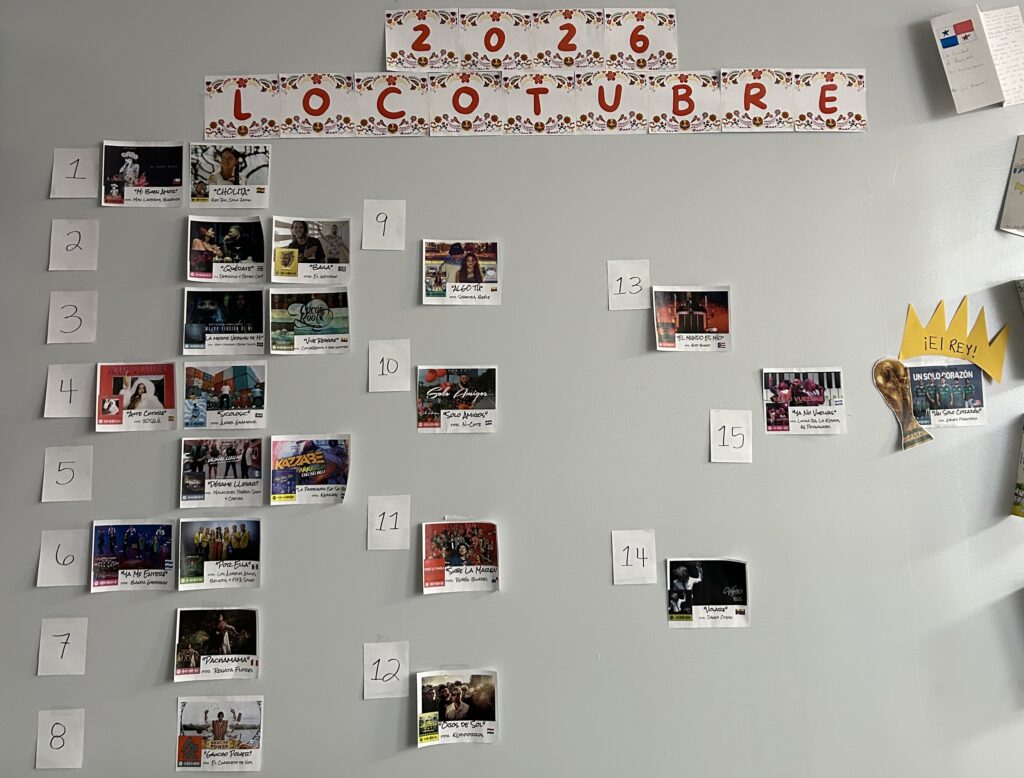
A gamified approach can also be used with authentic cultural units. For example, in the annual Locotubre music tournament students watch Spanish-language music videos (pop, flamenco, rock, hip-hop) and predict which songs will advance in the tournament bracket. They submit their predictions via Google Forms before the competition begins, fueling data-driven discussion in class. Discussion centers on what they observe about accents, regional and dialectal varieties, and recurring sound patterns. The technology provides a practical utility outside the classroom: after the lesson, discussion, or activity, this functional language lets students apply what they have learned, such as noticing familiar words or sound patterns and adding songs to their daily playlists. They see a purpose in listening attentively while engaging with the music beyond the classroom.
Tasting the Soup: Digital Retrospective Reports
The overarching theme across these technological interventions is the shift from summative judgment to formative responsiveness. This ethos is captured in educational researcher Paul Black’s (1998) famous culinary metaphor: “When the cook tastes the soup, that is formative assessment; when the customer tastes the soup, that is summative assessment.” To “taste the soup” daily, language teachers can implement digital Retrospective Reports: quick, two-question exit tickets delivered via digital forms at the end of a lesson. Students briefly reflect on where their working memory encountered “speed bumps” during the day’s listening or grammar activities. This instant student data allows the instructor to adjust pacing, introduce visual dual-coding, or provide targeted re-teaching the next morning. This allows any anxiety over difficulties to be addressed immediately and mitigated.
Conclusion
In this article, I identified and addressed specific friction points in language students’ real-time processing loop that I have experienced in my class, along with the digital tools I have implemented to help resolve these frustrations. EdPuzzle slows down rapid oral input so learners can decode phonemes at their own pace. Anonymous word clouds eliminate peer pressure so that every student can contribute without fear of ridicule. Gamifying language learning through platforms like Gimkit and cultural music competitions like Locotubre supports more connection between vocabulary recall and authentic cultural engagement. Platforms like Gimkit and Blooket build rapid recall by leveraging retrieval practice. In these game loops, students repeatedly encounter target terms in varied contexts, requiring fast active recognition that creates the space to consolidate vocabulary into long-term memory before high-stakes production becomes required. Lastly, short exit tickets (retrospective student report) allow teachers to “taste the soup” daily and adjust the next lesson with real-time feedback.
| SLA Intake Factor | Cognitive / Emotional Challenge | Targeted Technological Scaffold | Pedagogical Outcome |
| Working Memory | Fleeting oral input fades in < 2 sec (now-or-never Bottleneck) | EdPuzzle (Self-paced video segmenting and embedded questions) | Lowers cognitive load; forces deliberate processing for deeper intake |
| Affective Filter | Fear of peer ridicule and speaking anxiety in front of group | Interactive Anonymous Word Cloud Creators | Reduces anxiety to zero; fosters inclusive participation and dual-coding |
| Lexical Automaticity | Slow, effortful retrieval of high-frequency word chunks | Gimkit / Blooket gamification and Google Forms brackets | Builds rapid automaticity through non-punitive, high-engagement repetition |
| Responsive Instruction | Unidentified learning gaps leading to summative failure | Digital Exit Tickets (Retrospective Student Reports) | Provides immediate data to adapt instruction before summative evaluation |
When teachers have support to clear away the cognitive and emotional taxing of language learning, we can transform a chaotic muchedumbre into a space where true language acquisition is attained.
References
Ahadu, E. (2019). Assessment practices in the Center for Regional and Local Development Studies, College of Development Studies in Addis Ababa University, Ethiopia. https://core.ac.uk/download/234642386.pdf
Black, P., & Wiliam, D. (1998). Inside the black box: Raising standards through classroom assessment. Phi Delta Kappan, 80(2), 139–148.
Christiansen, M. H., & Chater, N. (2016). The now-or-never bottleneck: A fundamental constraint on language. Behavioral and Brain Sciences, 39, Article e62.
Conti, G., & Smith, S. (2021). Breaking the sound barrier: Teaching learners to listen. Language Teacher Toolkit.
Field, J. (2008). Listening in the language classroom. Cambridge University Press.
Frost, R., & Monaghan, P. (2017). Sleep-driven computations in speech processing. PLOS ONE, 12(1), Article e0169538. https://doi.org/10.1371/journal.pone.0169538
Krashen, S. (1982). Principles and practice in second language acquisition. Pergamon Press.
Marian, V. (2023). The power of language: How the codes we use shape our minds. Dutton.
Steckol, K. F. (2007). Learner-centered teaching in higher education: Formative assessment study turns classroom into research lab. The ASHA Leader. https://doi.org/10.1044/leader.ae2.12052007.14
AI disclosure: Generative artificial intelligence was used in the preparation of this article only for brainstorming ideas or for spelling and grammar suggestions.