
Prompting With Purpose: Designing AI Interactions for Language Learning
By Amanda Dalola and Sabrina Fluegel, University of Minnesota


DOI: https://www.doi.org/10.69732/FYWH5040
When ChatGPT burst onto the educational scene in November 2022, language teachers found themselves in a familiar position: curious, intrigued, and perhaps a little skeptical. Some saw exciting possibilities for language practice. Others worried about accuracy, bias, academic integrity, or the role artificial intelligence might play in language classrooms. We found ourselves somewhere in the middle.
Rather than debating whether AI belonged in language education, we decided to experiment with it ourselves. Specifically, we wanted to know whether carefully designed prompts could help language learners engage in meaningful practice across reading, writing, listening, speaking, vocabulary development, and intercultural learning.
With support from the Center for Advanced Research on Language Acquisition (CARLA) and University of Minnesota’s Language Center (LC), we launched a project that eventually became PromptEd: AI Prompts for Language Educators, an open-access collection of AI prompts for language educators. What began as a prompt-writing project quickly became something much larger. As we tested prompts across languages and proficiency levels, we realized that successful interactions were not happening by accident. Certain patterns kept emerging.
Some prompts consistently generated useful language-learning experiences. Others failed spectacularly. As we dug deeper, we discovered that effective prompts shared common characteristics. We also realized that ChatGPT was not playing a single role during interactions. Sometimes it acted as a tutor. Other times it functioned as a coach, a conversational partner, a cultural guide, or a simulator.
One of the most important insights from this process was that imperfect AI output could itself be pedagogically useful. Inaccuracies, biases, omissions, and oversimplifications often created opportunities for learners to question linguistic norms, compare regional and cultural perspectives, verify information, and consider whose voices were missing. We therefore came to treat AI responses not as authoritative answers, but as starting points for critical language and cultural inquiry. This article shares what we learned from that process.
How We Built the Prompt Collection
We did not begin by writing prompts from scratch. Instead, we started with the ACTFL Proficiency Guidelines and explored how ChatGPT responded when given descriptions of learner abilities at different proficiency levels. We asked the chatbot to generate candidate prompts targeting specific language skills and communicative goals. Those prompts were then manually reviewed, revised, tested, and refined through multiple rounds of interaction in English, Spanish, and French. The initial testing and refinement were conducted by the two authors, not through formal classroom study; references to learner responses elsewhere in the article reflect informal observations and feedback, not systematically collected research data.
In many cases, the first version of a prompt did not work particularly well. Some produced language that exceeded the target proficiency level. Others generated responses that were too vague or too long for the limits of a human learner’s working memory. Occasionally, the chatbot misunderstood the task entirely.
The process became highly iterative. We tested prompts, documented the results, revised the wording, and tested again. Over time, patterns began to emerge regarding what made prompts successful. One important lesson appeared early in the project. Initially, we attempted to calibrate prompts to ACTFL sublevels such as Novice Low, Novice Mid, and Novice High. In practice, however, ChatGPT struggled to consistently maintain distinctions at that level of granularity. While the chatbot generally responded appropriately to broader proficiency bands such as Novice, Intermediate, and Advanced, performance became less reliable when finer distinctions were requested. As a result, we ultimately designed prompts around broader ACTFL proficiency categories rather than sublevels. This approach produced more consistent interactions and proved easier for instructors to implement.
The Anatomy of an Effective Prompt
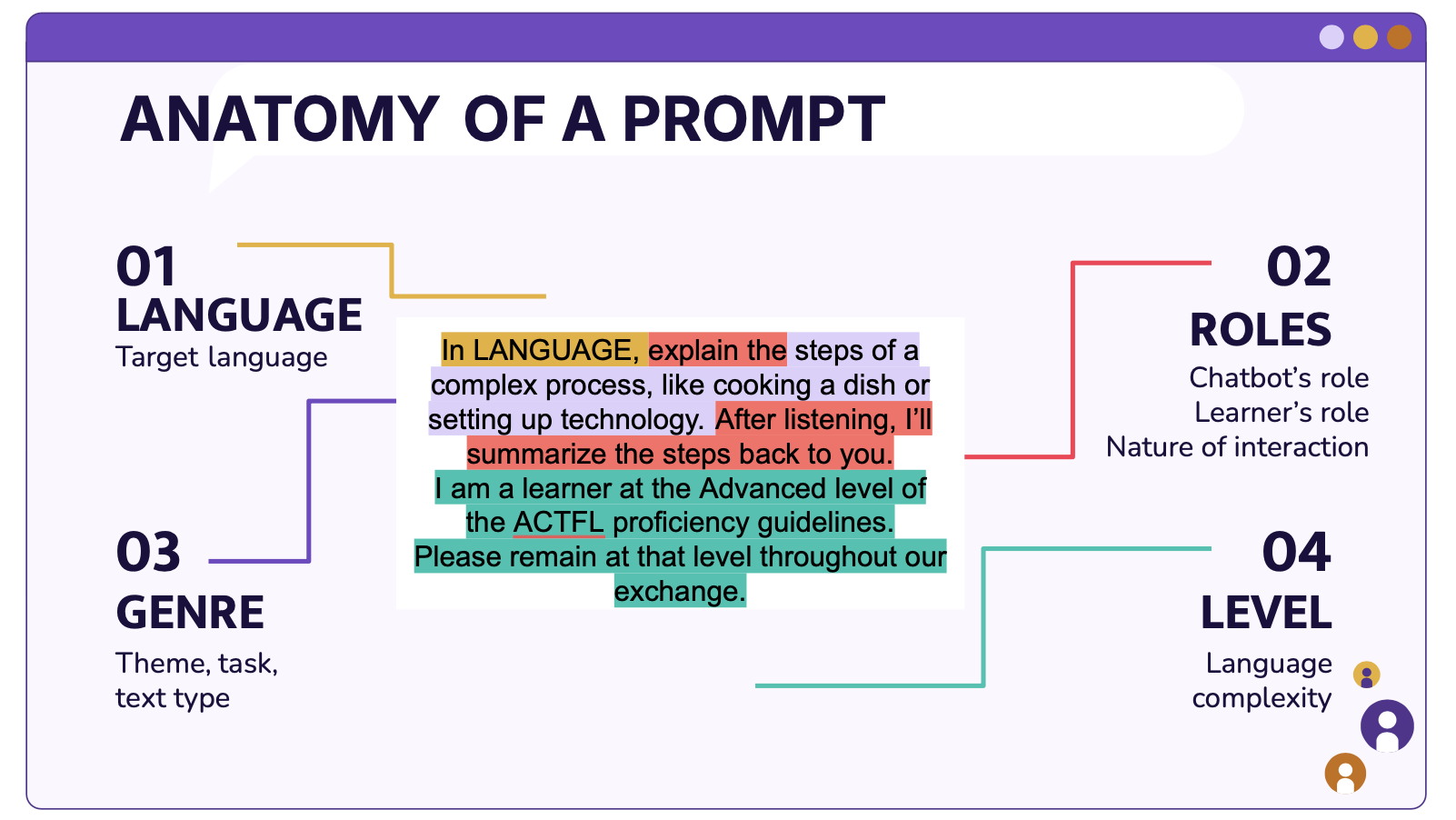
As we continued testing prompts, we noticed that the most successful ones shared four common components. Together, these elements formed what we began calling the anatomy of a prompt.
Language
The prompt specifies the target language to be used during the interaction.
Roles
The prompt establishes both the learner’s role and the chatbot’s role, as well as the nature of the interaction between them.
Genre
The prompt identifies the communicative task, topic, theme, and/or text type that learners will engage with.
Level
The prompt specifies the desired proficiency level and expected language complexity.
Picture 1 illustrates how these four components work together in a single prompt.
One of the most important lessons from our testing was that successful prompts are remarkably explicit. Human teachers are often comfortable filling in missing information or making assumptions about a learner’s goals. ChatGPT is not. The more clearly we specified language, roles, genre, and level, the more consistently the chatbot produced useful responses.
AI Can Play Different Roles
Another insight emerged as we reviewed hundreds of interactions. We realized that ChatGPT was not serving a single instructional function. Depending on the activity, it was taking on different pedagogical roles. To better understand those roles, we drew on Mollick and Mollick’s (2023) framework describing the various ways AI can function in educational settings. All seven roles identified in that framework (tutor, coach, mentor, teammate, tool, simulator, and student) are represented across the prompt database, with individual prompts sometimes positioning the chatbot in more than one role.
Thinking about AI in terms of roles helped us move beyond the question of whether AI was useful and instead focus on a more practical question: What role should AI play in a particular learning activity?
Throughout our testing, ChatGPT most frequently functioned as a tutor, coach, simulator, or tool, although all seven roles described by Mollick and Mollick (2023) are represented in the database. When introducing new vocabulary or checking reading comprehension, ChatGPT often acted as a tutor. During writing activities, it frequently functioned as a coach by providing feedback and revision suggestions. In speaking activities, it became a simulator, creating opportunities for conversational practice that many learners might not otherwise have. In vocabulary and culture activities, it often served as a guide or cultural informant.
This framework became increasingly useful because it shifted our attention away from the technology itself and toward the pedagogical purpose of the interaction. Effective prompts do more than specify a language and proficiency level. They also establish expectations for the role the chatbot will play.
AI as a Tutor: Supporting Reading and Listening
One of the most natural roles for ChatGPT is that of a tutor. In these interactions, the chatbot introduces information, checks comprehension, and provides immediate feedback. Unlike a textbook, however, the interaction is dynamic. Learners can ask questions, request clarification, and receive individualized support.
Reading Example
Prompt
Give me three short descriptions of common professions in LANGUAGE [LANGUAGE]. Then quiz me on the descriptions in English [ROLES, GENRE]. I am a learner at the Novice level of the ACTFL proficiency guidelines. Please remain at that level throughout our exchange [LEVEL].
Note: We used all caps in LANGUAGE to signal to the user that they would need to input the name of the language they wished to interact in before executing the prompt.
Why This Prompt Worked
Many novice learners struggle when reading feels disconnected from meaningful communication. We like this prompt because it places vocabulary into short, understandable contexts rather than presenting isolated word lists. Learners encounter familiar professions, read brief descriptions, and then demonstrate comprehension through follow-up questions. The task feels manageable while still requiring learners to make meaning from written language.
What We Learned
One of our first surprises involved gendered languages such as French and Spanish. ChatGPT consistently defaulted to masculine forms when generating professions. Rather than viewing this solely as a limitation, we found it created an unexpected opportunity for discussion. Learners quickly noticed the pattern and began experimenting with prompt wording to generate feminine and gender-inclusive alternatives. What initially appeared to be a flaw became a conversation about language, representation, and social norms.
Listening Example*
If you’re using a version of ChatGPT with voice enabled, you can type a prompt and it can respond out loud with voice audio. The speaking itself depends on the app/interface settings, not on whether your input is typed or spoken.
Prompt
Tell me the names of common items found in a classroom in LANGUAGE. Afterward, quiz me in English about the definitions of the items [LANGUAGE]. Ask me one question in English at a time before asking me another [ROLES, GENRE]. I am a learner at the Novice level of the ACTFL proficiency guidelines. Please remain at that level throughout our exchange [LEVEL].
Why This Prompt Worked
Finding opportunities for listening practice outside the classroom can be difficult, particularly for novice learners. This prompt allows learners to hear familiar vocabulary repeatedly while demonstrating comprehension through follow-up questions.
What We Learned
We quickly discovered that ChatGPT’s automatic transcription creates both opportunities and challenges. Because spoken interactions are displayed as text, learners can easily read rather than truly listen. During testing, we found that listening practice was strongest when learners responded orally and avoided looking at the screen. Several instructors suggested turning the device away during conversations to reduce the temptation to read along.
This observation reminded us that technology alone does not guarantee language practice. Thoughtful implementation still matters.
AI as a Coach: Supporting Writing Development
Writing was one area where ChatGPT consistently demonstrated potential. The ability to provide immediate feedback creates opportunities for revision and reflection that are difficult to replicate outside instructor office hours.
Writing Example
Prompt
I’ll write a short journal entry in LANGUAGE about my day [LANGUAGE]. Can you give me feedback* on my grammar and expression? [ROLES, GENRE] I am a learner at the Novice level of the ACTFL proficiency guidelines. Please remain at that level throughout our exchange [LEVEL].
*If you prompt ChatGPT in a language and don’t tell it to give you feedback in a different language, it will return feedback in the language of the prompt.
Why This Prompt Worked
Many learners hesitate to write because they worry about making mistakes. ChatGPT offers immediate responses that encourage experimentation and revision. Learners can submit a draft, receive feedback, revise, and repeat the process as many times as they wish.
What We Learned
One recurring challenge was that ChatGPT often wanted to improve student writing by making it more sophisticated rather than more accurate.
In several cases, the chatbot suggested grammatical structures or vocabulary that exceeded the learner’s proficiency level. While the revisions were often linguistically correct, they were not always pedagogically appropriate.
This finding reinforced an important principle: AI feedback should be treated as a resource rather than an authority. Learners benefit when they critically evaluate suggestions instead of accepting every recommendation automatically. Instructors can support this habit by reminding learners that they must remain the “human in the loop” and are responsible for deciding whether AI feedback is accurate, appropriate, and useful. Asking students to compare suggestions with course materials, explain which recommendations they accept or reject, and identify revisions that exceed the target proficiency level or alter their intended meaning can make this evaluative role explicit. Brief class discussions of accuracy, register, bias, authorship, and learner agency can reinforce that AI feedback is advisory rather than authoritative.
We also found that explicitly instructing ChatGPT to remain within a particular proficiency level significantly improved the quality of feedback.
AI as a Simulator: Creating Opportunities for Conversation
Perhaps the most exciting role we observed was ChatGPT’s ability to function as a conversational simulator. Many learners have limited opportunities to speak the target language outside of class. AI cannot replace human interaction, but it can provide additional opportunities for practice, especially when learners need a low-pressure environment in which to build confidence.
Speaking Example
Prompt
Describe your morning routine in LANGUAGE [LANGUAGE, GENRE]. I’ll listen and then tell you mine using similar phrases [ROLES]. I am a learner at the Intermediate level of the ACTFL proficiency guidelines. Please remain at that level throughout our exchange [LEVEL].
Why This Prompt Worked
The task focuses on a familiar topic while creating a natural conversational exchange. Learners listen, respond, and build upon the language they hear.
Unlike scripted dialogues, the interaction remains flexible and can evolve based on learner responses.
What We Learned
Many learners reported feeling less anxious speaking with ChatGPT than speaking with another person. The absence of social pressure appeared to encourage experimentation and risk-taking. Learners were often willing to attempt new vocabulary and structures because they did not fear negative judgment. At the same time, we noticed that conversations could become repetitive if learners limited themselves to short responses. Encouraging learners to ask follow-up questions often transformed simple exchanges into richer and more engaging interactions. More importantly, these activities reminded us that meaningful communication does not always require another human being. While AI should never replace authentic interpersonal communication, it can provide valuable opportunities to rehearse language before learners use it in real-world interactions.
AI as a Guide (Cultural Informant)
While many educators immediately think of AI as a tutor or conversation partner, some of our most interesting interactions occurred when ChatGPT served as a guide—helping learners explore linguistic variation, cultural practices, and diverse perspectives across the language-speaking world.
Vocabulary Example
Prompt
Help me learn new words by showing me names for different food items in different parts of the LANGUAGE-speaking world [GENRE, LANGUAGE]. I’ll repeat each word after you say it [ROLES]. I am a learner at the Novice level of the ACTFL proficiency guidelines. Please remain at that level throughout our exchange [LEVEL].
Why This Prompt Worked
Vocabulary instruction often focuses on a single “correct” word, even though language variation is a natural and important part of communication. This prompt encourages learners to see language as something dynamic rather than fixed. The activity also introduces learners to regional diversity from the very beginning. Rather than memorizing a vocabulary list, learners discover that speakers in different communities may use different words for the same concept.
What We Learned
One of our favorite discoveries involved food terminology.
For example, learners studying Spanish might encounter aguacate in one region and palta in another. Similar variation exists across many languages and language varieties. These moments often sparked conversations about geography, migration, identity, and language change. At the same time, we found that ChatGPT did not always volunteer these distinctions on its own. More specific prompts generally produced richer responses. Asking about vocabulary in Argentina, Puerto Rico, or Mexico generated far more nuanced discussions than simply asking about “Spanish.” This reinforced the importance of specificity: prompts naming a particular region or community produced more nuanced responses. When distinctions were missing or oversimplified, the output also provided material for the critical inquiry described below. We also encountered occasional hallucinations, including invented regional terms, inaccurate geographic associations, and confident explanations that could not be verified. This risk may be greater for less commonly taught languages and language varieties, where the model has had access to less training data. For that reason, instructors and learners should verify unfamiliar vocabulary with trusted dictionaries, corpora, community sources, or proficient speakers before treating it as reliable.
Culture Example
Prompt
I want to learn about social customs in a LANGUAGE-speaking country [LANGUAGE]. Can you describe how people typically greet each other in COUNTRY [GENRE]? After listening, I’ll compare it to the greeting customs in my own culture [ROLES]. I am a learner at the Novice level of the ACTFL proficiency guidelines. Please remain at that level throughout our exchange.
Why This Prompt Worked
One of our goals was to move beyond treating culture as a collection of facts to memorize.
Instead, we wanted learners to compare perspectives, practices, and experiences. This prompt encourages learners to reflect on their own cultural assumptions while learning about another community. The comparison component proved particularly valuable because it shifted learners from simply consuming information to actively interpreting it.
What We Learned
ChatGPT often provided useful cultural information, but the responses were sometimes overly generalized. When learners asked about “Spanish-speaking cultures” or “French culture,” the chatbot tended to generate broad statements that occasionally drifted toward stereotypes. More specific prompts generally produced more meaningful interactions. Asking about greeting customs in Puerto Rico, Senegal, Quebec, or Argentina often generated richer discussions than asking about an entire language community. We also discovered that cultural prompts frequently revealed the limitations of AI-generated knowledge. Some responses flattened cultural complexity or presented practices as universal when they were actually regional, generational, or context dependent. These limitations made cultural prompts especially useful for critical inquiry, as learners could identify generalizations, evaluate missing perspectives, and verify the chatbot’s claims against more authoritative cultural sources.
What Surprised Us Most
As we tested prompts across languages, proficiency levels, and communicative goals, several patterns emerged that we had not anticipated at the outset of the project. First, specificity consistently improved outcomes. The more information we provided about proficiency level, learner goals, target language, and AI role, the more successful the interaction became.
Second, we discovered that AI roles mattered more than we initially expected. Some activities worked well because ChatGPT was functioning as a tutor. Others succeeded because it was acting as a coach, simulator, or guide. Thinking explicitly about the chatbot’s role helped us design more effective prompts and anticipate where learners might need support.
Third, the chatbot’s limitations often became productive sites of inquiry. This pattern led us to a broader principle: AI output should be treated as a starting point for critical analysis rather than as an authoritative source.
Finally, although we provided ChatGPT with the ACTFL criteria for individual sublevels, it was able to respond reliably only to the broader Novice, Intermediate, and Advanced categories. This limitation should be understood as time-sensitive rather than fixed: because generative AI systems evolve rapidly, their ability to distinguish among sublevels may improve. Instructors should therefore retest prompts periodically rather than assume that earlier limitations will remain unchanged.
What ChatGPT Still Gets Wrong
Although we found many productive uses for ChatGPT in language learning, our testing also revealed several limitations that educators should keep in mind. Like any instructional tool, AI works best when its strengths and weaknesses are clearly understood.
Code-Switching Remains Challenging
One area where ChatGPT consistently struggled was code-switching. Early in the project, we envisioned activities in which the chatbot would move fluidly between English and the target language. For example, we asked it to introduce vocabulary in Spanish and then quiz learners in English, or to alternate between languages during a conversation. The results were mixed. In some cases, pronunciations became anglicized. In others, syntax became awkward or inconsistent. Occasionally, the chatbot appeared confused about which language it was supposed to be using.
Cultural Knowledge Is Not Cultural Expertise
One of the most important lessons from our testing involved culture.
ChatGPT can generate impressive amounts of information about cultural practices, traditions, and perspectives. However, information is not the same thing as expertise, and expertise is not the same thing as lived experience. For example, when we asked ChatGPT for famous movie quotes in Spanish, it often provided translations of quotes from Hollywood films rather than examples from Spanish-language cinema. While technically correct, these responses missed the cultural context we were hoping learners would encounter. Similarly, prompts about cultural practices sometimes produced responses that were overly generalized. Nuance, regional variation, and competing perspectives were occasionally lost in favor of broad descriptions that sounded authoritative but oversimplified reality. These experiences reinforced our broader principle that AI should support cultural inquiry, not replace authentic cultural voices or be treated as a source of cultural authority.
Biases Still Appear
Like many large language models, ChatGPT reflects patterns found in the data on which it was trained. During our testing, we observed examples of gender bias, cultural bias, and what might best be described as “default assumptions.” Profession prompts often defaulted to masculine forms in gendered languages. Cultural prompts sometimes prioritized dominant national perspectives while overlooking minority communities or regional variation. General questions about language communities occasionally produced responses that centered European or North American experiences. None of these issues were surprising, but they served as useful reminders that AI-generated content should be approached critically. These biases also provided concrete material for the critical evaluation of AI-generated content.
Language Literacy is Becoming AI Literacy
Treating AI output as a starting point rather than an authority requires learners to develop AI literacy alongside language literacy. As AI tools become more common, learners will need to evaluate responses, identify inaccuracies, recognize bias, and determine when information should be verified through other sources. In this sense, using AI in the language classroom is not only about language practice. It is also about helping learners develop the critical thinking skills necessary to navigate a world in which AI-generated content is becoming increasingly common. Rather than asking whether learners should use AI, we may need to focus on helping them learn how to use it thoughtfully and responsibly. This responsibility may be especially important in LCTLs (less commonly taught languages), for which learners often have limited access to proficient speakers, instructional materials, and reliable digital resources outside the classroom. In these contexts, the instructor may be the learner’s primary source of guidance not only in the target language, but also in evaluating and using AI-generated language appropriately. Helping students prompt, interpret, verify, and revise AI output in the target language therefore becomes an important extension of language instruction itself.
Final Thoughts: Start With the Role, Not the Tool
When we began this project, we thought we were building a collection of prompts.
By the end, we realized we were really developing a framework for designing AI-mediated language-learning experiences. The most successful prompts consistently shared four elements: Language, Roles, Genre, and Level. Together, these components helped us move beyond vague requests and create interactions that were aligned with instructional goals. Whether learners were practicing reading, receiving writing feedback, exploring regional vocabulary, or discussing cultural practices, the strongest prompts clearly communicated what the learner was expected to do and what role the chatbot was expected to play.
Perhaps the most important lesson we learned is that AI is not one thing. Throughout our testing, ChatGPT shifted between multiple instructional roles. At times it acted as a tutor, introducing new information and checking comprehension. At other times it functioned as a coach, providing feedback and supporting revision. In speaking activities, it often became a simulator, creating opportunities for conversational practice that might not otherwise be available. During vocabulary and culture activities, it frequently served as a guide or cultural informant. Thinking about these roles changed how we approached prompt design.
Effective prompts do more than tell the chatbot what topic to discuss. They establish expectations for the interaction by defining the relationship between the learner and the AI. In many ways, the most successful prompts in our collection were those that clearly specified not only what learners should do, but also what the chatbot should be. This shift in perspective helped us move beyond the common question of whether AI belongs in language education. A more productive question is: What role should AI play in this learning activity? The answer will vary depending on the instructional context. Sometimes learners need a tutor. Sometimes they need a coach. Sometimes they need a low-stakes conversation partner. In each case, the effectiveness of the interaction depends less on the technology itself and more on the pedagogical decisions that shape its use.
We also emerged from the project with a renewed appreciation for the role of language educators. ChatGPT can provide practice opportunities, generate feedback, and simulate conversations, but it cannot replace the expertise, judgment, cultural knowledge, and human connection that teachers bring to their classrooms. The most productive uses of AI occurred when educators thoughtfully designed and guided the learning experience rather than simply handing the task over to the chatbot.
For educators interested in experimenting with AI, our recommendation is simple: start small.
Choose a single learning objective. Decide what role you want the AI to play. Build a prompt that clearly specifies the language, roles, genre, and level. Test it. Revise it. Test it again.
Some of our most successful prompts emerged only after multiple rounds of revision, and many of our most valuable insights came from prompts that failed the first time. Those failures taught us just as much as the successes.
As AI continues to evolve, so will the ways language educators use it. We hope the two frameworks presented here, the Anatomy of a Prompt and AI Roles, together with the principle that AI output should be treated as a starting point rather than an authority, provide useful guidance for instructors exploring these possibilities with their learners.Ultimately, good prompt design is not about technology. It is about pedagogy. And like any effective teaching tool, AI works best when it is guided by clear learning goals, thoughtful instructional design, and a willingness to experiment.
References
American Council on the Teaching of Foreign Languages. (2024). ACTFL proficiency guidelines. https://www.actfl.org
Mollick, E., & Mollick, L. (2023). Assigning AI: Seven approaches for students, with prompts. arXiv. https://doi.org/10.48550/arXiv.2306.10052
About PromptEd
PromptEd is an open-access collection of AI prompts designed for language educators. The project organizes prompts by language skill, proficiency level, and instructional purpose while encouraging educators to adapt, test, and contribute their own prompt designs.
To learn more, explore the collection, or share your own prompts, visit: https://z.umn.edu/promptedlanguageprompts
AI disclosure: AI was used to format citations in APA 7th and do grammar, spell, and tone check vis à vis your style sheet. The authors then inspected its outputs and adjusted whenever necessary.
I really like this approach. Instead of asking whether AI belongs in language education, actually experimenting with carefully designed prompts gives teachers something much more useful: evidence from real classroom practice.
Absolutely loved your insights on purposeful prompting, especially how it enhances engagement in language learning! It really highlights the potential of AI to create meaningful interactions. Curious how you think this approach could evolve further—imagine integrating cultural nuances too!
I was disapointed that there was no mention of the role of ‘Coach’ in speaking activities. and feel some of the problems you discovered with feedback on writing apply equally to feedback on speaking.
For example, you said, “One recurring challenge was that ChatGPT often wanted to improve student writing by making it more sophisticated rather than more accurate.” is a problem when students ask for feedback on their recordings of speaking activities, too.
I found that ChatGPT and Gemini are getting better and better at adapting suggestions for improving students’ speaking when asked to identify, but possibly not reveal, the CEFR level of a student’s audio file. Even to the extent of A1, A1+, A2, A2+ etc
At present only Gemini offers feedback on the sounds students make, so I recommend it as it can be more useful than ChatGPT for help on pronunciation.
I look forward to explring the https://z.umn.edu/promptedlanguageprompts
prompts.