
From Classroom to the Booth: Professionalizing the Novice Interpreter
By Cristina Pardo-Ballester, Iowa State University
DOI: https://www.doi.org/10.69732/ILTP1621
Introduction
Translation and interpreting are often grouped together, but they involve very different kinds of communication. Translation usually works with written texts. A translator has time to stop, think, revise, consult dictionaries, and refine meaning before producing a final version. Interpreting, by contrast, happens in real time. The interpreter listens to a message in one language and immediately communicates it in another, often while the speaker is still talking. There is no pause button, no opportunity to rewrite a sentence, and no second chance once the words are spoken. Interpreting scholars and professional interpreters alike have emphasized that interpreting is shaped by immediacy and by the challenge of communicating meaning in real time (Pöchhacker, 2016; Cabrera, 2018).
For readers unfamiliar with the field, it may help to distinguish a few common types of interpreting. In consecutive interpreting, the speaker pauses every few sentences so the interpreter can reproduce the message, often using specialized notes. In simultaneous interpreting, commonly used at conferences and international events, the interpreter speaks while listening at the same time, usually only a few seconds behind the speaker. A third type, bilateral interpreting, involves interpreting back and forth between two speakers, such as a doctor and a patient or a teacher and a parent.
Because interpreting requires students to listen, process meaning, and speak almost simultaneously, it places very different cognitive demands on them than translation does. Many students initially feel more comfortable with translation because it allows more control and reflection. Interpreting, however, requires rapid decision-making, concentration, and the ability to keep communicating even when the message is imperfect.
That difference is exactly why interpreting can become such a valuable learning experience in the language classroom. Just as language teachers often try to recreate authentic communication tasks for students, interpretation training pushes learners to use language under real-world conditions: in real time, under pressure, and with a clear communicative purpose. The core mission of our training is to recreate those conditions as closely as possible, helping students move from thinking like language learners to beginning to think like professionals managing communication in the moment.
In my interpretation class, we try to prepare students for these challenges as realistically as possible. We read about interpreting, discuss professional situations, and practice the skills interpreters rely on in real settings. Students work with ACEBO training materials, which introduce foundational exercises in consecutive and simultaneous interpreting, build topic-specific glossaries, and practice interpreting in class. Unlike traditional vocabulary lists, interpreting glossaries are organized around specialized topics such as healthcare, agriculture, or economics, helping students prepare key terminology in advance so they can focus on communicating meaning rather than searching for words in the moment. Students also learn note-taking techniques and read reflections by Gabriel Cabrera, a Spanish professional interpreter and author of Mamá, quiero ser intérprete, whose writing helps them better understand the realities, pressures, and professional commitment involved in interpretation. Along the way, they develop the listening, concentration, and real-time communication skills necessary for interpreting, all within a regular classroom setting.
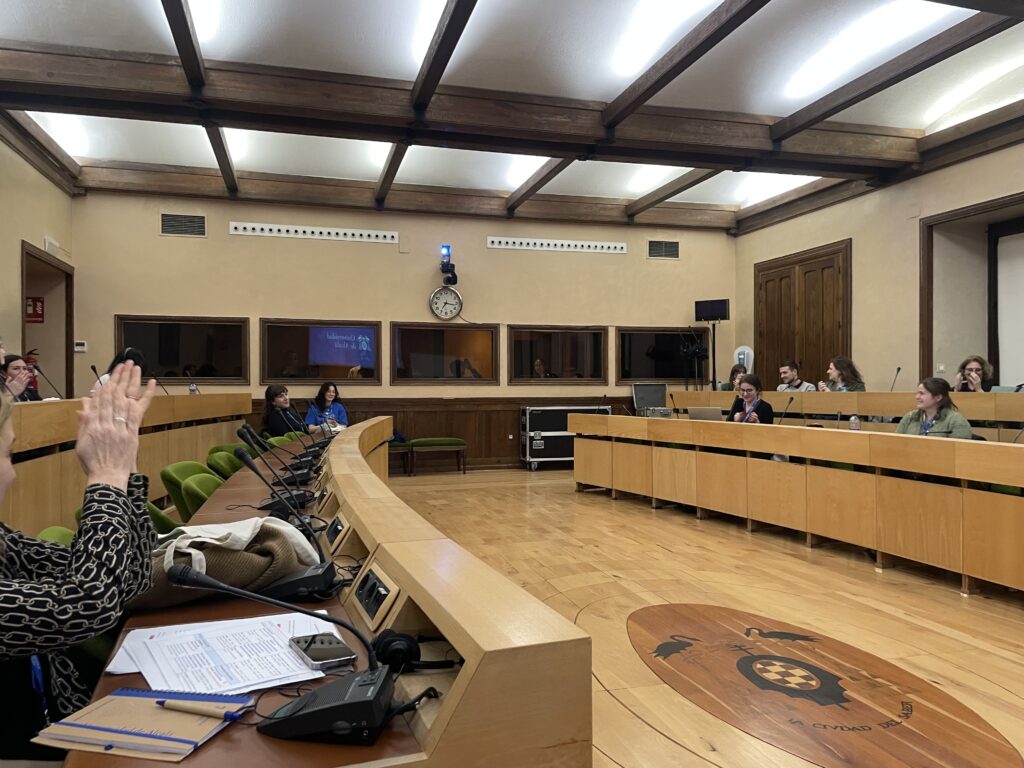
In our World Languages and Cultures department, we do not offer a major in Translation or Interpretation Studies; we only offer a minor, and we do the best we can with the resources available to us. And what we have matters. We do not have a permanent interpreting lab or the professional soundproof booths I trained in more than thirty years ago at the School of Translation and Interpreting at the University of Granada. There, stepping into a booth was part of the routine. Several times a week, we entered fully equipped interpreting booths, put on our headphones, and interpreted speeches in real time, often without knowing the topic in advance. The environment itself communicated something important: interpreting was not just another classroom exercise; it was a professional performance carried out under pressure.
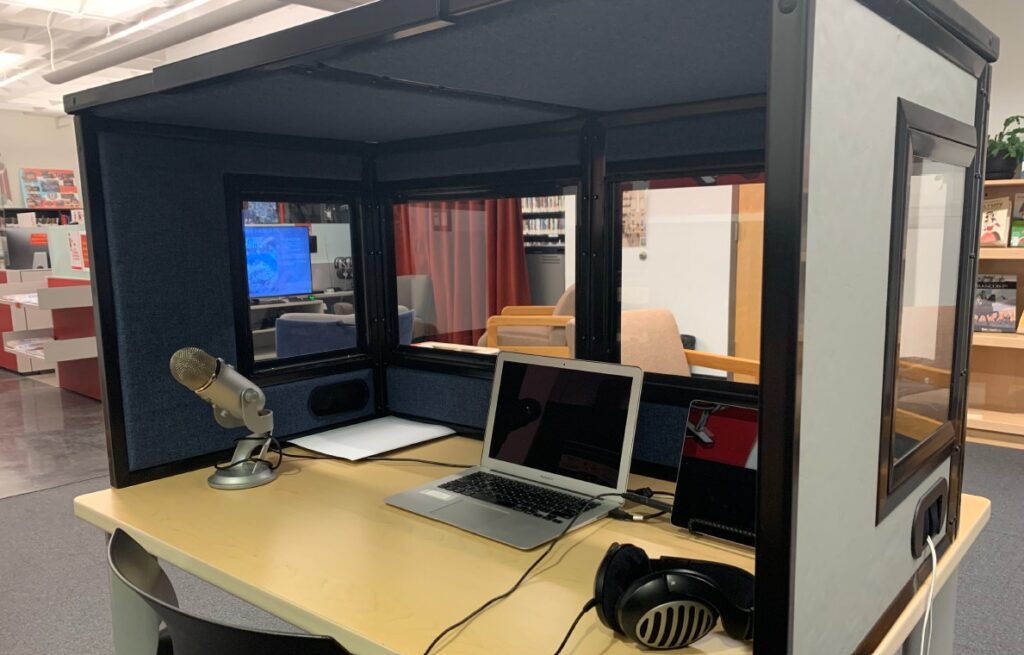
At Iowa State University, that experience is not built into the physical space. It is something we have had to imagine, adapt, and recreate from scratch. So, we get creative. Instead of a permanent interpreting lab, our department uses a portable booth setup in the Language Studies Resource Center (LSRC), a flexible learning space in the Department of World Languages and Cultures designed to support language learning through technology and interaction. The booth is designed to recreate some of the experience of professional interpreting within the resources available to us. The booth includes a tabletop sound-isolating structure, headphones, a microphone, and recording software connected to a laptop. The setup relies on relatively accessible technology rather than specialized interpreting consoles. While it is much simpler than the interpreting labs where I trained, it still creates something essential for students: a physical and psychological shift away from the normal classroom environment. Once students sit inside the booth, put on the headphones, and begin recording, the activity immediately feels more real, more focused, and more professional. In practice, the booth can be assembled in almost any quiet room using portable acoustic panels, a laptop, recording software such as Audacity, and a quality headset with a microphone.
But even with all that effort (readings, practice, and simulations and the booth itself), there is still something we cannot quite reproduce in the classroom. Students can pause the audio, ask questions, and try again. They work from their own computers, complete interpreting assignments at home, and if something does not go well, they can laugh it off and move on. There is always a safety net. And that is not a bad thing; it is how learning begins. Some students hesitate to volunteer because they are afraid of getting it wrong, while heritage speakers often step in more confidently. I remember the same dynamic when I was training; there was always someone ready to jump in when the rest of us felt unsure, whether because of vocabulary gaps or something as simple as struggling with note-taking.
But that safety net is also what makes the experience fundamentally different from real interpreting. Interpreting is not just about knowing what to do; it is about doing it in the moment, with no pause button, no rewind, and no second chance. I remember very clearly the first time I sat in a booth in Granada. It was not comfortable or controlled. It was intense, a little chaotic, and very real. You had to listen, process, and speak all at once, and once it started, there was no stepping out of it. This is the essence of simultaneous interpreting: listening and speaking concurrently while managing meaning under significant cognitive pressure.
I wanted my students to experience some of that reality, not the anxiety, but the sense of responsibility and immediacy that comes with interpreting in real time. The booth helps create that shift. Once students put on the headphones, hear their own voice through the microphone, and realize the recording will continue without stopping, the activity immediately feels different from an ordinary classroom exercise. Even if our setup does not resemble the professional booths where I trained, it still helps students move from simply practicing interpreting to experiencing what it feels like to perform under real-time conditions.
Because in the end, this project is not about equipment. The booth matters because it helps create a more authentic environment, but the deeper goal is pedagogical: creating that moment when students realize that interpreting is no longer just an exercise. It is something they have to perform, right then and there. And that is something the classroom alone, no matter how well we teach in it, cannot fully provide.
The Pedagogical Framework: Why Does the Booth Matter?
When I think about how to bring students closer to real interpreting, I always come back to one idea: it’s not just about teaching the skill, it’s about changing the conditions under which they practice it. In a typical language classroom, students are supported by time. They can pause, think, revise, and try again. That works well for translation, but interpreting is different. It happens in the moment, and that’s something we must intentionally recreate. So, when my students go into the booth at the LSRC, the goal is not perfection; it’s experience.
I build this experience gradually. Each interpreting project is worth 15% of the final grade, so students understand that the work matters, but before they are formally evaluated, they have opportunities to practice in ways that help them get comfortable in the booth environment. One way we do this is through bilateral interpreting practice. In these sessions, students interpret back and forth between both languages, much like an interpreter working between a doctor and a patient or between two speakers in conversation. Because students must interpret in both directions, the activity helps them develop flexibility, confidence, and the ability to manage communication in real time.
These practice sessions are lower-stakes, but still counts toward the course grade because they prepare students for the more demanding interpreting projects later in the semester. Just as importantly, they allow students to make mistakes early on, adjust, and begin developing the rhythm of listening, processing, and speaking without the pressure of a major graded task. By the time they move into the main projects, they are more prepared, not just linguistically, but mentally as well.
Students complete two major interpreting projects. The first focuses on consecutive interpreting, where they listen to short segments, take notes, and then reproduce the message in the target language. To support this process, students learn note-taking strategies inspired by Jean-François Rozan, whose note-taking principles remain influential in interpreter training because they help interpreters capture meaning quickly through structure, symbols, abbreviations, and visual organization rather than complete sentences.
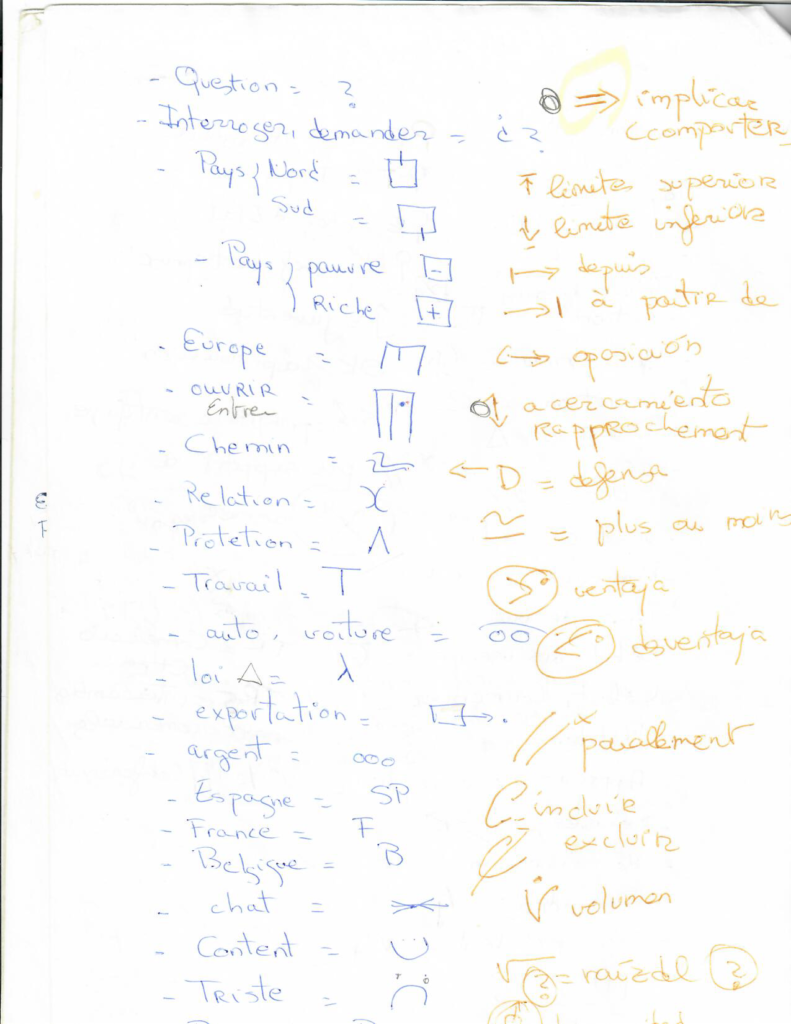
This is where all the work with symbols, structure, and listening for meaning comes into play. Students learn to abbreviate rather than write full words, to organize their notes vertically so ideas are clearly structured, and to use simple links and symbols to show relationships between ideas. They also practice marking emphasis, indicating negation, and capturing shifts in meaning as the message unfolds. Very quickly, students realize that effective interpreting notes are not about writing everything down; they are about selecting and organizing key ideas in a way that allows them to reconstruct the message clearly and confidently.
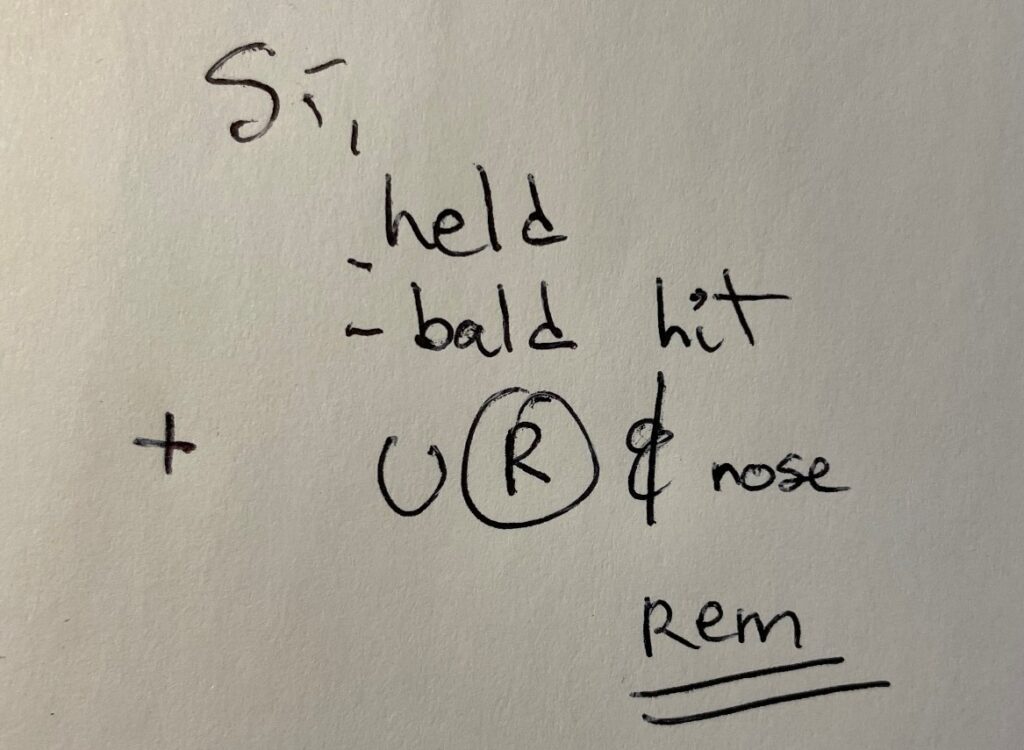
Students practiced note-taking using short witness-style statements such as: “Yes, of course. He was the one who held me while the guy with the shaved head hit me. Also, he has an earring in his right ear and another one in his nose. I remember him perfectly.” Picture 4 shows one example of how students condensed this information into interpreting notes. The notes demonstrate abbreviation and symbol use, such as replacing also with the symbol “+” to quickly indicate additional information. The image also reflects the principle of verticality, with ideas arranged downward to mirror the progression and structure of the message rather than written in complete horizontal sentences. In addition, specific details are represented visually and economically: the circled “R” next to the ear symbol indicates right ear, while the nose piercing is captured with a simple symbol rather than a full written description. The notes further show selective emphasis and memory cues, as seen in the abbreviation “Rem” (for remember) being underlined twice to stress the speaker’s certainty and confidence in identification. Overall, the example highlights how interpreting notes prioritize concise visual organization, symbols, and meaning-based recall instead of verbatim transcription.
This process is not only practiced but also assessed. In addition to submitting their recorded interpretation, students turn in their glossaries and their handwritten notes, usually collected in a manila envelope. Reviewing these materials allows me to evaluate not only the final interpretation, but also the preparation and decision-making process behind it: how they researched the topic, organized information, and used their notes to support delivery in real time.
The second project is simultaneous interpreting, and this is where things really shift. Before students step into the booth, we spend time building the skills they need to handle that level of cognitive demand. We start with exercises such as shadowing in which students repeat speech in the same language while listening at the same time. The goal is not memorization, but helping students become comfortable processing and producing language simultaneously.
From there, we gradually add more complexity through dual-task activities designed to train concentration and divided attention. For example, I might tell students a short story about a weekend, a vacation, or a personal experience while they repeat the message aloud and simultaneously write numbers from 1 to 100 on paper. At the end, students often discover that they skipped numbers without realizing it, revealing how easily concentration can break down when the brain is managing multiple tasks at once. Other variations include counting backward, writing multiplication tables, or completing alphabet exercises while shadowing the spoken message. These activities are often practiced over the course of several class sessions, and sometimes an entire 50-minute class period is devoted to developing concentration, listening, and processing skills through these exercises.
We also work on chunking, helping students stay slightly behind the speaker so they can process units of meaning rather than individual words, and on short paraphrasing exercises that encourage flexibility and discourage word-for-word translation. In some exercises, students retell a story using different wording while preserving the original meaning. In others, they complete fill-in-the-blank activities in which they must infer missing words from context rather than rely on direct translation. Together, these activities help students develop the mental flexibility necessary for simultaneous interpreting.
By the time they reach the booth, students understand that simultaneous interpreting is not about translating every word, but about managing meaning in real time. In this project, they are not expected to rely on notes in the same way as in the consecutive project. In fact, I encourage them not to. However, I do ask them to keep paper and pencil nearby in case they need to jot down a number, a name, or another detail that may be difficult to retain. That small support makes a difference, giving them confidence while still pushing them to rely primarily on listening, processing, and speaking at the same time.
Another important piece of the framework is what I call the “one-take” reality of the booth. Once the audio starts, it doesn’t stop. There is no pausing or rewinding. This is very different from how students practice at home, and it immediately changes their mindset. They stop aiming for perfect sentences and focus instead on keeping the message moving. They learn to make decisions quickly, recover when something doesn’t come out right, and continue without freezing.
I often refer to Gabriel Cabrera’s reflections on the profession, particularly his emphasis on the level of commitment interpreting requires once you begin. Students respond strongly to that idea because they start to understand that interpreting is not just about language ability; it also involves preparation, composure, and learning to trust their own voice in real time.
Since students complete their booth sessions independently at the LSRC and submit their recordings afterward, I experience this shift mainly through what I hear rather than what I see. At the beginning, many students rely heavily on their notes and try to capture every word. That often comes across in their delivery: hesitations, false starts, or a tendency to stay too close to the original structure. But after a few sessions, something begins to change. Their interpretations become smoother, more fluid, and more focused on meaning rather than individual words. They sound more confident, more natural, and more in control of the message. That shift reflects a deeper change in how they approach interpreting: they move from trying to reproduce language to communicating it.
Student Voices: What They Take with Them
This course is an introductory course in interpretation, and that matters. Most students who enroll are not planning to become professional interpreters. Some are heritage speakers with strong bilingual skills, while others simply want to improve their speaking and listening. Over the years, the classroom has brought together students from a wide range of backgrounds, engineering majors, future healthcare professionals, and students pursuing Spanish as a second major or minor. And yet, despite these differences, the impact of the course tends to be remarkably consistent.
I often think about former students when I reflect on what this experience means beyond the classroom. I have been teaching this course since 2015, and many students who once entered the booth nervously and unsure of themselves have gone on to very different professional paths while still carrying something important from the experience.
Some are now working in healthcare or pursuing medical degrees. One former student, now in medical school, found the course especially challenging at first. Over time, the experience strengthened her listening comprehension, expanded her medical vocabulary in Spanish, and gave her greater confidence communicating under pressure. Today, she volunteers as a medical interpreter in a clinic serving patients without insurance or access to resources. Another former student, now pursuing graduate studies in engineering, once told me that every student studying Spanish should take a course like this, even if they do not plan to become interpreters, because it improves real-time processing, listening skills, and confidence in spontaneous communication.
Students often realize that what they are developing goes far beyond interpreting itself. They learn to stay focused under pressure, continue communicating even when unsure, and prioritize meaning over perfection. What stands out most is a shift in how they think about language: they move from asking, “Did I say this correctly?” to asking, “Did I communicate the message?”
Years later, when I hear from former students working in healthcare, engineering, business, or education, they rarely talk about interpreting techniques. Instead, they talk about how the course helped them listen more carefully, think faster, and communicate more effectively across languages and cultures. And in many ways, that is what stays with them.
The following video is a testimonial from a former student who now works as a medical interpreter:
Technology and the LSRC Model: Making the Booth Possible
At this point, you might be wondering: This sounds great, but how do I actually make this happen in my own program? Or maybe you’re thinking about your own language lab and wondering whether an interpreting project is even possible with the resources available to you. The good news is that it is. What matters most is not having a perfect professional facility, but creating an organized experience that combines space, technology, structure, and support.
Our interpreting sessions take place at the LSRC in Room 3228, also known as the Global Student Workspace. The space functions as a flexible learning environment where students study, collaborate, and, in this case, complete their interpreting projects using the portable booth setup. The booth itself is not a permanent installation, but a portable setup that can be assembled when needed using relatively accessible technology rather than specialized interpreting consoles. It includes a tabletop sound-isolating booth, headphones with microphone, a laptop with recording software such as Audacity, and a separate device, usually an iPad, for audio playback. Together, these tools create a simplified version of the simultaneous or consecutive interpreting environment while still preserving its essential challenge: listening and speaking in real time.
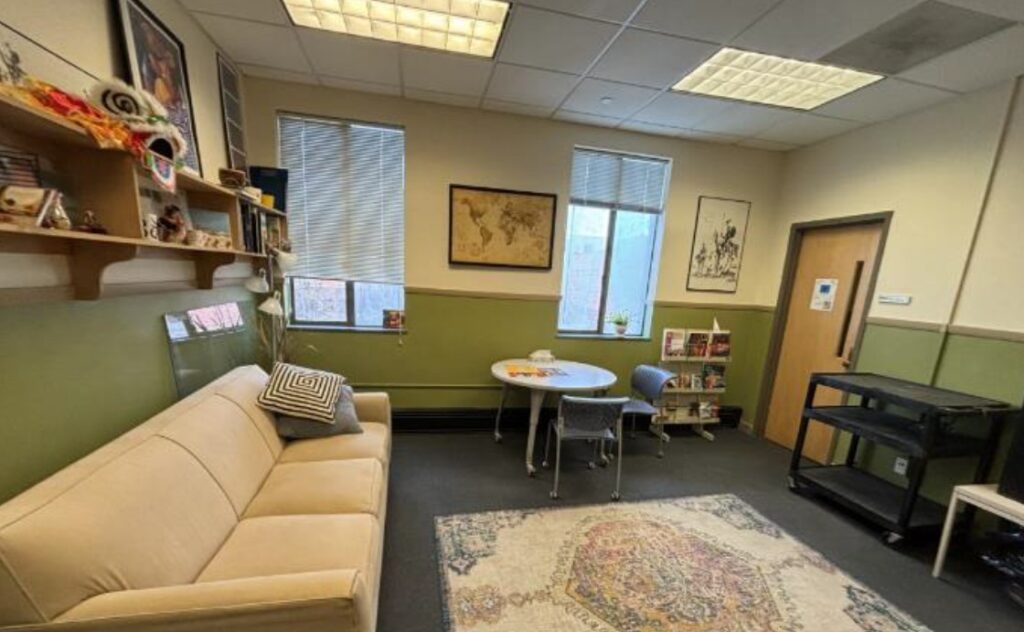
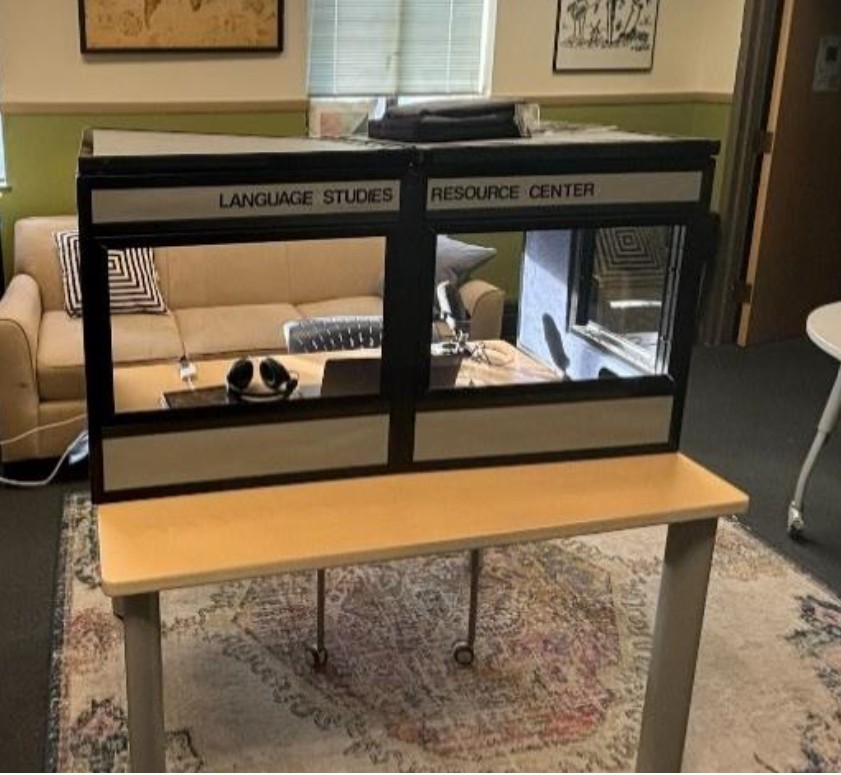
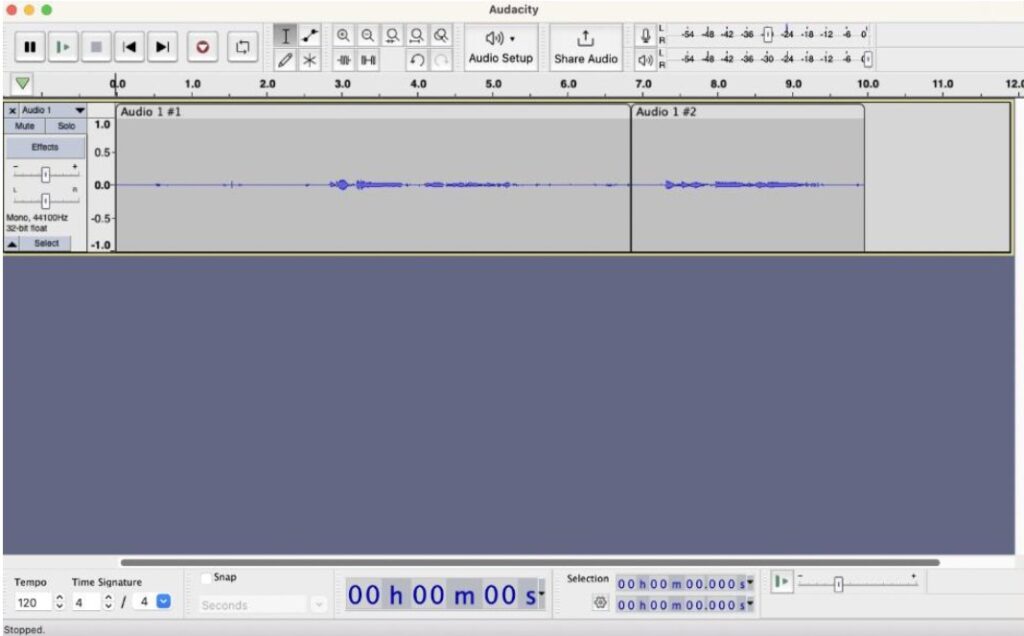
Students record their interpretations using Audacity, a free audio recording software that allows them to capture their performance in a single audio file. The speech they interpret is played from a separate device so they can listen through headphones while simultaneously recording their interpretation. Although the setup is much simpler than a professional interpreting lab, it still creates a focused environment that feels distinct from an ordinary classroom and helps students approach the task more seriously and professionally.
What really makes the system work, though, is the role of the LSRC student assistants. Students sign up for a time slot and complete their session at the center, where assistants guide them through the process. They help set up the equipment, make sure the microphone and recording software are working properly, and run a short test before the actual recording begins. Once everything is ready, students complete their interpreting task independently, reassured that someone is there if anything goes wrong.
Behind the scenes, however, there is quite a bit of coordination that makes all of this possible. As the instructor, I have to organize the schedule so that every student has a time slot that works and ensure that LSRC student assistants are available to support those sessions. That logistics work takes time. There are semesters when staffing is tight, and we have to adjust by extending assistant hours, bringing in additional support, or finding alternative solutions so that each student still has the opportunity to complete a 30-minute booth session. Much of this coordination remains invisible to students, but it is essential to creating a consistent and equitable experience.
There is also a significant amount of preparation involved before students ever step into the booth. This is a third-year course, and most students have already completed—or are simultaneously enrolled in—a translation course, so they arrive with some prior experience thinking about language carefully and analytically. Even so, proficiency levels vary, and one thing students quickly discover is that interpreting is not only about speaking ability; it is also about preparation.
Choosing the topic for each project is an important part of that process. I usually give students some choice among broader themes such as healthcare, economics, or politics and then narrow those areas into more specific and manageable topics. For example, a general healthcare topic may become a focused interpreting assignment on bronchitis or respiratory infections. Once the topic is selected, I prepare the audio materials myself rather than using YouTube or outside recordings. I typically write and record the speeches using my own voice because this is an introductory course, and the booth experience itself already creates enough pressure for students without adding the extra challenge of unfamiliar accents.
Students receive key terminology in advance, but preparation goes far beyond memorizing vocabulary lists. They are expected to build specialized glossaries, research the topic independently, and understand the material well enough that they could comfortably explain it themselves. A glossary for a healthcare assignment, for instance, might include terms such as cough, mucus, fatigue, or respiratory infection, but students are also expected to understand the broader medical context surrounding those concepts. In consecutive interpreting projects, students often prepare and memorize their own note-taking symbols as part of this process. What becomes clear very quickly is that students who prepare thoroughly often perform extremely well, regardless of whether they initially consider themselves the strongest speakers in the class.
And, of course, sometimes things do go wrong. Technology is not perfect, and neither are we. There have been occasions when the audio doesn’t play correctly, or when a student assistant, despite training, accidentally plays the recording twice instead of once. When that happens, the task no longer reflects what interpreting looks like in the real world. In a professional setting, interpreters don’t get a second chance; no one repeats a conference presentation for them. They can adjust and recover in the moment, but they cannot listen to the same speech twice.
There are also very human moments. Some students, overwhelmed by nerves, forget to press the record button. Others, under the pressure of the moment, fall back into classroom habits and begin repeating what they hear rather than interpreting it into the target language. These situations are not failures; they are part of the learning process. In fact, they reveal something important: students are learning to navigate uncertainty. They are learning that interpreting is not about control, but about managing what happens in real time.
Although the final booth projects typically involve interpreting from Spanish into English, students spend much of the semester practicing bilateral interpreting so they become comfortable working in both directions. In these activities, students simulate real-world interactions such as conversations between doctors and patients, interpreting from English into Spanish when the doctor speaks and from Spanish into English when the patient responds. This type of practice helps reduce anxiety while also preparing students for the unpredictability of real communicative situations.
Because students enter the course with different levels of confidence and proficiency, creating an equitable classroom environment is essential. Heritage speakers often volunteer more quickly, while other students may hesitate out of fear of making mistakes. To balance participation, I pair students strategically so that stronger speakers can support less confident classmates, and I consistently remind students that mistakes are part of the learning process. We approach interpreting practice much like any communicative language classroom: students check for comprehension, ask questions when necessary, and gradually build confidence through repeated practice in a supportive environment.
These moments also open the door for reflection. After each project, I ask students to think about what happened in the booth, not just in terms of vocabulary or accuracy, but also in terms of decision-making. What did they do when they didn’t understand something? How did they handle speed? Did they prioritize meaning or structure? These questions help them become more aware of their own process and reinforce the idea that interpreting is an active, strategic task.
This structure allows me, as the instructor, to step away from the technical aspects and focus on what matters most: listening to the final product. Students upload their recordings to Canvas, where I evaluate their performance. At the same time, in-person support at the LSRC ensures a smooth, consistent experience for everyone.
There is also something important about the physicality of the setup. Over time, it becomes clear that the booth is shaping not only student performance, but also students’ understanding of the profession itself. By working within a structured environment that includes time limits, technical constraints, and a defined workflow, students begin to see interpreting as more than a classroom activity. They start to recognize it as a practice that requires preparation, coordination, adaptability, and composure under pressure.
In the end, this model works because it is both structured and flexible. Every student goes through the same process, signing up for a session, entering the booth, completing a one-take recording, and submitting their final product. That consistency supports fair assessment, but it also allows students to track their own progress over time. Listening back to their recordings becomes a learning tool in itself, helping them notice not only what they say, but how they say it.
Can This Work Outside ISU?
At this point, you might be wondering if something like this can actually work in a different context. I had the same question when I first started thinking about bringing the booth experience into my own classroom without having the kind of facilities I had as a student in Granada. What I have learned over the years is that it is possible—but it does not have to look exactly the same.
The most important thing is not the booth itself. It is the experience we are creating for students: the moment when they have to listen, process, and speak in real time, without stopping. That is something we can recreate in many different ways, even without a dedicated space or specialized equipment.
In our case, the LSRC helps structure and standardize the process, but the core idea is simple. Students need to move away from controlled practice and into situations where they have to perform. Even a quiet room, a laptop, and a recording tool like Audacity can be enough to create that shift. What has made the biggest difference in my experience is not the technology, but how the activity is designed. Giving students time to prepare, asking them to build glossaries, and then placing them in a situation where they cannot pause or start over changes the way they approach language. They stop searching for the perfect word and start focusing on communicating the message.
At the same time, I will say that this kind of project takes planning. Scheduling students, preparing materials, coordinating with the LSRC, and handling unexpected issues behind the scenes are all part of the process. It is not always perfect, and sometimes things go wrong. But in a way, that is also part of the learning experience, for them and for us.
If I had to share one thing with colleagues who might want to try something similar, it would be this: start small and see how your students respond. You do not need to recreate everything at once. Even introducing one activity in which students interpret in real time, without pausing, can already make a difference.
One simple starter activity is to use a familiar story that students already know well, such as Cinderella or Little Red Riding Hood. The instructor tells the story in the target language while students interpret it into English as they listen. Because students already know the basic plot, they can focus less on comprehension anxiety and more on the process of listening and reformulating meaning in real time. To make the activity more engaging, instructors can intentionally change parts of the story, for example, replacing the traditional red hood with a blue one, or turning the wolf into a charming young man, to see whether students are truly processing meaning rather than simply anticipating the narrative. Activities like this create a low-pressure introduction to interpreting while still encouraging students to think quickly, listen carefully, and communicate meaning spontaneously.
Over time, I have seen students change how they see themselves. They come into the course thinking of themselves as language learners, or maybe as students who are “good at Spanish.” By the end, many of them begin to see themselves as capable of doing something more demanding, something that requires focus, decision-making, and confidence.
What has stayed with me over the years is not a perfectly executed interpretation, but those moments when students realize they can keep going even when things are not perfect. I have seen students walk out of the booth exhausted, sometimes frustrated, but also surprised by what they were able to do. That moment, when they say, “I didn’t think I could do that,” is the one that matters. It is where confidence begins to grow.
And it is often only later, sometimes years later, when they are in a hospital, an office, or another professional setting, that they realize how much that experience shaped the way they listen, think, and communicate. And that shift, more than any piece of equipment or setup, is what makes this experience worth it.
Acknowledgments
I would like to express my sincere gratitude to the Language Studies Resource Center (LSRC) team for their continued support of this project. Special thanks go to Samantha Birkett, whose work as a student assistant was instrumental in developing the Interpretation Booth Manual that helps guide the technical and logistical aspects of the experience. I am also deeply grateful to Jacob Larsen, former Director of the LSRC, for his many years of collaboration and support in implementing and sustaining this project. Finally, I would like to thank the current LSRC Faculty Director, Shenglan Zhang, for ensuring the continuity of this work and supporting its ongoing success despite changes in leadership.
References
Cabrera, G. (2018). Mamá, quiero ser intérprete. Calamo & Cran.
Mikkelson, H. (2006 a). Edge 21: Consecutive interpreting. An interpreter’s edge for the 21st century. ACEBO.
Mikkelson, H. (2006 b). Edge 21: Simultaneous interpreting. An interpreter’s edge for the 21st century. ACEBO.
Pöchhacker, F. (2016). Introducing interpreting studies (2nd ed.). Routledge.
Rozan, J.-F. (2002). Note-taking in consecutive interpreting (2nd ed.). Routledge.
AI disclosure: During the preparation of this article, the author used ChatGPT to help refine wording, organize ideas, and draft some portions of the text. All content was reviewed, revised, and adapted to reflect the author’s own experience and voice. The author takes full responsibility for the final content of the article.
The emphasis on practicing under real time pressure is really interesting. Interpreting seems like one of those skills where realistic conditions matter just as much as knowing the language itself.
Hola Maria Laura,
Thanks so much!
You will enjoy “Mamá, quiero ser intérprete” a lot. I love that book!
Congratulations on this initiative!!! Very inspiring for everyone! I want to read the book “Mamá quiero ser intérprete”!!