

Portfolio-Based Assessment in the World Language Classroom
By Julia Simon, Spanish and EAL Teacher at the American Overseas School of Rome

DOI: https://www.doi.org/10.69732/YXDS4511
The Problem: Apathy and the Assessment Trap
Language teachers are often tasked with teaching groups of students all coming in at very different language levels. They must figure out a way to keep all students engaged while differentiating the material. Students who fall at either end of the spectrum can be unengaged, bored, or act out. In all iterations of language classes that I have taught, mixed grade-level classes, mixed proficiency level classes, and International Baccalaureate (IB), I have faced the same core tension: how do you meet every learner where they are?
Meeting students where they are can often be in direct conflict with traditional grading systems. While traditional grades attempt to capture student performance, they are influenced by student behavior, linked with teachers’ implicit bias, and offer an incomplete picture of what a student may be capable of doing (Link & Guskey, 2019). Most grading systems do not distinguish the performance on one given day from the progress a student has made over a longer time period. This means grades sometimes stop communicating what a student actually knows and can do. The grade becomes the goal, and learning becomes secondary. I was searching for ways to combat this when I discovered portfolio-based assessments. Implementing portfolios allowed me to shift the goal back to learning, student progress over time, and to deemphasize a one-size-fits-all exam, which can help meet all students where they are.
The Idea: Portfolio-Based Assessment
In the summer of 2023, I had the opportunity to attend Klingenstein Summer Institute (KSI) and met a colleague who was facing the same dilemma. KSI is a two-week-long summer fellowship put on by the Klingenstein Center at Teachers College, Columbia University, that brings together early-career teachers. During the fellowship, I found myself really thinking about this question. Over our two weeks at KSI and many long walks between plenary sessions, we talked over how we were noticing similar things in our classrooms: student apathy, not completing work, not participating in class, not reading feedback, or something else. This all combined to create an increased workload for us – always having to grade late work, and then students not even taking the time to read their feedback before throwing it away. It felt like they couldn’t see the relationship between these factors and their own growth.
Out of those conversations came an idea: a portfolio-based assessment system aligned with the ACTFL Performance Descriptors for Language Learners (American Council on the Teaching of Foreign Languages, 2012), built around student goal-setting, self-reflection, and the development of metacognitive skills. Portfolio-based assessments are a means of assessing students by collecting work over time. I decided to take it upon myself to use it to create a new way of assessing students and their achievements. What follows is what I built, what I learned, and what my students said about it.
The decision to use portfolio-based assessment is grounded in a growing body of research. As cited by Yin (2013) in Phung, these types of assessment have been shown to increase students’ autonomy, metacognition, motivation, and self-reflection and positively impact their language skills, especially their writing skills (Phung, 2016, p. 93). Also relevant to my work is a study conducted by Ziegler and Moeller (2012). They found that there is a link between portfolio-based assessment and “increased student intrinsic motivation, increased task-value, and more accurate self-assessment of learning” (Ziegler & Moeller, 2012, p. 330). Portfolios also align with what we know about neuroscience. In the book Make it Stick, the authors Brown, Roediger, and McDaniel (2014) tell us how retrieving and reflecting on prior learning can help strengthen our retention and is more effective for long-term learning than simple re-reading. The way the portfolio is structured forces students to participate in these retrieval practices by reflecting on their learning and evidence. It helps make the invisible work of learning a language visible, something especially important for students at intermediate levels who may feel like they have hit the “intermediate plateau” and are not aware of their progress.
Gholdy Muhammad (2020) echoes some of these ideas. In her book Cultivating Genius, Muhammad centers learners in their own learning, arguing that meaningful learning must meet students’ identities, skills, intellect, and criticality, not just simply contain content. A portfolio system that asks students to define their own goals, choose their own evidence, and narrate their own growth centers the learner as an active agent in their education, not a passive recipient of a score.
How It Works: Beginning of the Year
Our portfolio process starts even before our first unit. Each class engages in a structured self-assessment of its language proficiency. Students look at examples of writing and speaking at different ACTFL proficiency levels. They see examples both in Spanish and in their home language. Then, they self-assess across each of the four domains: interpretive listening, interpretive reading, presentational speaking, and presentational writing.
This self- assessment becomes the jumping-off point for a broader conversation around what it means to demonstrate learning. For example, could you show learning outside of a test? What if you had a bad day on the day of a test? What does it look like to learn something over time? These questions do not have a single right answer and naturally lead us to the idea of building a portfolio as a way to show cumulative growth over time without relying on one single performance.
We use this conversation to lead us into goal-setting. Teaching students what a measurable, realistic skill looks like is its own lesson in itself. Many students have not experienced setting goals in a world language classroom and have to be taught how to set goals that can be accomplished in a unit. However, I found that by the end of the year, my students had gotten pretty good at it.
How It Works: During the Unit
At the beginning of each unit, students set goals. For their first unit, they use their initial self-assessment as a baseline. These goals go on their portfolio sheet, a three-column sheet with “goals” in the leftmost column, “evidence” in the middle, and “reflection” in the final column. The sheet is also divided into four different rows, one for each of the ACTFL language domains (presentational writing, interpretive listening, etc.). To fill out the goals column, I project information about the unit: essential questions, key vocabulary, and a list of major assignments we would be doing in that unit. Students combine that with the relevant ACTFL Performance Descriptor to write a specific, personalized goal for each of the ACTFL domains.
The ACTFL Performance Descriptors serve two purposes. They help give students language to describe what they can do and become the evaluative framework at the end of the unit. This transparency matters — students are not guessing at hidden expectations or juggling multiple grading expectations.
For example, during the SOMOS curriculum unit on Los Niños Prisioneros, a unit connected to rights and that I adapted to fit with the UN Convention on the Rights of the Child, one of my students took the can-do statement “I can share information on both very familiar and everyday topics, using a variety of practiced or memorized words, phrases, and simple sentences through spoken, written, or signed language.” and they used it to write their presentational speaking goal, “Present my opinion on [children’s] rights using multiple sentences even if the sentences only have basic words”. This student was in my Spanish 3 class and at a Novice High/ Intermediate Low level. This goal was individual to that student. Setting individual goals provides students with some autonomy and buy-in, while also individualizing their learning and making it so that they have a goal that is appropriate for their language proficiency, regardless of the “level” class they are in.
When students finish writing their goals, I review them to make sure they are specific and achievable, but not too easy. Students are never graded on whether or not they meet their goal because I worry that students would set goals that are too easy, and this would take away from the overall purpose of the portfolio. Their goals serve as a guide for their learning in that unit. And as a guide for me! It helps me see where my students’ interests lay and to build more learning around their goals.
This logging and goal setting took deliberate training. We also discussed what could or could not go into the portfolio. For example, participating actively in a class discussion is legitimate evidence of interpersonal communication, but it is challenging to document. These conversations helped students think concretely about what language use actually looks like, and what it means to demonstrate it.
At the end of a unit, if a student’s evidence does not match their goal, I redirect them to find a better-fitting piece or choose their strongest work from the unit and explain in the reflection why things went differently than planned. Evidence from the unit could include a video of themselves speaking about a topic, class writing we did in Spanish, reading comprehension worksheets with questions, or anything that could show their learning.
During the unit itself, instruction looks largely the same as before I implemented portfolios. We engage in the same planned activities, including formal assessments. I give feedback on everything, but withhold grades from work that would be portfolio-eligible, for example, a piece of writing. (My school required both summative and formative gradebook categories; formative work, which included classwork and homework, was graded on completion.). This practice of providing feedback but withholding grades is supported by Dickson and Housiaux (2021), as noted in Feedback in Practice. Separating the feedback from the grade increases the likelihood that students will read the feedback and then apply it. This work becomes part of a student’s portfolio, and at the end of each class, they take a few minutes to place any work into their portfolio folder as well as note any evidence for the day in the “evidence” column on their portfolio sheet. They note the date and the name of the activity under the corresponding ACTFL domain. For me as a teacher, the logging also served as a useful accountability check: at a glance, I could see whether I was giving students enough opportunities to practice across all four domains throughout a unit.
Portfolio Day: The Heart of It
At the end of each unit, we had Portfolio Day. Students opened their folders, reread their original goals, and wrote a self-reflection for each domain in their home language: Did they meet their goal? What evidence supports that conclusion? Which specific piece of work best represents what they learned? For example, one student, for the same SOMOS curriculum unit on Los Niños Prisioneros, said in their listening reflection: “ I met my goal this unit by understanding main ideas/topics and familiar words in the ‘Los Niños Prisioneros’ video.”
This was the part of the process that I valued most. It forced students to look back at what they had done and think and write about how they had learned, not just what they had learned. That kind of metacognitive reflection is rare in traditional assessment structures, but research shows that this type of reflection can help develop autonomous, self-regulated learners (Phung, 2016). Student reflection coupled with connecting new learning to prior knowledge and then rephrasing in one’s own words is an important strategy for retaining learning (Brown et al., 2014). In addition to retention of current material, Portfolio Day also offered students the opportunity to revisit their work rather than being evaluated on a single attempt. It created a structured opportunity to present your best self, not just a snapshot from a random day.
Once students completed their reflections and selected their evidence, I graded the portfolios. Each portfolio was entered in the gradebook as a summative assessment, broken into the four ACTFL domains, with the weight of each domain varying by class level. My process was consistent: read the original goal, read the self-reflection, then evaluate the chosen piece of evidence using the ACTFL Performance Descriptors as a rubric. That score became the summative assessment grade for that domain for the unit.
This was more front-loaded work than traditional grading. However, it changed what grading felt like. I was no longer scoring every individual activity. I was able to read what students thought about their own learning, then evaluate one carefully chosen piece of evidence. It became a more meaningful kind of grading.
What Students Said
Throughout the year, I always solicit feedback from students. Once I started using portfolios, I included questions about the portfolio system. The survey had regular course reflection questions like: “What skills (i.e. writing, speaking, reading, listening, etc) do you feel like you improved this trimester?” and once I started the portfolio process, it also asked questions about that. The survey was sent out once a school year and included two questions: “Do you prefer portfolio-based assessments (completing a reflection at the end of the unit) or traditional tests and quizzes every unit as your assessments?” and “Why do you prefer portfolio or why do you prefer traditional assessments?”. All students in my class responded to the survey. My classes ranged from having seven students in my smallest class to nineteen in my largest class.
Over the two years I piloted the portfolio, my students’ feedback stayed consistent.
The table below summarizes the results of two statistical tests run on that feedback data. Across two surveys spanning grades 6–11 (n=80), 68.8% of students preferred portfolio-based assessment, a proportion significantly greater than chance (p < 0.001). Preference was strongest among older students, with grade 9 respondents preferring portfolios at a rate of 85.7%.
| Test | Dataset | Null Hypothesis | Result | Conclusion |
| One-sample binomial test | Combined (n=80) | H₀: preference = 50% | p = 0.0005 | ✔ Significant |
| Chi-square test | Portfolio Survey by grade | H₀: preference independent of grade | χ²=6.76, df=4, p=0.149 | ✘ Not significant |
The majority of students in grades 7 through 12, at proficiency levels ranging from Novice High to Intermediate High, preferred portfolio-based assessment to traditional testing. However, my 6th Graders leaned toward traditional assessments, citing that they are “quicker” or “easier.” However, as students progress, the preference for portfolios increases sharply. Based on the student feedback data provided, I conducted a statistical and qualitative analysis of preferences for portfolio-based assessments versus traditional tests. There is a clear trend showing that older students tend to prefer portfolio-based assessments more than younger students.
The evidence collected around portfolio-based assessment has its limitations. It is conducted at one school, by one teacher, and is a small sample. Additionally, given these limitations, it is difficult to draw a precise conclusion about the impact of portfolio-based assessment and say whether it could be replicated at other institutions.
In students’ written feedback, several trends emerged. Students frequently cited the ability to “choose” and “showcase” their “best work.” This allows them to take ownership of their academic narrative rather than being defined by a single performance on a test day. One of the most recurring themes was the reduction of “stress” and “pressure.” Students reported that portfolios allowed them to “express what they did” without the fear of “one assignment ruining my grade.” Additionally, portfolios act as a longitudinal tool. Students noted that looking back at early-unit work compared to late-unit work provided a “growth point” that a numerical quiz grade cannot offer. Advanced students noted that traditional assessments “do not have room to adapt to people who might learn slower,” whereas portfolios allow for “individual growth” to be graded. However, I must address why some students (roughly 44% of 6th graders) still prefer traditional tests. The younger students often find portfolios “confusing” or “too long.” and viewed traditional tests as “quicker” and “simpler.” Given this student feedback, to make portfolios successful with younger grades, one suggestion is to simplify the reflection prompts and provide more scaffolding to reduce the “procedural” stress that can overshadow the “learning” benefits.
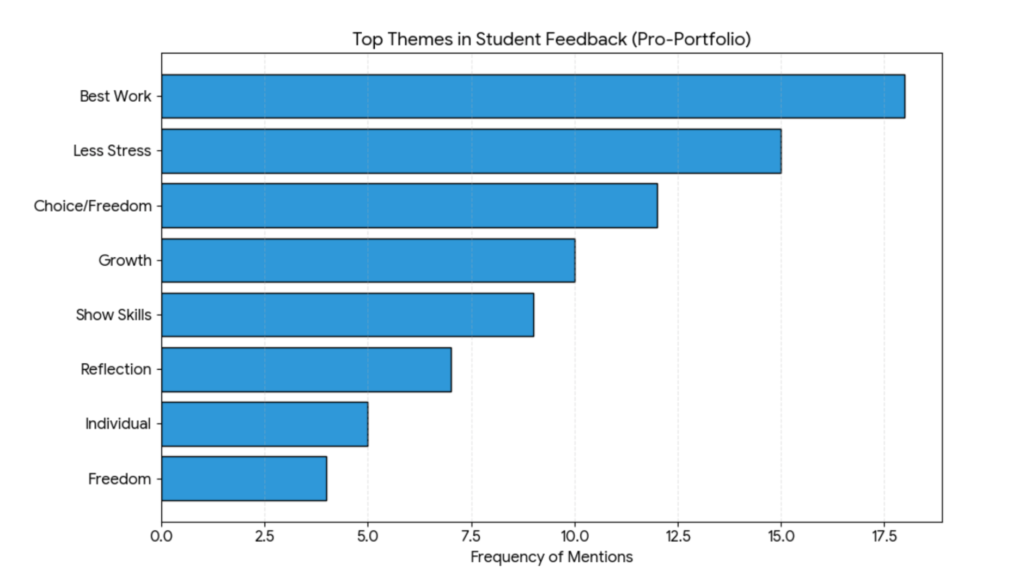
Overall, the data indicate that portfolio-based assessment fosters a growth mindset by rewarding progress and curation. For high school students, it is shown to be a tool for engagement and stress reduction. For middle school, it remains a powerful developmental goal that requires intentional scaffolding to help students transition from the “speed” of testing to the “depth” of reflection.
These students are expressing something the research also supports: portfolio assessment reduces the pressure of high-stakes testing, honors individual differences in pace and learning trajectory, and makes growth visible to the learner.
Is It Worth It?
Teachers today are being asked to differentiate instruction, build student agency, reduce anxiety, and make learning meaningful. And to do all of this within systems that may not be designed to support all of those things at once. Portfolio-based assessment is not a perfect solution, and it carries real costs in setup time and ongoing management. It also leaves some lingering questions to work through: How do you handle a student who sets goals that are too low? What do you do when a student has a weak unit with nothing strong to submit? How does the portfolio grade interact with your school’s other gradebook requirements?
However, these are just roadblocks. The payoff at the end of having students who can articulate what they have learned, choose their best work deliberately, and have a clearer sense of where they’re going has been worth it for me.
My portfolio project did not end there. While I have moved schools since my two-year portfolio adventure, I would like to pilot it again. In future renditions, I would like to implement this again but see if I could get other teachers on board so I could compare across classes. I would also look into having students evaluate their progress across multiple years. Portfolios are not exclusive to Spanish class. It could be adapted to other subjects; for example, in science it could be adapted with the Next Generation Science Standards.
If you’re a language teacher feeling the weight of keeping students engaged, differentiating instruction, and making student learning visible, this might be worth trying. Start small. Pick one class. See what happens on Portfolio Day.
References
American Council on the Teaching of Foreign Languages. (2012). ACTFL performance descriptors for language learners.
Dickson, B. & Housiaux, A. (2021, August). Feedback in practice: Research for teachers. Tang Institute at Phillips Academy. https://tanginstitute.andover.edu/resources/resource-title-2
Link, L., & Guskey, T. (2019). How traditional grading contributes to student inequities and how to fix it. Curriculum in Context, 45(1). https://uknowledge.uky.edu/edp_facpub/53
Muhammad, G. (2020). Cultivating genius: An equity framework for culturally and historically responsive literacy. Scholastic.
Brown, P.C., Roediger, H. L., & McDaniel, M. A. (2014). Make it stick: The science of successful learning. Harvard University Press.
Phung, H. (2016). Portfolio assessment in second/foreign language pedagogy. Hawaii Pacific University TESOL Working Paper Series, 14, 90–107.
Yin, M. (2013). Portfolio assessment in the classroom. In The Companion to Language Assessment (pp. 659–676). John Wiley & Sons, Ltd. https://doi.org/10.1002/9781118411360.wbcla042
Ziegler, N., & Moeller, A. (2012). Increasing self-regulated learning through the LinguaFolio. Department of Teaching, Learning, and Teacher Education: Faculty Publications. https://digitalcommons.unl.edu/teachlearnfacpub/179
AI Disclosure: The author used Claude, an AI assistant developed by Anthropic, during the revision process of this manuscript. Specifically, AI assistance was used for structural editing, prose refinement, and statistical analysis of student survey data. The underlying classroom practice, pedagogical framework, student feedback data, and all interpretations and conclusions are entirely the author’s own, developed through two years of classroom implementation.
Great article! I like how it explains that portfolio-based assessment measures learning over time instead of relying on a single test. It seems like a meaningful way to encourage reflection, creativity, and continuous improvement. Thanks for sharing these valuable insights!