
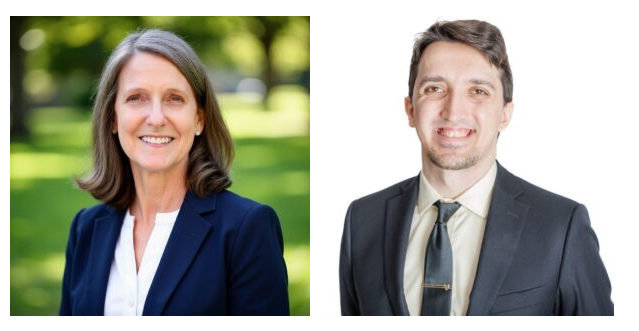
Interview with Betty Rose Facer and Denis Uebiyev: VR, Language Advocacy, and the Scenic Route
Hi! I’m Lisa Frumkes, and I’m the Interviews Editor for The FLTMAG! In January 2026, I interviewed Betty Rose Facer, Master Lecturer and Director of the Language Learning Center at Old Dominion University, and Denis Uebiyev, a graduate student pursuing his PhD at Purdue University. We talked about their collaborative work in Virtual Reality (VR) as well as language advocacy. Betty Rose and Denis began this work together after being matched by the IALLT Scenic Route mentorship program.
DOI: https://www.doi.org/10.69732/JTKZ5747
Lisa Frumkes: Denis and Betty Rose, how did you each come to be members of IALLT?
Betty Rose Facer: My first IALLT was at the University of Maryland, College Park, in 1999. I had just started my position at Old Dominion University (ODU) in Virginia in 1996. When I attended the Foreign Language Association of Virginia (FLAVA) conference, I met Dick Kuettner, who said I had to go to IALLT. The only IALLT conference I’ve missed was the one in Oregon [2019]!
Denis Uebiyev: I was working at the University of Hawai’i at Manoa and was asking around about conferences in the language-learning-and-technology space. It was Julio Rodriguez who encouraged me to attend IALLT. My first one was the virtual conference in 2021.
LF: I understand that the two of you met through IALLT’s Scenic Route Mentorship Program. What did you expect to get out of the Scenic Route experience?
BRF: Having been at ODU so long, I thought I’d be giving back to the profession. Denis and I were matched because of our mutual interest in VR, which I was just starting to get into.
DU: I thought it was a good opportunity to meet someone in the field, learn about their work, and to brainstorm together about what I could do in research on VR in an academic environment. I was really looking for a thought partner, but I was also open to the idea of collaborating. That definitely worked out for both of us! We’ve now presented our work at four or five conferences, and we wrote a book chapter together. Way more happened as a result of this mentorship program than I’d expected! The intent was to do six meetings over the course of the year. We met every month for six months, and then we decided to just keep on going. The Scenic Route is really great because it provides you with a lot of discussion questions to start conversations. We got through all of them!
BRF: And we’ve been meeting ever since!
LF: Tell me more about your collaborative conference presentations!
DU: We used to focus on our VR collaboration, particularly the work that Betty Rose has been doing at ODU, and then I attended one of Betty Rose’s language advocacy sessions at IALLT. I realized that advocacy was something I was interested in getting involved with too, so I asked Betty Rose if I could help.
BRF: At that time, I had been IALLT’s liaison to the Joint National Committee for Languages and National Council for Languages and International Studies (JNCL-NCLIS) for 20 years. I originally did that with Bob Fischer [CALICO’s Executive Director from 1997 until 2011], who was representing CALICO. He was my mentor when I got involved in 2005 – he showed me around when I didn’t know what I was doing! I represented both IALLT and CALICO at JNCL-NCLIS for years, which wasn’t ideal. So when Denis offered to help, we split the responsibilities, with Denis beginning as CALICO liaison in 2023.
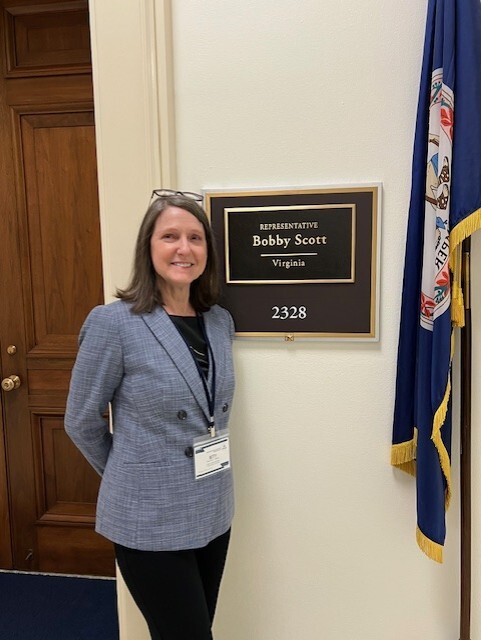
DU: The first time I went to Washington DC to participate in the JNCL-NCLIS Language Advocacy Day, I thought: I’m surrounded by all these seasoned language professionals. What am I doing here? I’m just a grad student! But I learned from my colleagues from the Indiana delegation, and Betty Rose helped orient me as well.
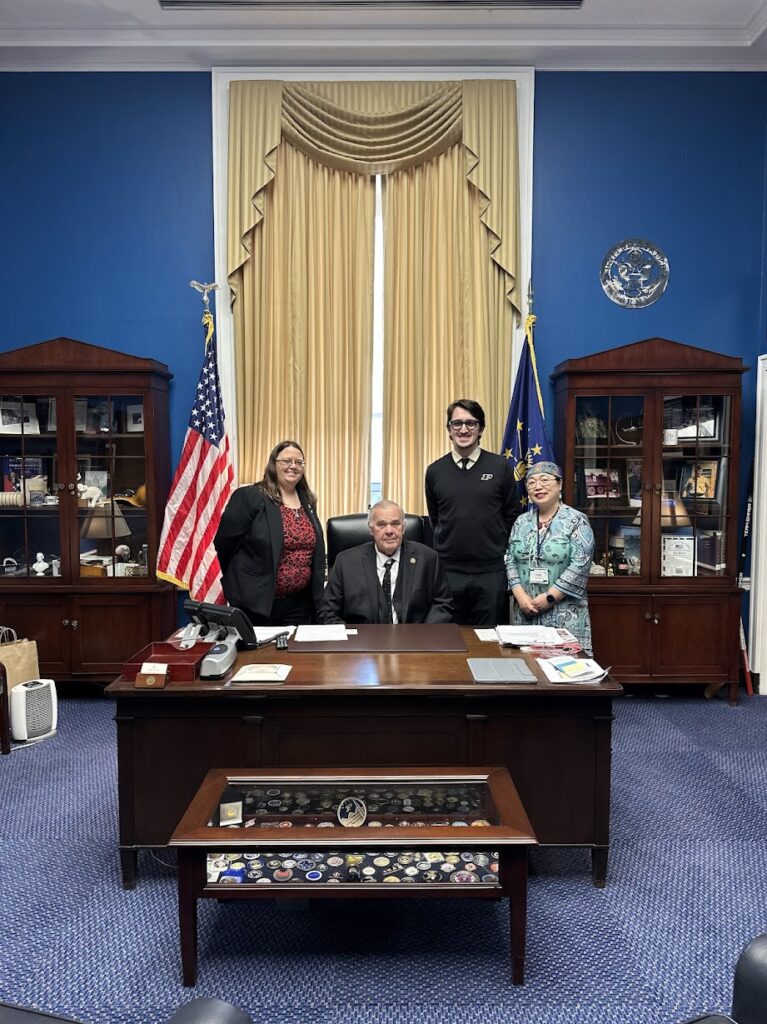
BRF: Language advocacy can be overwhelming! There’s a lot of legislative priorities and talking points, and everyone worries because they feel like they don’t know how to talk about them. But knowing all the facts isn’t the only important part when you talk to your representatives – it’s really the storytelling: bringing to the attention of the lawmakers stories about studying language at your institution and sharing your students’ impressions of it. We talk to them about how we’re using our language centers, as well as VR and AI. And when you go to your representatives’ offices, whether they’re in the House or the Senate, you’re often talking to their young staffers, and their ears really perk up when you start talking about VR.
DU: They come to the realization that you can actually use VR to teach languages! We want them to know that everyone in the US should have access to learning English and at least one other language.
LF: Speaking of VR: you’ve both been doing a lot of work there! What’s going on in your VR world? How did you get involved with the VR platform ImmerseMe?
DU: When I started my PhD, I needed to do instructional design work for a project. And at that time, Betty Rose was trying to bring ImmerseMe to her colleagues at ODU. I wanted to help train those colleagues. So I did a little instructional design work and developed a training on how to use the teacher dashboard portion of ImmerseMe. I built it out as an Articulate module and shared it with Betty Rose. Betty Rose said I should show it to Scott Cardwell, the CEO of ImmerseMe, and see what he thought. So I did, and he said it was great work. He asked me to do some editing work on some video material that they had shot and were planning to put on their platform. So that’s how I started a professional relationship with ImmerseMe. It just fell in my lap – I just had perfect timing!
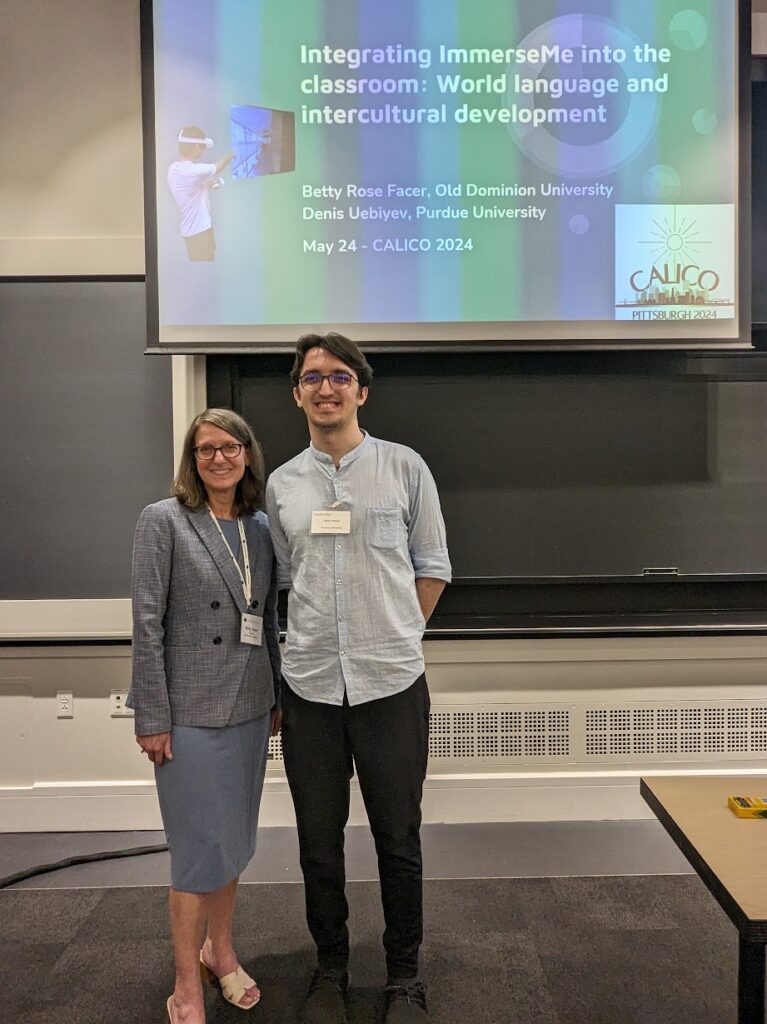
BRF: It worked out well! I started with VR in October of 2020, when Denis and I were already deep into our Scenic Route meetings, I took part in a VR workshop at Old Dominion University and asked: how can we use this for World Languages? What tools are out there, and how can I use them? I had no idea! I applied for a grant at the end of that workshop. I found out about a week before classes started that I got it – and then I was in a panic because I can’t plan that quickly! But thanks to Denis, I was able to work it out. Then I got to meet Scott Cardwell and that was just really wonderful!
DU: Betty Rose was asking what VR tools existed. I told her about the various apps, about which ones I liked and which I didn’t. At that point, I had been playing around with ImmerseMe, and it looked pretty good. It sounded like a good opportunity to use it.
BRF: So we used ImmerseMe for my French class in the spring of 2021 with 17 students. We were online because of COVID, and the students needed more practice on their own. It was a fun semester; I think VR made a world of difference. One of my students, a gamer, said I should ditch the textbook and just use VR!
DU: Since that first class, it’s expanded. Betty Rose has gotten a few more grants and awards – most recently from the Provost’s office – to expand the use of ImmerseMe out to the other languages and other instructors at ODU. So she’s been figuring out how she can use her language center to assist all these other instructors who are trying to learn VR for the first time and get all their students on board. She provides training to the student workers at her center. Then those students teach the teachers and the other students. It’s a super cool system!
BRF: We went from a high-impact-practices grant to a faculty innovator grant with 104 students. And then I received a Provost’s award that supported 202 students! So we’ve added more languages and faculty since that first experience of using it with those 17 students. First, I had to figure out what worked well, and then how to organize it. Because when you present it to faculty, you’ve got to make it something that they can do – something that isn’t overwhelming on top of everything they’re already doing. A lot of the participants are adjuncts.
DU: The research and the data that we’ve collected is very beneficial for demonstrating to the upper levels of higher-ed administration that this is a program that works. The students love it, and we can showcase it to other instructors to demonstrate why they should be considering using it in addition to their traditional methods. We also realized we could also be publishing and presenting about this work, because it’s good data that more people should be aware of. So it’s just snowballing further and further!
BRF: Our deans in the College of Arts and Letters asked us to present our work to the Provost, and then to the Board of Visitors and the university president. I never imagined we would be talking about this to administrators, but they really found it fascinating and loved and supported the idea!
LF: Are you surprised by the level of support you’re getting from your institution, Betty Rose? Do you know of other examples of places where this kind of work is really being accepted and pushed along by administration?
DU: There’s some examples that have emerged recently. Whenever we go to IALLT, we hear that a lot of language center directors are trying to figure out what they can do with technologies like virtual reality. They’re learning about what we’re doing with ImmerseMe, picking up our template, and trying to figure out how they can do it as well. Some of those efforts have been pretty successful!
BRF: The Provost talked to me about this. He said: you get all these grants, but what happens afterwards? How does this become sustainable? I haven’t reached that point yet – I’m still pursuing different grants to support it. But by now, we’ve proven that this use of VR is really something important. It’s worth integrating it into the World Language curriculum. We may eventually need to push the cost off to students. But we just got a Mellon Foundation grant via ODU for Work-Based Learning! I’m working in French with a colleague and that’s where AI also comes into play. I ask students to do ImmerseMe lessons that are aligned to what we’re doing in class, and then they interact with AI conversations to enhance their communicative competencies, followed by a reflection on their experience via a seven-question template.
Before, when I asked students to reflect on their learning experience, they’d say things like: “Well, I’m not majoring in French and this is just a requirement.” But now they say, “I see that if I go to Paris and I have to use greetings, or if I’m in a meeting, I’ve got to be using very formal language.” The AI helps them reflect on their learning.
My students are at the novice level, but we’re also looking at students from the advanced level French courses. VR makes language more relevant to the students. We’re making sure they see language study not just as a requirement, but as something that can really go with any discipline.
DU: Too often people think of languages as: “You’re either a language major and you need to study a language, or you’re not a language major and you don’t need to study one.”
But you can work in technical fields and still benefit from knowing another language. I’ve met plenty of aerospace students who study Russian because they’re interested in learning more about what the Soviet Union used to do – and what Russia is currently doing – with their space program. That kind of stuff is constantly interesting and evolving. I’ve met plenty of mechanical engineers here at Purdue who learn German because they want to go to Germany for an internship and work in German.
We can also connect students through our different institutions. Students go abroad, learn and study in that language, and then bring back their experiences to share and enhance their degrees.
LF: Talk to me some more about your experiences working with Scott Cardwell of ImmerseMe, and working with other folks in industry in general – what has been interesting or surprising about it? How can other people get involved with companies like ImmerseMe?
BRF: This is where ACTFL is really a big player, because of their World Expo. That’s what I love about going to ACTFL: talking to the different creators of these platforms. I met the creator of TalkAbroad years ago. He suggested I use TalkAbroad for a semester – for free! So now I just say to vendors: “This is a great platform. Can I use it for a semester for free, just to try it out and see if it works?” If it does work, then I can help faculty in our department use it.
DU: I served as the chair of CALICO’s Immersive Realities Special Interest Group. One of the things I did was email a bunch of companies and ask them to come present to us about their work. People should be willing to email and message these creators! I find people on LinkedIn all the time and just ask about their work, and that creates a lot of great connections.
If I use a platform, I use the feedback button a lot – and give genuine feedback that I think could be constructive. At least twice – once for ImmerseMe and once for Extempore – someone in charge has reached back, thanked me, told me what they’d fixed, and invited me to take another look. These creators love their platforms. They’ve created them for a reason – they want people to use them! Beyond the financial benefit to their company, they believe that what they’re doing is solving an issue in world language education. So we need to be making those connections and asking, “Is this platform suited for what I’m trying to do? Is it fulfilling the student needs that I’m seeing?”
BRF: If I’m working on a grant and I have ten or so faculty members, I require that they come to a workshop where they can meet the creator and ask questions. It’s really fun! We’re doing a workshop now with TalkAbroad because they’ve added different features to their platform that we might not be familiar with. Another company – Speakology – said they’d be in the Norfolk area and asked if they could come in. And I said: “Absolutely. I’ll have a gathering of faculty together. Tell us all about what we should know about Speakology AI so that we can start using it this semester.”
LF: I like the word you used to talk about these vendors and entrepreneurs: you called them “creators.” That seems like a word that takes down that boundary that many of us perceive between the academy and industry. Why have you landed on that term?
BRF: These creators put their heart and soul into their product, their platform. They’re not creating it for free. We want good‑quality platforms that are going to help our students. If I can write the grants to make those platforms accessible, that’s one thing. But then we need to talk about when those grants aren’t available: how are we going to pay for the platform? Are the students going to pay? Is the price reasonable? How does it affect student learning outcomes? All of the platforms I’ve been using certainly are worth it. I like to hold up these creators as such, because that’s what they are – they’ve worked really hard on these platforms and tools for us.
LF: To come back to the language-education advocacy piece: what are the things that people should know about advocacy, either via JNCL‑NCLIS or otherwise?
BRF: I just love the Joint National Committee for Languages! I’m in awe of their leadership and the members who are so dedicated. Languages are really important, no matter what side of the political aisle you’re on. You leave your politics at the door, and you go in to present stories from your university. You’re talking about the legislative priorities that really pertain to world language education and international studies.
We have two main advocacy events: the main Language Advocacy Days in early March, which are in person, and then the Advocacy Action Day in the fall that’s remote. But everybody who’s a member is working year‑round, all the time. We have monthly updates on the legislation and priorities.
People can get involved at any level – local, state, national…all you need to do is go to the Legislative Action Center on the JNCL website.
For example, there was recently an urgent alert for WLARA, the World Language Advancement and Readiness Act. It was proposed for fiscal year 2026 to be funded in the Department of Defense for $15 million. It was cut in the previous year by $5 million, and we’re still working on those appropriations. JNCL makes it really easy for you to contact your legislators in Congress via pre‑composed letters. You don’t have to get nervous about writing; it’s already done for you! You can also include your own personal message, and I always take advantage of that to say, “Hey, remember me? I’m at Old Dominion University. This is how we’re learning world languages, and it’s really successful.”
You can also help at the local level. I go to town halls and ask questions. Then, when we go to DC, we can bring information to the senators and representatives so they can make better‑informed decisions moving forward.
DU: I’ll echo the point that it’s very easy to get involved! That little section for additional comments, being able to tell your story, is super impactful. Our senators and representatives – or at least their aides – read those. I sometimes get response letters back from them. It’s an easy and important way of getting involved. There are also a bunch of organizations within our individual states that do this advocacy work.
JNCL‑NCLIS is an organization of organizations: they have delegates from all these different groups. You can find organizations in your state that are advocating on behalf of world language education and connect with them to build that momentum further.
BRF: I would also encourage everyone to invite senators, representatives, or even their staff members to your institutions to see the innovative ways you are teaching. I also created a podcast to advocate for world languages in different ways. Every time I come up with a new series or a new episode, I send it to my legislators! It’s really important to stay in contact with them, so that it’s not just a one‑time‑a‑year connection – you can strengthen these connections over years.
DU: That constant reaching out works! I remember the second time I went to the JNCL-NCLIS Language Advocacy Day: the staff at one of the legislator’s offices looked at me and said, “You’re Denis, you do virtual reality research.” I’m like, “You know me!” Having that contact is super important. We are the experts in this space. We can help our politicians understand why world language education is so important.
LF: I like what you were saying, Denis, about personalization. A lot of us think, “I can’t do this because I can’t speak for the entire profession.” What you’re saying is: don’t try to speak for the entire profession. Speak for yourself, and then they will know who you are and listen to you.
DU: That personalization is something I’ve learned from talking to Betty Rose – making sure I’m telling my story – and I’ve tried to echo that as well.
BRF: I was invited to the office of the National Endowment for the Humanities (NEH) as part of JNCL-NCLIS. When I visit senators and representatives, I talk about how I spent money that I won as a recipient from NEH for podcasting, and how the podcast is still going strong. It’s not always just about national security and the economy. There’s more to it: making our students global citizens and making sure they’re more competitive in the job market is important!
LF: That’s so inspiring, because in this world that always seems to be telling people “Don’t study what you’re interested in; study what’s going to make you money,” it sounds like your successes have been tied to following your interests and passion – and the opportunities have then followed.
DU: For my part, I’ve continued to do more research on VR, and I’ve been inspired to think about how we can build and use 360° photos and video. These super‑high fidelity cameras are getting better every year. You get an 8K-quality camera; you press one button and it takes a whole panoramic view. I’m like, “How do I use these effectively?” ImmerseMe shows how to use it with language learning, how to create branching scenarios and dynamic language lessons. I’ve also started exploring this in an XR class I took here at Purdue with my advisor. A student from the School of Aviation and Transportation Technology wanted to use virtual reality to help aircraft maintainers. So we started a class project together using little 360° cameras to record a procedure. We found a platform that allowed us to upload that video, create hotspots, and then build a lesson out of it. We tested it and showed it to the department heads and they said, “This is great. Do you want to do more of this?” I said yes, and they created a paid assistantship position just to do this kind of work! Going from a class project to generating an assistantship was a super‑unique opportunity, and all because I got interested in how to maximize this technology. We can use it for really technical environments; we can also create it for complex language and nuanced environments. My brain is always thinking, “ What else can we do with this?” We’re constantly taking chances, constantly pushing forward. I’m known as the guy who talks about virtual reality constantly, and I think that’s great because I’m passionate about this topic. It’s something I love learning about and using.
BRF: And I feel very fortunate to be sharing all that with students and faculty.
LF: Anything else you’d like to share or discuss?
DU: I will recommend the book chapter that we wrote for the Language Center Handbook. It’s Chapter 2: “A Blueprint for Integrating VR into Language Centers.” We try to outline as best as we can ODU’s example and the things you should keep in mind if instructors or language center directors are interested in how to bring virtual reality into their space.
Honestly, working with Betty Rose has been so much fun! I couldn’t have expected a mentorship program to last this long. We’ve been meeting for many years now. I’m very fortunate and blessed to have met Betty Rose and been part of this process. And I wondered how I could give back to the Scenic route mentorship program. So I signed up to be a graduate student representative for IALLT. The main thing I really do as grad rep is ask, “How do I work on this mentorship program to make it better?” So if people have thoughts and feelings about it, they’re more than welcome to reach out to me; I’m happy to figure out how to make it a better program. I’ve seen other organizations try mentorship programs, and I think IALLT’s got the best one by a long mile.
BRF: I’m currently mentoring a CALICO grad student, and that’s fun! It’s a great program. I even demonstrated it at ODU as a great template for a really successful program. I just wish something like this had existed when I was a grad student, or even when I started my position at ODU. How fabulous is it to have somebody who’s already been in it forever helping you through questions like, “How do you fund this?” or “How do we train our student workers?” IALLT does a lot of that, but the mentorship program is just genius.
DU: When I was applying for PhD programs. I got to go over my letters with her; I got to go over the CVs that I submitted. Having somebody there to give me additional support was huge: a great mentor who can give me her insights and feedback, who knows this field extremely well, who can help connect me as needed, who knows different universities and programs that exist and what they’re doing.
BRF: It’s just fun, years later, to be following all his successes and to have him be more than a colleague. He’s also a really good friend, and I’m just thrilled.
LF: Thank you so much, both of you. Thank you so much for taking the time to meet with me.
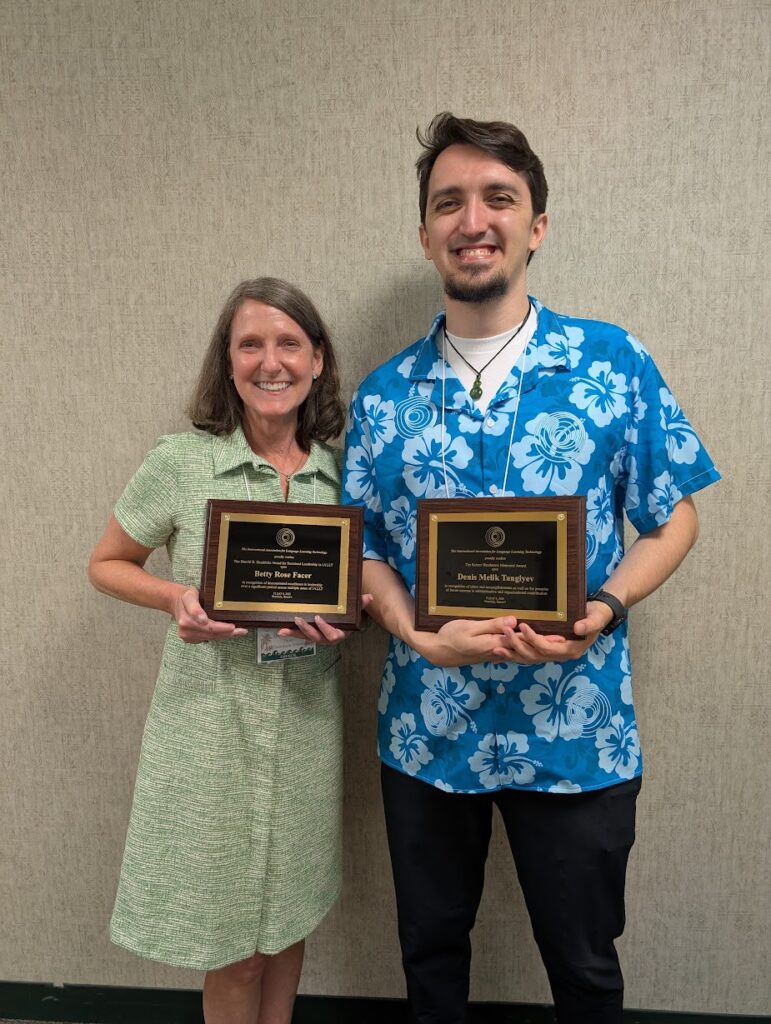
Denis and Betty Rose were also honored by IALLT in 2025! Denis received the Robert Henderson Award and Betty Rose was awarded the Harold H. Hendricks Award for Sustained Leadership in IALLT. Congratulations to both!
What a heart warming and wonderful story of two incredible innovators within the language learning community!! It’s been an absolute pleasure getting to work with you both, I can’t get enough of your passion, creativity and advocacy for world languages. I loved Betty Rose’s quote “There’s more to it: making our students global citizens and making sure they’re more competitive in the job market is important!” It’s so true. Language learning opens doors to a world of possibilities, such as collaborating with both of you! (And Lisa Frumkes too, of course!) Bravo Betty Rose, Denis, Lisa. Keep up the inspiring work!