
Integrating Digital Storytelling to Bridge Culture and Language Learning in Novice Arabic
By Nevine Abraham, Carnegie Mellon University

DOI: https://www.doi.org/10.69732/NHSJ3527
Many novice learners of Arabic navigate layers of complexity that students of Latin-based languages rarely encounter, such as mastering a completely different alphabet system and letter connectivity while balancing the dual demands of formal Modern Standard Arabic (MSA) and a spoken dialect. Beyond these linguistic hurdles lie vibrant, diverse Arab societies and shared human experiences, which we, as educators, aspire to integrate into the classroom. While traditional curricula often relegate culture to a separate, secondary component, I argue for its integration as a primary path for language learning rather than a supplement. By bridging cultures and introducing students to the diversity of Arab societies at an early stage, we can cultivate inquisitive minds that engage with cultural nuances while enriching their lexical repertoire, thereby optimizing their learning process.
In this essay, I explore the transformative potential of Digital Storytelling (DST) at the novice level. DST is uniquely capable of animating pedagogical texts, transforming static readings into multimodal, immersive experiences that ground language in authentic cultural landscapes. By situating linguistic instruction within a nuanced sociocultural framework and real-life cultural context, DST motivates active, inquiry-based learning, facilitates mastery of the Arabic writing system (through subtitles, for instance), enriches lexical repertoire, and opens possibilities for other pedagogical activities that cultivate intercultural competence (ICC). This competence empowers students to navigate real-world interactions with empathy, critical awareness, and a sophisticated understanding of cultural differences.
To illustrate this potential, I present a digital story titled “Hobbies and Technology in My Daily Life,” developed with an emerging AI tool for a second-semester Arabic course. The video is based on an original, contextualized reading developed specifically for this lesson. The narrative tells the story of a young Qatari man attempting to balance the universal challenge of technology and social media use. This relatability allows students to immerse themselves in the life of a peer in an Arab country, transforming the language-learning process from decoding script to engaging with a living, technologically-mediated culture.
The development of the reading and its multimodal digital representation addresses a gap in current Arabic pedagogical materials, which often prioritize the four language skills at the expense of critical cultural engagement. Through DST and scaffolded activities, I offer a model where Arabic learners engage “with the unfamiliar” and participate in active knowledge-seeking behaviors (Ibrahim, 2022). This framework ensures that communicative fluency and cultural awareness develop in tandem. Concurrently, I take a critical look at the strengths and limitations of AI-based video-generating tools, interrogating the capacity for these digital narratives to facilitate cultural authenticity.
Finally, this case study is part of a broader, comprehensive Elementary II Arabic curriculum hosted on the Open Learning Initiative (OLI), “a research-grounded platform [that] deliver[s] high-quality, data-rich course materials that support both teaching and discovery.” I developed this curriculum in collaboration with Gisele El Khoury, Director of the Language Resource Center and an Arabic instructor at St. Lawrence University. This curriculum, as well as its preceding Elementary Arabic 1 curriculum, aims to make Arabic learning as inclusive, accessible, and affordable as it is intellectually rigorous.
Introduction
Storytelling has historically been a fundamental socio-cultural practice that has served as one of the primary vehicles for cultural transmission. In the context of second-language acquisition (SLA), narrative has transcended its traditional role to become a critical cognitive framework. By contextualizing linguistic input, storytelling facilitates heightened comprehension and retention. As Numonova (2024) posits, active learning occurs when students negotiate meaning within real-world contexts. Storytelling thus serves as a tapestry that weaves language acquisition with cultural significance, fostering the pragmatic use of language in authentic scenarios.
Within language education, Digital Storytelling (DST), a contemporary evolution of the oral tradition, is conceptualized as a sophisticated extension of traditional narrative practices, facilitated by the integration of diverse media formats. DST was introduced as a pedagogical tool in the 1980s (Robin, 2008), and in the Arabic context, it lends itself the role of the hakawati, a traditional Arab storyteller, who transmits culture by telling stories as a means of cultural preservation (Seeman, et al, 2016).
There are several benefits to the digital aspect of storytelling, particularly in the Arabic classroom. Since there are 22 Arab countries with diverse cultures, DST can be a window through which learners explore such diversity. Reinforcing orthographic skills through Arabic subtitles is another benefit, especially at the novice level. When a student reads a sentence in Arabic while seeing it contextualized in a situation, it becomes easier to understand, repeat, and retain the vocabulary. Moreover, for novice Arabic learners, abstract grammatical paradigms and isolated lexical lists are notoriously difficult to internalize. Without a narrative framework, students struggle to establish meaningful connections between linguistic structures and cultural nuances. Consequently, DST provides an immediate anchor that reinforces reading comprehension at the novice level through level-appropriate themes, such as describing one’s daily routines or one’s city. Additionally, the multimodal nature of DST, which merges varied semiotic resources (such as photography and soundscapes) into a cohesive narrative allows the integration of authentic music and photography in the background to enrich the linguistic meaning of words.
Nonetheless, the practical implementation of AI-generated DST in the Arabic curriculum necessitates an interrogation of linguistic and cultural authenticity. Central to this debate is the selection of the appropriate linguistic register: the choice between Modern Standard Arabic (MSA), with or without formal declension (i’rab), and regional dialects. The rise of Generative AI introduces further complexity regarding the phonological accuracy of synthesized voices, i.e. proper pronunciation when generated by AI voices, versus the voice of a native human.
The digital narrative, which I discuss here, transformed an original story reading titled “الهوايات و التكنولوجيا في حياتي اليومية” (Hobbies and Technologies in My Daily Life) utilizing Pictory, an AI-generated video editing platform that converts text to video (please see Gisele El Khoury’s “Enhancing Language and Culture Courses with Pictory” (2025) for a review of this tool). Narrated in Modern Standard Arabic (MSA) via a first-person AI male voice, it explores the universal tension between professional obligations, leisure, and digital life. The script strategically integrates thematic vocabulary related to modern technology while reinforcing critical grammatical concepts, specifically verbal nouns (المصدر), the present tense in its indicative, subjunctive, and jussive forms (المضارع المرفوع المنصوب، و المجزوم), alongside the past tense. To situate the narrative within an authentic cultural landscape, the visual backdrop comprises original ethnographic photography from Doha, Qatar. This video, part of a broader series developed for the course, is 3 minutes and 40 seconds long and includes subtitles. In class, the inclusion of either embedded questions at sporadic segments or simply pausing the video to prompt students to synthesize the content with their personal lived experiences can be highly interactive, targeting lexical and syntax points. Such interactivity fosters a participatory classroom environment shown to be more pragmatic and effective for long-term linguistic retention (Chung, 2021).
This pedagogical paradigm supersedes conventional rote reading practices by situating linguistic instruction within a cohesive, culturally situated narrative. Its instructional potency is derived not merely from the transmission of lexical and syntactic knowledge, but from the deliberate encapsulation of these elements within an authentic discourse: the negotiation of the ubiquitous tension between leisure and technological saturation as experienced by a young Qatari protagonist. By framing the universal struggle of digital-life balance through a specific regional lens, the model transforms abstract language acquisition into a lived experience, allowing a more profound, empathetic understanding of contemporary Arab life.
Local-Global Cultural Intersections: Script and Video Development
The script for this DST project is a multimodal adaptation of an original reading, delivered through two complementary formats: a DST video featuring synchronized Arabic subtitles (from the reading), and a standalone comprehensive text. In the curriculum page, students are prompted to watch the video first, but are advised that the video follows the script of the reading below it. This dual-format approach provides students with both dynamic, time-aligned linguistic input and a stable reference for deeper textual analysis in the appropriate cultural context.
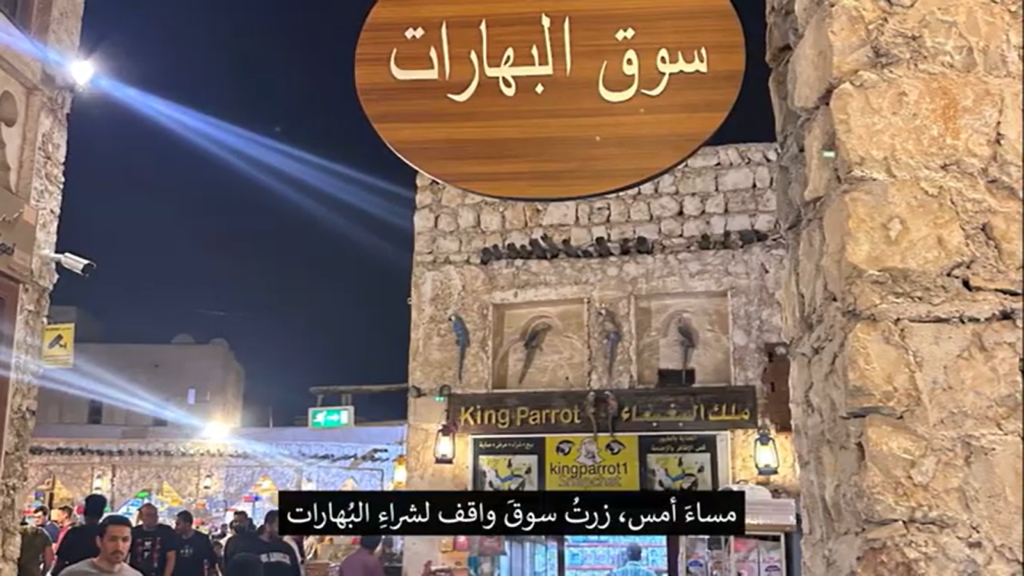
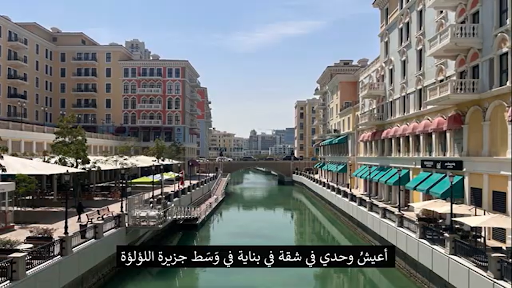
A primary objective in the development of the narrative script is the strategic integration of the diverse Qatari landscape, which serves as a virtual ethnographic tour of Doha. By grounding the narrative in specific locales and cultural practices, the project provides students with a nuanced exposure to regional life. For instance, the digital story purposefully juxtaposes distinctly local markers with more universal activities. These local experiences include the industrial worksites of national oil companies, the residential architecture of Pearl Island, and the sensory experience of purchasing spices at Souq Waqif.
This fusion of the specific and the global is illustrated through the protagonist’s daily routine: he navigates the Corniche and rides traditional boats, yet also engages in globalized pastimes like playing soccer, cycling, and utilizing digital platforms for social media or self-directed learning (e.g., researching majbus recipes or learning to play the oud via the web). By highlighting these intersections, the narrative portrays a realistic “day in the life” of a young Qatari, effectively bridging the perceived gap between Western and Arab experiences. This approach fosters intercultural competence by allowing students to recognize familiar human behaviors within a culturally distinct framework, thereby dismantling the “othering” often found in traditional media.
Below are some photos of the scenes of the video “الهوايات و التكنولوجيا في حياتي اليومية” (Hobbies and Technologies in My Daily life). The backdrop photos of Doha are mine, taken during a recent visit. Or you can watch the video itself, which is embedded below.

Pedagogical Sequence with Scaffolded Activities
This online Arabic curriculum facilitates flexible delivery across in-person and hybrid modalities, leveraging a flipped-classroom model to maximize synchronous speaking time. By providing students with asynchronous access to digital narratives, the curriculum encourages self-paced review and preparation, ensuring that learners are equipped for robust engagement with the interactive prompts during live sessions.
Prior to engaging with the digital narrative, learners undergo a structured scaffolding phase where they are introduced to the chapter’s thematic vocabulary, specifically regarding hobbies and technology, through a combination of audiovisual materials and interactive digital flashcards (Quizlet). This pre-exposure ensures that students achieve a degree of lexical familiarity, allowing them to engage in multiple auditory repetitions and process new terminology before encountering it within the more complex, contextualized environment of the video or the primary reading.
During the synchronous classroom session, the digital narrative serves as a catalyst for interactive learning. The instructor employs a “pause-and-reflect” strategy, halting the video at predetermined intervals to allow students to respond to the instructor’s questions. Possible comprehension questions to engage students in language practice are included on the web-based platform following the video and reading.
The synchronous viewing of the video is followed by a collaborative peer-learning phase, where students work in pairs to formulate targeted questions and construct dialogues that personalize and integrate the new lexical terms. This process requires students to perform a comparative analysis between their personal lived experiences and those of the Qatari protagonist, facilitating a meaningful connection with the material.
The pedagogical sequence continues asynchronously with a post-reading comprehension practice designed to check comprehension and reinforce lexical acquisition through a combination of true/false, multiple-choice, and open-ended questions. A pivotal component of this curriculum includes an inquiry-based approach that requires students to conduct independent research into specific cultural signifiers mentioned in the narrative, thereby fostering self-directed cultural acquisition and regional knowledge. These formats are designed to introduce supplementary vocabulary that students can subsequently leverage during oral discourse.
To achieve a full synthesis of linguistic and thematic concepts, the final summative assessment requires students to compose a reflective narrative detailing their own negotiation of hobbies and technology, in relation to the digital narrative, using target grammar. This transition from receptive engagement to active, personalized production ensures the internalization of the target language within a meaningful context. In essence, the strategic scaffolding of pre- and post-viewing activities facilitates a comprehensive integration of all four language competencies while immersing students in active, intercultural knowledge-seeking.
The sequence below depicts the introduction of the digital narrative and reading with follow-up practice exercises, which can be used synchronously and asynchronously.
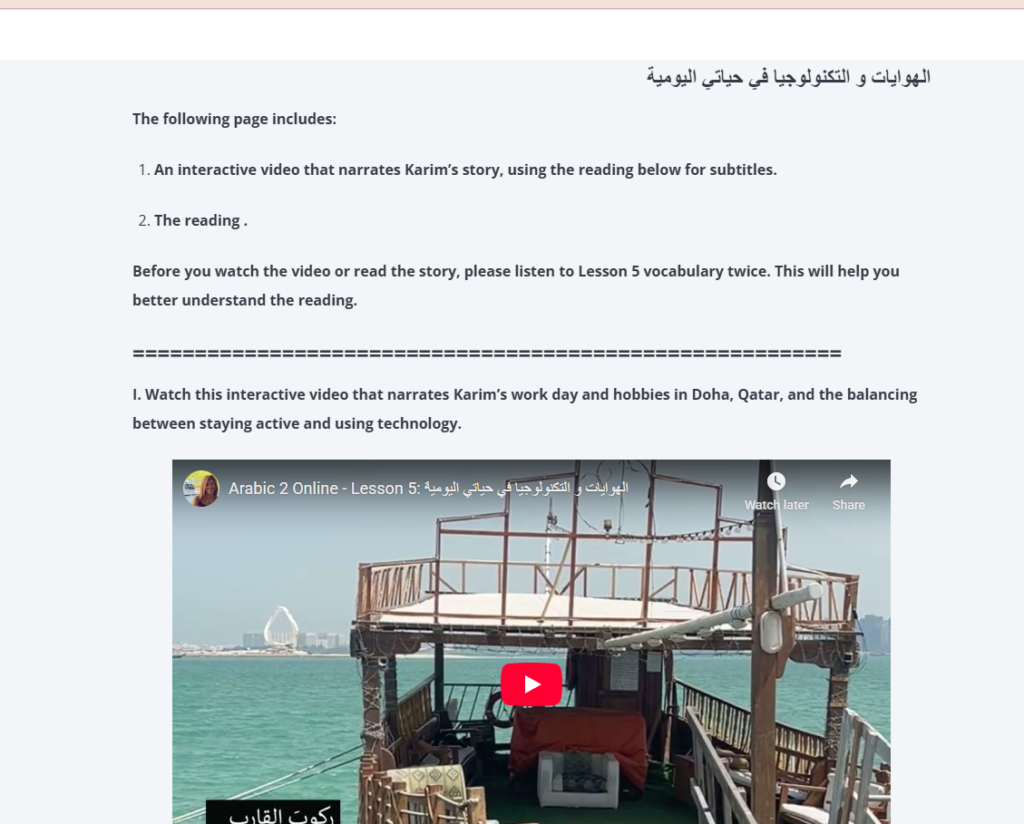
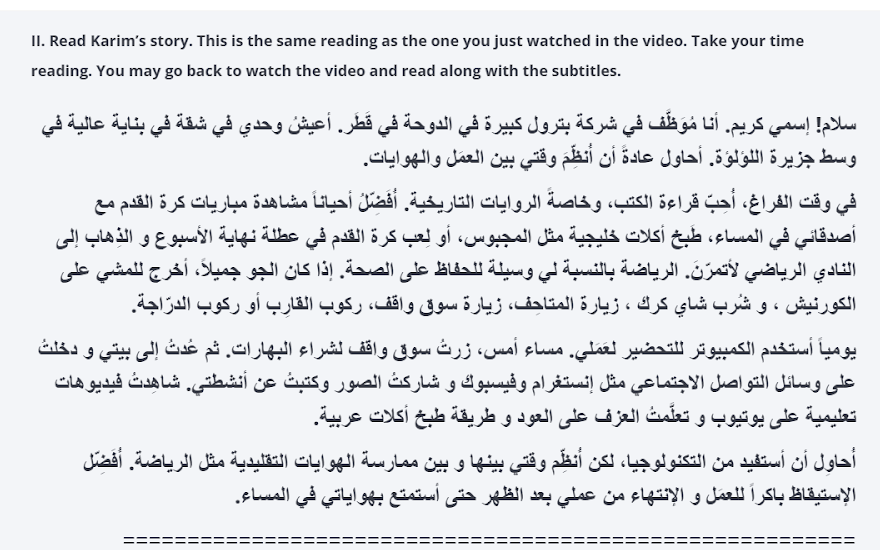
Due to space constraints, I have focused here on the third exercise: a series of open-ended comprehension questions. These prompts are designed to facilitate critical in-class discussions regarding contemporary cultural life in Qatar and prompting them to research a few of the items mentioned in the video: the Majboos dish, the Karak tea, and Souk Waqif. By inviting students to explore these unique cultural aspects of Qatari culinary life, this activity allows them to learn about culinary traditions, the types of spices, and the souk as a space of cultural intersections. This enriches their vocabulary and helps them perform a comparative analysis between the protagonist Karim’s daily activities and their own lived experiences.
.١. صِف شقة كريم ومكانها
٢. ما هي هوايات كريم المختلفة؟ اذكر ثلاثة على الأقل.
٣. كيف ينظم كريم وقته بين العمل والهوايات؟
٤. ما أهمية الرياضة بالنسبة لكريم؟
٥. كيف يستخدم كريم التكنولوجيا في حياته اليومية وفي وقت فراغه؟
٦. ما رأيك فيما فَعَل كريم مساء أمس؟ هل ما فعله يشبه ما تفعله أحياناً؟ كيف؟
٧. تحدث النص عن “المجبوس” و “الكرك” و “سوق واقف”. ابحث عن هذه الأشياء واكتب بعض الجمل عن كلٍ منها.
Finally, a writing prompt الأنشطة اليومية وكيف تغيَّرت invites students to use target grammar as they describe their daily activities, how they changed over time and whether they’d like to experience any of Karim’s activities seen in the digital narrative on Doha.
Challenges and Limitations in DST Creation
While AI video editing platforms like Pictory provide an automated segmentation of text into discrete scenes, the refinement of this output, specifically the merging or splitting of scenes to maintain narrative cohesion, represents a significant time investment. The curation of a culturally authentic visual landscape is a rewarding endeavor, yet it is often constrained by the availability of original ethnographic photography and the time required for meticulous selection.
Linguistic precision also presents a technical challenge; the synthesized AI voice frequently necessitates manual intervention to correct phonological inaccuracies, particularly the misapplication of short vowels (harakat). In Arabic, ensuring grammatical accuracy requires manual application of the appropriate diacritical marks to the script to modulate the auditory output. Beyond these temporal and technical constraints, the cost of access to the platform may limit the availability of high-level features for some educators. However, notwithstanding the exigencies of time and expense, the sophisticated editing capabilities of such DST platforms offer an unprecedented degree of flexibility. This agency allows for the construction of a highly authentic digital narrative that reconciles modern technological affordances with the rigorous demands of linguistic and cultural representation.
Furthermore, while I recognize that institutional funding constraints often preclude the adoption of emerging digital technologies, the development of this curriculum demonstrates a significant cost-benefit advantage. The production expenses associated with AI-driven DST represent a mere fraction of the capital required for on-location filming. It is crucial to emphasize, however, that these two media serve distinct and complementary pedagogical objectives. While AI tools provide a comparatively affordable and scalable narrative framework, they cannot currently replicate the sociolinguistic nuance captured in the curriculum’s authentic videos. These filmed segments, featuring Egyptian and Syrian actors and engaged in real-life dialogues across MSA and regional dialects, remain indispensable for modeling authentic human interaction, a level of linguistic and cultural complexity that generative AI has yet to master. Nonetheless, for curricula that face budget restrictions and cannot cover the cost of hiring a filmmaker and actors to shoot on location (these can cost thousands of dollars), video-generating tools are an affordable alternative.
Pedagogical outcomes from the Fall 2025 academic term underscore the efficacy of integrating multimodal digital narratives within the Arabic curriculum. The deployment of customized, animated visualizations of core readings provides a dynamic framework for synchronous student engagement, optimizing oral output and maximizing communicative practice. This approach stimulates critical inquiry, prompting learners to navigate both auditory and visual cultural signifiers. To make this engagement more significant, I coordinated a virtual exchange session between my beginner Arabic class at Carnegie Mellon University (Pittsburgh) and their peers at Carnegie Mellon University in Qatar. While such institutional partnerships may have limited feasibility for all instructors, this cross-continental dialogue allowed students to explore the nuances of daily life through peer-to-peer interaction. These sessions culminated in collaborative student-produced video projects, representing a critical application of the target language and fostering a deliberate fusion of linguistic precision and cross-cultural awareness.
In conclusion, by presenting the target language through a high-interest, animated medium, the traditional reading exercise is transformed into a site of active cultural commentary. Students are more inclined to navigate sociocultural references when they are anchored in a visual narrative, leading to a more vibrant and participatory classroom environment.
Instructors can create a free account to evaluate and/or adopt the first-semester online Arabic curriculum and the second-semester online Arabic curriculum, available on Open Learning Initiative.
AI disclosure: No use of AI.
References
Chung, M. H. (2021). Digital storytelling project for language teachers. In Y. Zhang (Ed.), Handbook of research on effective online language teaching in a disruptive environment (pp. 50–68). IGI Global. https://doi.org/10.4018/978-1-7998-4697-0.CH004
Egan, K. (2005). An Imaginative approach to teaching. San Francisco: Jossey-Bass.
El Khoury, Gisele (2025). Enhancing language and culture courses with Pictory. The FLTMAG. https://www.doi.org/10.69732/WEYZ7787
Ibrahim, H. B. (2022). Implementing backward design to foster intercultural communicative competence in textbook-based curricula: A proposed framework for English language practitioners. Intercultural Communication Education (Online), 5(1), 1–16. https://doi.org/10.29140/ice.v5n1.638
Lim, P. R., & Md Noor, N. (2019). Digital storytelling as a creative teaching method in promoting secondary school students’ writing skills. International Journal of Interactive Mobile Technologies (iJIM), 13(07), 117.
Moradi, H., & Chen, H. (2019). Digital storytelling in language education. Behavioral Sciences, 9(12), 147. doi:https://doi.org/10.3390/bs9120147
Nassim, Shahala. Digital storytelling: An active learning tool for improving students’ language skills. PUPIL: International Journal of Teaching, Education and Learning, 2(1), 14-27. https://doi.org/10.20319/pijtel.2018.21.1427
Numonova, M. (2024). Communicative methods of teaching English vocabulary and grammar in context. QO‘QON Universiteti Xabarnomasi. https://doi.org/10.54613/ku.v13i.1090
Robin, B. R. (2008). Digital storytelling: A powerful technology tool for the 21st century classroom. Theory into Practice, 47(3), 220-228.
Sadik, A. (2008). Digital storytelling: A meaningful technology-integrated approach for engaged student learning. Education Technology Research 58, 487-506.
Semaan, G., Doueiri, D., & Cuevas, R. (2016). Transforming students into digital hakawati: Digital storytelling in the AFL classroom: Learners’ attitudes and recommendations. Journal of the National Council of Less Commonly Taught Languages, 19(Spring 2016), 96–114.
Shin, J., Eslami, Z.R., & Chen, W.C. (2011). Presentation of local and international culture in current international English-language teaching textbooks. Language, Culture and Curriculum, 24(3), 253–268. https://doi.org/10.1080/07908318.2011.614694
Smeda, N., Dakich, E., & Sharda, N. (2014). The effectiveness of digital storytelling in the classrooms: A comprehensive study. Smart Learning Environments, 1, 1–21. https://doi.org/10.1186/s40561-014-0006-3
Veyis, F., Gözüyeşil, E., & Ciğerci, F. M. (2025). The effect of digital storytelling on students’ language skills performance: a meta-analytic study. Education and Information Technologies. https://doi.org/10.1007/s10639-025-13722-2
Yu, B., & Wang, W. (2025). Using digital storytelling to promote language learning, digital skills and digital collaboration among English pre-service teachers. System (Linköping), 129, Article 103577. https://doi.org/10.1016/j.system.2024.103577