
Bridge the Tech Gap: 5 Takeaways About the Future of L2 Pedagogy
By Gisele El Khoury, St. Lawrence University

DOI: https://www.doi.org/10.69732/IKVV4067
Introduction
Over the winter break, I engaged in intensive professional development through Coursera and LinkedIn Learning focused on generative AI and digital strategies for teaching, communication, and design (you can find links to them in the References section at the bottom of the article). What became clear is that skills such as prompt engineering, AI-assisted visual creation, and strategic use of digital platforms are no longer reserved for “techies”; they are quickly becoming essential tools for world language educators. Below are five key takeaways from this experience.
Takeaway 1: The “Agent” Advantage: From Quick Fixes to Sustained Partnership
One of the biggest “aha!” moments for me was realizing that Agent Mode (available for paid users in ChatGPT; find it through the “+”) doesn’t just give better answers, it makes the process visible. Instead of the AI instantly producing a finished response, the work unfolds step by step right in front of you. It may take longer than a single prompt, but the payoff is purely instructional: you can see which tools the AI uses, which websites and articles it consults, and how each decision shapes the final result.
In the classroom, this transparency changes how students engage with AI. Rather than just accepting an answer without question, they can track revisions, examine sources, and reflect on why certain choices were made. The real value here isn’t speed, it’s visibility. By exposing the reasoning path, Agent Mode turns AI from a “black box” into a collaborative space that supports critical thinking, revision, and evaluation. It moves the focus from the “result” back to the “learning.”
Takeaway 2: Fast Visual Editing with Adobe Firefly: From Days to Minutes
Previously, if I wanted to create a high-quality visual for a lesson, I knew I was in for a long night. I used to spend hours (sometimes even days) manually masking subjects, fighting with shadows, and trying to composite images in Photoshop just to get a culturally accurate scene. My recent training in Adobe Firefly has completely flipped that script. Now, instead of doing the “heavy lifting” myself, I use Generative Fill to add, remove, or replace elements simply by brushing over an area and typing what I need (some institutions have access to Adobe Firefly through the Adobe Creative Cloud suite, or others can use Generative Fill for free using a limited number of credits that are available for free users).
If I want to swap a desert backdrop for a vibrant, modern street scene in Beirut, I just describe the new setting, and the AI generates multiple realistic options in seconds, automatically blending the shadows and perspective. It has even transformed how I “fix” images; I can instantly remove distracting objects or use AI to “out-paint” and extend a background if I need a wider shot. A pro-tip I’ve discovered is that you can actually upload the photo you want to alter into ChatGPT first and ask it to generate a highly detailed prompt for you to use back in Adobe Firefly, making the two tools the ultimate creative tag team.
For those of us in language education, this speed is about much more than just convenience; it’s about authenticity. We are no longer forced to settle for outdated stock photos or generic clips that don’t quite fit our curriculum. Instead of being stuck in the “tedious manipulation” phase of image editing, I get to act as a Creative Director. I can create visuals that match the context of a lesson almost instantly, whether that means adding a contemporary detail to a scene or stripping away old stereotypes. This breakthrough frees me up to spend my energy on what actually matters: curating accurate representations of the Arabic-speaking world and helping my students develop their own visual literacy.
Takeaway 3: Visibility Is Strategy: Rethinking Social Media in Language Programs
It is no secret that many language departments face the challenges of declining enrollment and budget cuts. In this climate, visibility is no longer optional; it is a survival skill. My recent courses on Social Media Strategy emphasized that we cannot simply expect students to find us. Instead, we must meet them in the digital spaces they already occupy. However, simply “being on social media” is not the same as having a strategy.
In education, we often treat social media like a physical bulletin board, posting digital flyers for upcoming lectures or events. A true strategy requires a shift toward community building. By using “content pillars,” we can showcase the unique personality of our programs and move beyond dry announcements. This means sharing the “human” side of language learning: student success stories, “day-in-the-life” study abroad reels, or lighthearted faculty features.
Last year, the Language Resource Center (LRC) at St. Lawrence University launched a series titled “Get to Know Your Professor in 10 Questions.” This initiative yielded some of our highest engagement numbers to date. The views reflected a clear trend: students want to see their professors as relatable human beings rather than just distant authority figures. This kind of “human-centric” content builds the rapport necessary to draw students into our physical and academic spaces.
I recommend implementing three core content pillars to strengthen a department’s digital presence:
- Value-Added Content: Share educational “micro-content,” such as AI-generated cultural tidbits or “Word of the Week” reels created with tools like Pictory.
- Behind-the-Scenes (BTS): Show the “messy,” fun process of learning. Capture short clips of students collaborating on projects, language clubs setting up events, or students practicing a traditional song or dance.
- The “Why”: Share testimonials from alumni explaining how their language skills provided a competitive edge in careers like International Business, Healthcare, or Tech.
Takeaway 4: Reimagining Assessment in the AI Era: From Grading the Destination to Grading the Journey
One of the most important realizations from the Generative AI for Educators course is that we cannot continue to grade using our “old ways.” If a student can prompt an AI to write a perfect 500-word essay on Al-Andalus in seconds, then the finished product is no longer a reliable measure of learning. Instead of fighting a losing battle against AI, we must pivot our assessment strategy to focus on the process over the product. In my classroom, I am moving away from high-stakes, closed-door assignments and toward transparent assessment. To adapt to this new landscape, I am shifting my assessment strategy from grading the finished product to evaluating the student-AI journey. One way I do this is through AI-Annotated Drafts. I have my students generate a starting point with AI, but the real work happens when they use “track changes” and comments to call out the AI’s mistakes (whether it’s a factual error, a tone that feels too ‘robotic,’ or a total lack of cultural awareness). They are essentially humanizing the machine’s output. I also use Process Portfolios, in which students are graded on their “Prompt Logs” to show how they gradually improve their prompts to achieve better results, turning prompt engineering into a measurable language skill. When we use ChatGPT in class, students usually start with very short, rushed prompts. They are often just hoping to get a quick answer and move on, without giving much thought to how the question is framed. But when I ask them to slow down and really work on their prompts by adding context, clarifying what they want, adjusting the tone, giving the AI a specific role, or even switching languages (in some cases), the experience changes. The focus shifts away from “getting the answer” and toward thinking about how that answer comes together. This process usually serves as the first step in a larger assignment, like a podcast project. At this early stage, students are allowed to use AI to help sketch out an outline, and they quickly notice how much better the results are when the prompt is thoughtful and well-designed. After that, the role of AI is deliberately scaled back. Students move on to doing their own research and writing their podcast scripts themselves, without AI assistance, so the final product reflects their own voice, ideas, and understanding.
Ultimately, because AI cannot replace the spontaneous “human connection,” I have reprioritized oral presentation and in-class performance, ensuring that real-time remains the ultimate proof of proficiency.
Takeaway 5: Moving Beyond the “One-Size-Fits-All” Curriculum
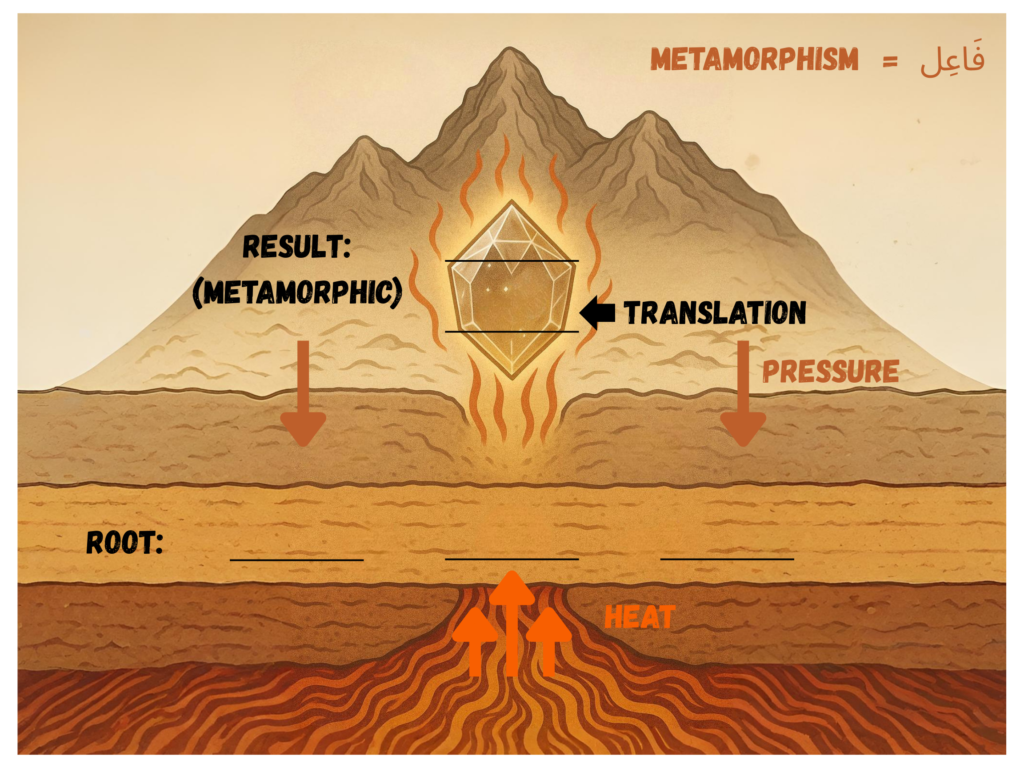
My final takeaway is inspired by a project I developed last fall, where I tailored my elementary Arabic classes to a specific demographic: STEM students. To engage these logical thinkers, I moved away from traditional storytelling and instead highlighted the structural links between the Arabic language and quantitative reasoning. Arabic is uniquely suited for STEM students because of its mathematical architecture. I explained that the Arabic root system and its verb forms function exactly like a mathematical formula or a chemical equation. Where a mathematician sees variables and a chemist sees reactants, a linguist sees the root as the core element that determines meaning and structure. When you apply a specific “pattern” or “formula” to that root, you get a predictable result. By framing the language as a logical algorithm, students aren’t just memorizing vocabulary; they are learning to decode a system. This shift in perspective lowers the barrier for students who might feel intimidated by “humanities” but thrive in “logic-based” environments.
We used Canva to create some of the handouts needed for this new approach, and below are two examples:
![Picture 1 - This handout is designed for students studying biology, and it relates specifically to the gender lesson in Arabic - Use the morphology flowchart to determine gender based on visual "traits", word endings, or exceptions. has one column that says biological trait/exception, and "explain your reasoning", then other columns: gender, ends in, and Arabic word. on the bottom are 3 steps: 1. use the classification flowchart to identify gender based on: morphological cues, known exceptions, then explain your reasoning. 2. mark each word as [Arabic word] or [Arabic word]. 3. Then explain your reasoning using the "trait tag" analogy.](https://fltmag.com/wp-content/uploads/2026/01/Picture-1-724x1024.png)
![Picture 3 - These flashcards are part of a deck designed to explain the different root patterns to students studying geology. Analogy: Metamorphism happens when rock is buried deep within the earth and subjected to intense heat and pressure. though the materials stay the same, their structure transforms - becoming harder, more crystalline, and changed in form. In Arabic, the [Arabic word] pattern does the same: it applies energy to the root and transforms it into the active doer of the action. When [Arabic word] undergoes this metamorphic transformation, it becomes: [Arabic word] - "the writer." same letters. restructured.](https://fltmag.com/wp-content/uploads/2026/01/Picture-3-1024x768.png)
Conclusion
As I reflect on these two weeks of intensive learning, one truth stands out: The “Humanities” are more important in the age of AI than ever before. While these tools can generate text, images, and videos in seconds, they lack the “soul” that a language educator brings to the classroom. I encourage my fellow educators to embrace the “uncomfortable” learning curve. The goal isn’t to become a computer scientist; it’s to become a more empowered, efficient, and creative advocate for the languages and cultures we love.
References
Dhar, V. (2025). Ethics in the age of generative AI [Online course]. LinkedIn Learning.
https://www.linkedin.com/learning/ethics-in-the-age-of-generative-ai
Demirdag, P. S. (2024). What is generative AI? [Online course]. LinkedIn Learning.
https://www.linkedin.com/learning/what-is-generative-ai
Sheer, R. (2023). Introduction to prompt engineering for generative AI [Online course]. LinkedIn Learning.
https://www.linkedin.com/learning/introduction-to-prompt-engineering-for-generative-ai
Mollick, E. AI in education: Leveraging ChatGPT for teaching [Online course]. University of Pennsylvania. Coursera.
https://www.coursera.org/learn/wharton-ai-in-education-leveraging-chatgpt-for-teaching
Ng, A. (2023). Generative AI for everyone [Online course]. DeepLearning.AI & Coursera https://www.coursera.org/learn/generative-ai-for-everyone
Jamthe, S. (2024). Designing agentic AI products (no code required) [Online course]. LinkedIn Learning.
https://www.linkedin.com/learning/designing-agentic-ai-products-no-code-required
El Khoury, G. (2024). Get to know your professor in 10 questions. St. Lawrence University Language Resource Center. DOI: https://www.doi.org/10.69732/IQEA1122
Adobe. (2024). Adobe Firefly [Generative AI model]. https://www.adobe.com/sensei/generative-ai/firefly.html
Pictory AI. (2024). Pictory (Version 3.0) [Video generation software].
https://pictory.ai/
OpenAI. (2024). ChatGPT (GPT-5.2) [Large language model].
https://chat.openai.com
Acknowledgement: The author sincerely thanks Alisa Krakhofer for her invaluable assistance in designing all the pictures included in this article.
AI Disclosure: This article outline was developed with the assistance of Gemini to help structure the author’s reflections on recent professional development courses. All pedagogical applications and personal anecdotes are the original work of the author.